

If your mother has pointed at a TV ad and asked what you think, her first question probably sounds like price: how much a month? Behind it sits a quieter one, which is whether the company would be able to pay when the time comes.
Those two questions need different evidence. The premium shows what the coverage costs. A company's license, its complaint record and any financial rating you can find say something about the company behind the promise.
Start with comparable policy terms, then put the premium beside the company's licensing, rating and complaint information. Texas insurance regulators advise checking those company records rather than choosing by price alone. Affordability belongs in the comparison too.
This guide is part of our larger one on balancing costs and family coverage.
Make the offers comparable before judging the price
The Texas Department of Insurance cautions that a cheaper policy may provide less coverage. It advises comparing similar benefits and considering how much death benefit the premium buys, rather than deciding on price alone.
Texas identifies age, health, risk factors, coverage amount and policy features as pricing factors. It calls the insurer's application assessment underwriting; that assessment often involves an exam and questions about the applicant's health, work and habits.
Keep the benefit, waiting period and premium promises aligned
A few contract details can quietly change what a price means. Put them side by side for every offer:
- The benefit. How much would be paid, to whom, and in what form?
- Payment conditions. Texas says many prepaid funeral policies won't pay the full cost of a funeral if the person dies before a required amount has been paid in. Ask whether anything like that applies.
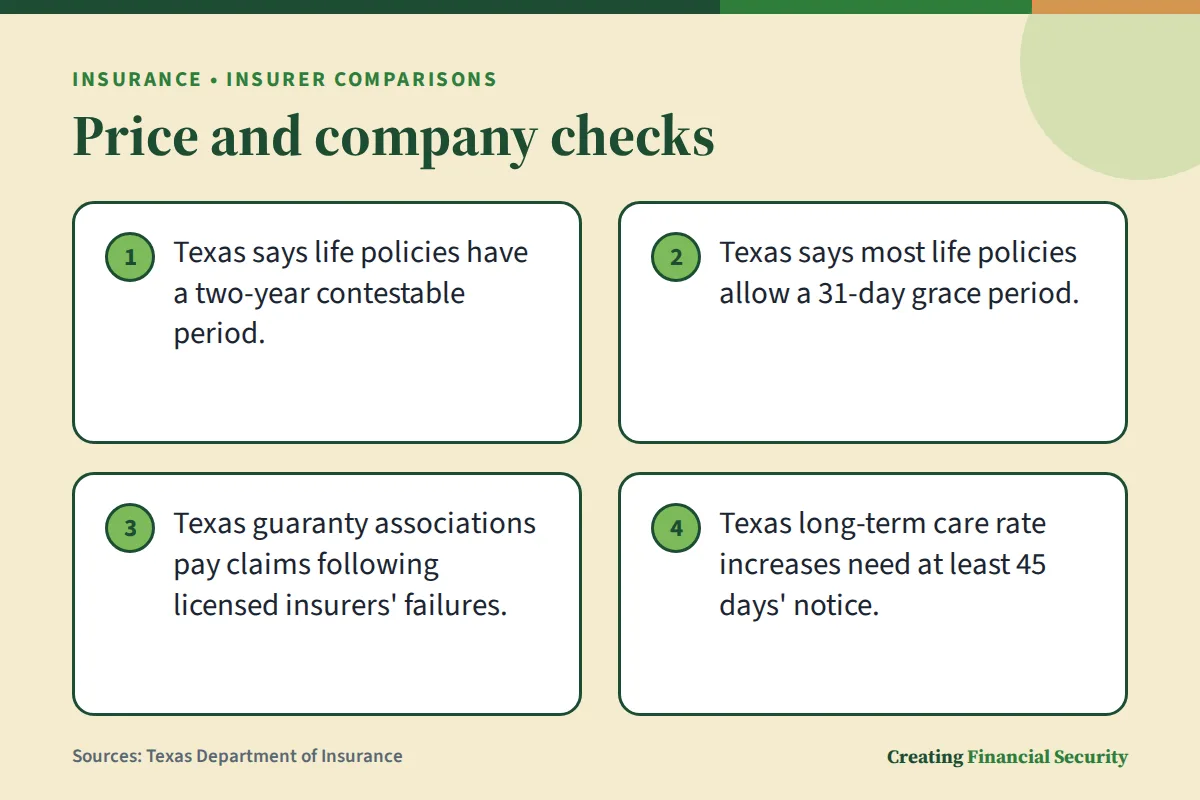
- The contestable period. Texas says life policies have a two-year contestable period. A death inside that window lets the company review the application, and it can deny payment over wrong or missing information, even when the mistake was honest.
- The grace period. Texas says most life policies allow 31 days after the due date. Ask how each offer treats a late payment.
- Whether the premium can change. For term life, Texas says the premium stays the same for the whole term and rises on renewal, because the new price is based on your age at that point. Ask what each contract promises for the coverage you're comparing.
- Health questions. Does the offer ask them, or require an exam? Get the answer in writing.
Keep burial coverage and care coverage in separate comparisons
Your mother may hear about burial insurance and long-term care coverage in the same week. They do different jobs, so one premium can't be ranked against the other.
Texas describes prepaid funeral insurance as a policy that pays funeral expenses, and says its upside is that it fixes funeral costs at today's prices. Texas also cautions that funeral insurance can cost more than other kinds of life insurance, that the premiums paid might end up exceeding what the policy pays, and that regular life insurance or savings might be a better way to cover a funeral. Which route fits depends on the family, and a licensed professional can help with that.
Long-term care insurance helps pay for assistance with daily activities, including bathing and eating. Texas identifies the benefit amount, benefit duration and elimination period—the wait before payments begin—as pricing factors. For a preexisting condition, coverage may not begin immediately: Texas describes a possible delay lasting up to six months from the coverage start date.
Some life policies offer an accelerated death benefit for a qualifying illness. Texas explains that amounts used for long-term care reduce the beneficiaries' later death benefit. Ask how that feature affects the amount left for the family.
How it works, step by step
- Ask the seller to name in writing the company that would issue the policy, since sellers and insurers can differ.
- Check with the state insurance department that both the company and the seller are licensed in your mother's state.
- Use Texas's company lookup or Consumer Help Line to obtain rating and complaint information.
- Get quotes from several companies and record each offer's terms side by side on one page.
Find the company that would actually owe the claim
An advertisement may show a brand name, a phone number and a friendly spokesperson. The company that signs the contract and owes the benefit is a separate question. Texas points out that life insurance can be bought from a company, an agent or a broker, and that a broker sells for multiple companies. The person on the phone and the insurer behind the policy aren't necessarily the same.
Here is a short path to the one that matters:
- Ask the seller to name, in writing, the insurance company that would issue the policy and owe the benefit.
- Find the insurance department of the state where your mother lives.
- Ask about its lookup tools. Texas provides company and agent searches. California offers an agent-and-broker license search using a name or license number, plus separate company information and complaint studies.
- Check licensing for the company and seller. If the available tools don't answer the question, contact the department.
- Write down the name exactly as the state record shows it, and use that name for every step that follows.
Match the legal name across the quote, policy and state record
Compare the insurer name on the quote and policy form with the state record. Ask the seller to explain any mismatch in writing, and ask the department to clarify licensing.
Any rating or complaint record only helps if it belongs to the company that would owe the claim. If the lookup tools feel confusing, the state department's consumer line can help you read them. Texas, for one, runs a Consumer Help Line for these questions.
Read a financial-strength rating without treating it as a promise
Texas tells shoppers to check a company's financial rating together with its complaint history, and says its Consumer Help Line can share both. For long-term care coverage, Texas adds that the companies you're considering should be financially stable. A rating is one piece of evidence in that picture.

Keep the rating information alongside the contract, not in place of it. Texas separately advises checking company records and comparing policy coverage. Ask the state department what rating information it provides and what additional explanation is available.
Check the rating type, agency, date and outlook
For the worksheet, record the rating exactly as provided, who supplied it and the date you checked it. Questions to take back to the department include:
- What does this rating assess?
- Where can I find the publisher's explanation?
- Does the information concern the insurer named on this offer?
- Is there accompanying commentary or an outlook to review?
Investigate disagreements and missing ratings
If information is missing or seems inconsistent, leave the comparison unresolved and ask the state department for help. Texas directs consumers to its Consumer Help Line or company lookup for rating and complaint information. Ask what is available for the insurer on the offer; don't fill a blank with an assumed grade.
Look beyond the rating for claim-handling concerns
Texas advises checking complaints as well as financial ratings. Its help line and company lookup provide complaint counts. California also lists complaint studies and enforcement actions among its company research resources.
Here's a way to use whatever your mother's state provides:
- Find the state insurance department's company or complaint lookup.
- Search for the legal insurer name you confirmed earlier.
- Note which product line the information covers, such as life insurance, and which period.
- Copy down anything the department says about how to read the figures.
- If nothing is available, leave that space blank and ask the department why.
Read complaint measures in their proper context
Ask the department what its figures count, which products and years they cover, and whether it provides guidance for comparing companies. If company size or product categories make the figures confusing, ask for an explanation rather than creating your own ranking.
Use customer stories as questions, not proof
If a customer story raises concerns, ask about the specific claim requirements rather than assuming the explanation. Texas says the death benefit is due within two months once the insurer has proof of death and has verified the beneficiary. It also says payment can take longer during the contestable period. Ask how those requirements apply to the policy being discussed.
Ask what the higher premium actually buys
For families considering how to weigh financial strength against price when choosing an insurer, Texas's guidance supplies a starting point: examine licensing, financial information and complaints as well as cost.
A price gap isn't a sign of strength by itself. Because premiums reflect age, health, coverage amount and policy features, two offers can differ in price for reasons that have little to do with the company's finances.
Here are questions that help sort out what a price gap is made of:
- Is the benefit the same as in the lower-priced offer?
- Do the waiting periods and payment conditions match?
- Does the contract promise the premium will stay the same, and for how long?
- Does the higher price include a feature your mother wouldn't use?
- How much of the price goes to commissions and fees? Texas says a policy with low commissions and fees, known as a low-load policy, might save money.
Separate stronger evidence from a different contract
Texas recommends collecting several long-term care quotes because similar benefits can carry different prices across insurers. Ask sellers to explain the differences in writing.
Separate the answers into contract differences—benefits, conditions and premium promises—and company information, such as licensing, ratings and complaints. Keep unexplained differences on the worksheet as questions. That makes it easier to ask what the extra premium buys without treating price itself as a company rating.
Consider affordability for the full commitment
Keeping coverage in force is an important affordability consideration. Texas says a life policy lapses when the premium stays unpaid through the grace period, which means the coverage ends and the beneficiaries wouldn't receive the death benefit.
For long-term care coverage, Texas asks consumers to consider reduced income and higher premiums. A rate increase must apply to all holders of that policy, with notice at least 45 days beforehand. The agent will explain the insurer's long-term care increases during the past 10 years. Texas says that record describes earlier increases, not what future increases will be.
Texas also describes a trade-off in the elimination period: a longer wait can reduce premiums, but extends the time the policyholder must fund care before insurance payments start.
For your mother, the plain question is whether she can keep making the payment from her own income, and what the contract says about the payment changing.
Understand the state safety net before relying on it
Texas says licensed insurers belong to a guaranty association that pays claims following insurer failure. It warns that an unlicensed company's failure could leave a beneficiary without payment. This is Texas guidance; ask the department in your mother's state how its protections work rather than assuming the same answer applies everywhere.

Things to ask your mother's state insurance department:
- Is this insurer licensed here, and under what exact name?
- Which guaranty association applies to licensed insurers in this state?
- Does that association's protection reach my mother's kind of policy?
- What limits apply, and where can I read them?
Verify eligibility and limits for the relevant state
Keep the state's answers with the policy documents, noting who provided them and when.
Bring a one-page comparison to the next conversation
Label three columns Offer A, Offer B and Offer C, and use the prompts below as rows. Keep each kind of coverage on a separate worksheet. Enter only information you've obtained; leave unknowns blank.
- Insurer named on the offer and on the policy form: / / ____
- Name in the state record, and which state you checked: / / ____
- Company and seller licensing status: / / ____
- Benefit amount and who receives it: / / ____
- Payment conditions before the full benefit applies: / / ____
- Contestable period and what happens during it: / / ____
- Grace period and what happens after a late payment: / / ____
- Premium amount and how often it's due: / / ____
- Premium promise (stays the same? for how long? can change?): / / ____
- Free-look period: / / ____
- Rating details (publisher, type, date, commentary): / / ____
- Complaint information (product line, period, what the figure counts): / / ____
- Affordability note (can she keep paying from her own income if the amount changes?): / / ____
- How the seller is paid: / / ____
- State protection information and where it was verified: / / ____
- Unresolved questions: / / ____
Record the evidence and leave unknowns visible
Date entries and keep the supporting documents together. Use the blanks to organize the next conversation.
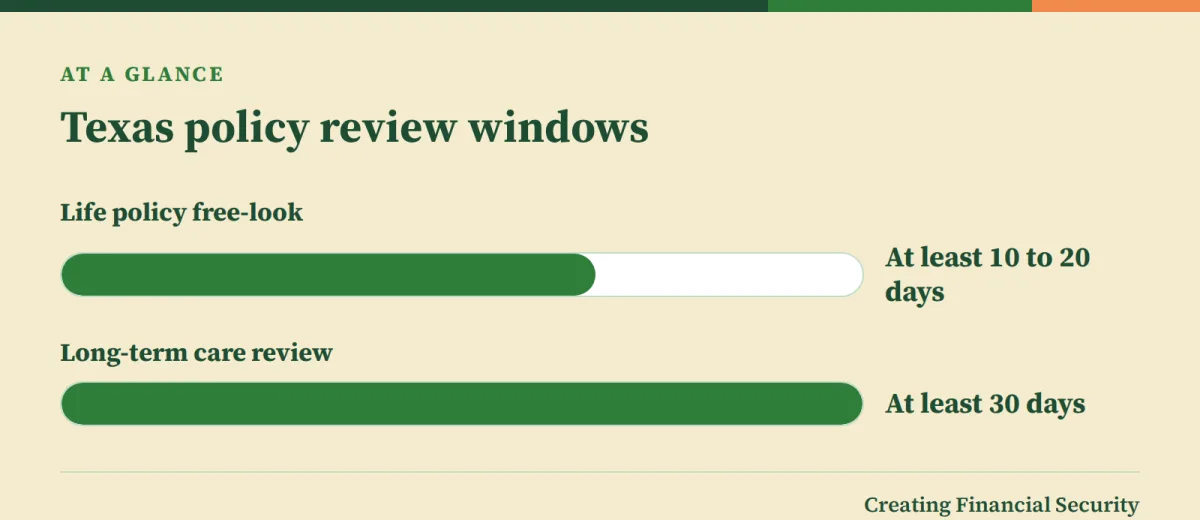
For Texas life policies, the free-look window is at least 10 to 20 days, with cancellation for any reason and a full refund during that time. Texas requires a review window of at least 30 days for long-term care policies. Ask the relevant state department what applies to the offer being considered.
Ask for the reason behind a recommendation
Bring the worksheet to a licensed insurance professional and ask for a written explanation of the trade-offs, including commissions and fees.
Questions worth bringing:
- Why is this offer being suggested over the others on my sheet?
- Which differences in terms are still unresolved?
- How is the seller paid on this policy?
- Can you put the trade-offs in writing?
- What happens if my mother misses a payment?
The bottom line
Compare the company information and the policy price separately before bringing them together. Texas advises checking ratings, complaints and licensing, comparing similar coverage, and not deciding by price alone. Keeping those checks separate makes unresolved differences easier to discuss.
Start by making the offers comparable: same benefit, same conditions, same kind of coverage. Then confirm the legal insurer and its license in her state, note any rating with its publisher, type and date, and add what the state shows about complaints. Ask what a higher premium buys, and whether she can keep paying it from her own income.
Ask her state insurance department about licensing and any applicable protections, including eligibility and limits. A licensed insurance professional can explain the policy trade-offs for her situation. Bring the worksheet and supporting documents, with unknowns marked clearly as questions for the next conversation.
Questions readers ask
Does a higher premium mean an insurer is financially stronger?
Where can I ask about an insurer's financial rating?
Can similar long-term care benefits have different prices?
What is one cost to check before replacing permanent life insurance?
What does Texas say about protection when a licensed insurer fails?
Sources
- Texas Department of Insurance: Life insurance types, household coverage needs, underwriting, accidental-death coverage, b
- Texas Department of Insurance: Long-term-care insurance settings, assisted living, benefit eligibility, elimination perio
- California Department of Insurance: Company research resources for checking authorization, identifying the legal insurer, revi