

Imagine a family reviewing a burial-insurance offer after their mother sees a TV ad. Nobody recognizes the company name. Before judging the offer, they need to establish which insurer is behind it.
A newer life insurer is not automatically unreliable, but its age alone can't show whether it will pay claims. A better first move is to look at the records that do exist: the legal insurer's state authorization, any financial evidence it offers, its complaint record and whatever claims history is available. Then write down where the record is too short to judge.
Two questions run side by side through all of this. One is whether the company is reliable. The other is whether this particular policy fits what your family needs. A good answer to the first doesn't settle the second, and the reverse is true as well.
This guide is part of our larger one on reviewing family coverage options.
Find out what is actually new
An unfamiliar offer can raise several different research questions. The ad may be selling a fresh brand name, a new kind of policy, an older company under new ownership, or an insurer formed recently. A new brand, policy or owner does not by itself establish how long the legal insurer has operated.
What counts is the legal insurer, the company the policy names as the one promising to pay. The Texas Department of Insurance describes several sales channels: buying directly from an insurer or through an agent or broker. A broker may sell policies from several insurers. The voice on the phone and the company on the contract can carry different names.
Each possibility points to a different question:
- A new brand name: has the insurer operated under another name?
- A new kind of policy: how long has the insurer offered this coverage?
- A new owner: what changed, on what date, and which insurer's records does it belong to?
- A newly formed insurer: the record is short, which is better said plainly than filled in with guesses.
Trace the name on the policy documents
The aim is to pin every record to the right company:
- Find the full legal name of the issuing insurer on the application or a sample policy, not just the marketing name.
- Write down the address and any identifying number the documents list.
- Ask the seller, in writing, whether that insurer has used other names.
- Search the state insurance department's records under each name that turns up, and mark which name each record belongs to.
Keep ownership history separate from financial backing
A change of ownership is a record about who controls a company. One entry in the Texas order list, dated 8/28/2001, approves a filing for acquisition of control of several life insurers that were subsidiaries of one corporation, and it names each insurer on its own.
That entry is about control. Whether a parent's history says anything about this insurer's promises is a question for the insurer, in writing: what documented arrangement, if any, connects the two?
How it works, step by step
- Find the full legal name of the issuing insurer on the application or a sample policy, since the seller's name may differ.
- Look up the insurer and the seller separately in the state department's license search, or call its help line.
- Ask the department for the insurer's financial rating and complaint count, and note the date you asked.
- Search regulatory orders by company name, then check whether a later order replaces the entry found.
- Use the free-look period to review the policy; ask your own state's department what applies.
Confirm permission to sell in your mother’s state
The Texas guidance below applies to Texas. For an offer elsewhere, ask the insurance department in the mother's state which rules and records apply.
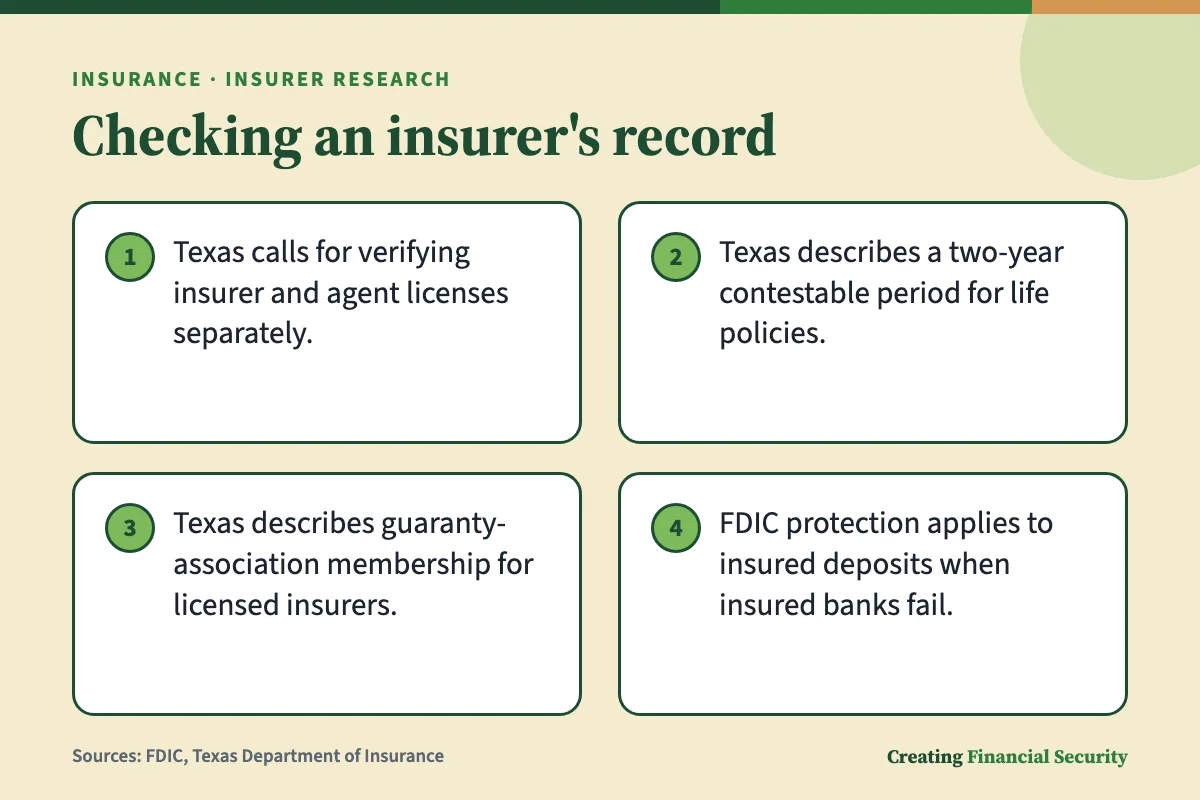
Texas tells buyers to verify two licenses: the insurer's and the agent's. It warns that an insurer operating without a license could fail without the beneficiary receiving payment.
- Find the insurance department for the state where your mother lives.
- Use its company lookup with the insurer's exact legal name. Texas provides an online company-and-agent search and a Consumer Help Line at 800-252-3439.
- Look up the person selling the policy separately.
- Write down what you found and the date you checked.
- If the lookup comes back empty or shows a similar name, call the department before drawing a conclusion.
Check the insurer and the person selling the policy
Texas treats these as two checks. A listed company answers one permission question, and a listed seller answers another. Neither is an endorsement of the policy, and neither says how the company handles claims.
Texas also prohibits sales inducements involving gifts or discounted investments or loans. Its help line accepts reports of improper offers. Those concerns involve the seller's conduct, not evidence of the insurer's finances.
Read regulatory findings with their dates and outcomes
The Texas order list shows an order number, a version, the date issued and a short reference line. Many entries concern rate filings, plan amendments and fee assessments for plan associations. Others name a business: some are emergency cease and desist orders, one is a 2009 supervision order for an agency, and a few are consent orders.
When an order names the company you're researching, a few questions give it context:
- What date was it issued, and does a later order cover the same matter? An entry dated 04/09/2020 supersedes an earlier order, so a title can be replaced by something newer.
- Does it name the legal insurer, an affiliate, an agency or an individual?
- What happened, and what was the outcome?
Read the order itself before drawing conclusions from its title, and keep unresolved allegations separate from findings. Texas accepts open records requests for additional orders. An unsuccessful name search does not establish a clean history.
| What to record | Where to look | What to ask next |
|---|---|---|
| Licensing | State insurance department lookup or help line | Is the issuing insurer listed, and is the seller listed separately? |
| Regulatory orders | Department order list | Record the named entity and date; check for a superseding order. |
| Rating and complaints | Department lookup or help line | Which company, period and category, and what does a zero or blank mean? |
| Contestability | Policy and state guidance | What application review can follow a death during the contestable period? |
| Dividends | Insurer records | How did earlier dividend forecasts compare with actual payments? |
Look for financial evidence beyond a reassuring rating
The Texas department suggests checking a company's financial rating and complaint history, and says its lookup tool or help line can supply both. A rating is a useful lead. It's one piece of evidence, not a promise about claims years from now.
Financial evidence worth asking about includes:
- A rating, if the offer mentions one, and the legal insurer it applies to.
- Dividend history, if applicable. Texas says an insurer need not pay dividends and actual payments may fall below estimates. It suggests comparing earlier forecasts with payments made.
- Cash-value growth. Texas cautions that sales charts generally illustrate possible results. It suggests requesting past results rather than relying on a forecast.
- Annual universal-life reports. Texas says these report the policy's cash value and estimated remaining duration.
Record unavailable history as a limitation, not a favorable or unfavorable result.
Verify whose rating it is and when it was issued
Before leaning on a rating in an offer, ask:
- Which legal insurer was rated: the one on the policy, or a related company?
- Who issued it, what type of rating is it, and on what date?
- If another insurer shows a rating from a different issuer, what does each scale measure?
An offer that doesn't mention a rating isn't the same as an insurer that has none. The first is answered by asking the seller or the department. If none exists, the follow-up is why, and the other records matter more.
Know what public financial records can tell you
If a document mentions capital, reserves or reinsurance, ask what each term means, which insurer the information concerns and its date. Ask the department what those records can establish; a figure without an explanation need not become a conclusion.
The licensing department is the place to ask what financial records it can point to, and whether they cover earlier years or only recent ones. If what comes back is dense, a licensed insurance professional can help read it for your mother's case.
Read complaint data without overreading small samples
The Texas department can tell callers how many complaints are on file against a company. That count is a starting point, and a few details decide what it means:
- The company: the exact legal insurer the count belongs to.
- The coverage category: life insurance, or other lines.
- The period: the dates the count covers.
- The details: whatever else the department can share.
A positive count, a reported zero and unavailable data are different results. Ask which result the lookup shows and what period it covers. Do not record missing data as zero complaints. Neither a zero nor a short reporting history establishes future service or claim payment. A short history may leave less evidence to review.
Match the company, coverage category and reporting period
- Confirm the record belongs to the issuing legal insurer, not an affiliate or a similar name.
- Ask which kind of insurance the complaints concern, since a lookup may include other lines.
- Note the reporting period, and ask for the same period when comparing two companies.
- Write down anything you couldn't match, so it stays a question and not a conclusion.
Use reviews as leads, not a reliability score
Reviews and testimonials can raise useful questions: how long did a claim take, how clear was the paperwork, did the seller push? Each is one person's account. A specific concern can go to the insurer as a question, and the department's records show what else is on file.
Texas accepts reports of improper sales offers and complaints about improper policy replacement. Concerns about that conduct can be raised with the department rather than judged solely through online reviews.
Ask what the claims record actually proves
Claims research has a practical purpose: understanding what evidence exists about payment and what conditions a future claim would have to meet. A company can have a decent record and still sell a policy whose terms don't suit your family, so company evidence and contract rules are worth keeping apart.
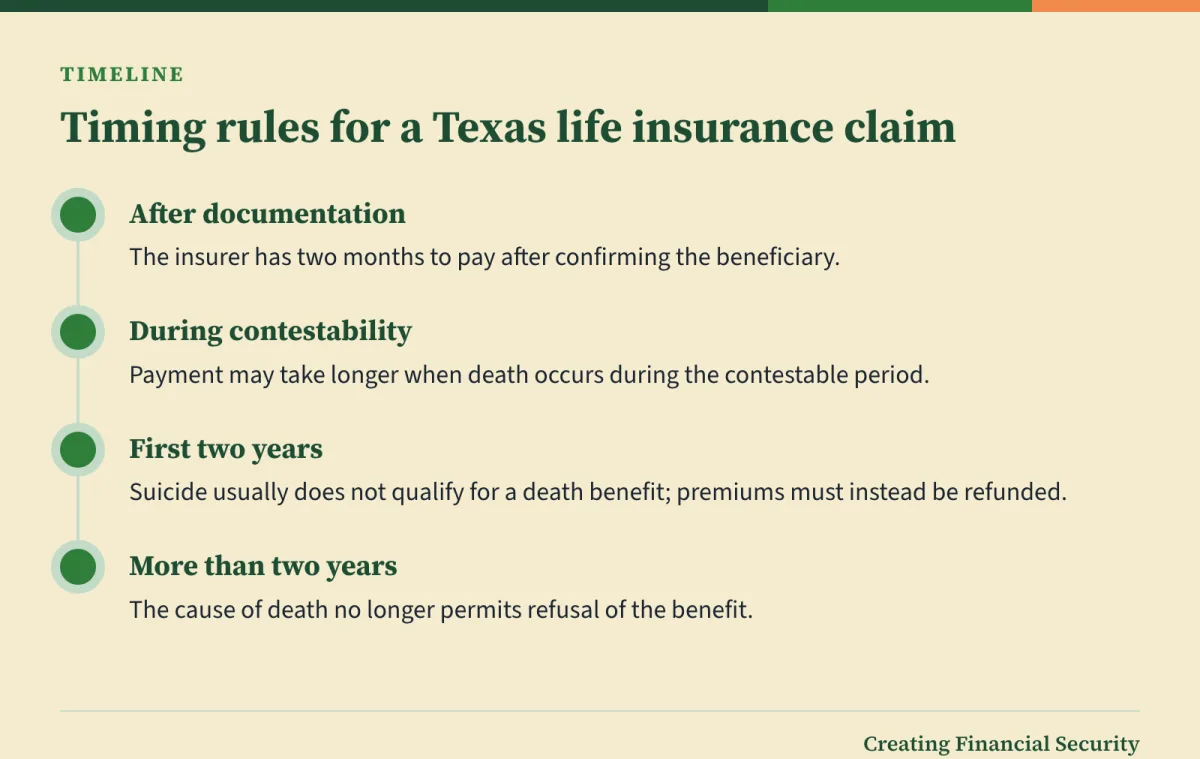
The Texas department describes these timing rules for Texas life policies:
- After receiving death documentation and confirming the beneficiary, the insurer has two months to pay.
- Individual-policy benefits also accrue interest between receipt of that documentation and the agreement to pay.
- Payment may take longer when death occurs during the contestable period.
Separate payout advertising from comparable claims evidence
If an ad cites how often or how fast claims are paid, a few questions make it checkable:
- What period does the figure cover?
- Which legal insurer does it describe?
- Which policy category, such as individual or group?
- How does the insurer define a claim for this figure?
For a newer insurer, it's fair to ask whether the period is short or the group of policies small, and how much weight the insurer itself thinks the figure can carry.
Check how a parent’s policy handles an early claim
Texas describes a two-year contestable period for life policies. A death within that period permits the insurer to recheck the application. Incorrect or omitted information may justify refusing payment, including an honest mistake or information unrelated to the death. Texas says a denial on those grounds requires the insurer to refund premiums to the beneficiary.
Texas says suicide usually does not qualify for a death benefit during the first two years; premiums must instead be refunded. After more than two years of coverage, the cause of death no longer permits refusal of the benefit. Reinstatement after a lapse restarts contestability. Most policies provide 31 days after the premium deadline to pay while maintaining coverage.
Questions for the seller: is there a waiting period or reduced early benefit, and where does the policy say so? What happens if an application answer turns out to be wrong? These are contract questions, and by themselves they say nothing about whether the company is strong or weak.
Check whether the offer is prepaid funeral insurance rather than assuming all burial-related coverage works alike. Texas describes a trade-off: prepaid coverage fixes funeral prices, but may cost more than other life coverage. Total premiums could exceed the eventual benefit, and full funeral payment may depend on first paying a specified amount. Texas identifies ordinary life coverage or savings as possible alternatives. The offer's wording determines which questions apply.
Understand the protections behind the contract
Several kinds of protection surround insurance, and which apply depends on the state and the policy. The Texas department's guidance describes these:

- Licensing: Texas calls for checking the insurer and agent separately.
- Complaint assistance: the department accepts complaints and provides telephone help.
- Guaranty association: Texas describes membership for licensed insurers and claim payments when an insurer fails.
- Free look: Texas describes a review window of at least 10 to 20 days. Cancellation within that window requires no particular reason and returns the full payment.
Separate insurance protection from bank deposit insurance
FDIC protection concerns deposits, not insurance contracts. If an FDIC-insured bank fails, its insured deposits are protected. Selling a non-deposit investment through an insured bank does not bring that investment within deposit coverage.
A life insurance policy isn't a deposit account, so FDIC insurance isn't what stands behind a life insurance claim. Texas points instead to licensing and the guaranty association.
Check state-specific eligibility and exclusions
Ask the state insurance department or guaranty association whether a particular policy qualifies, what exclusions apply and whether payment is capped. Identify the insurer and policy, and keep the dated answer.
Put the evidence and unanswered questions on one page
Keep findings and limitations together for discussion with the seller, regulator or licensed professional. The worksheet records evidence; it does not rank the insurer.

Build an evidence worksheet, not a company score
Use four labels: the finding, the source and date, the limitation, and the follow-up question. A made-up row might read: finding, the state lookup lists the insurer as licensed; source and date, the department lookup on the day you checked; limitation, a license answers a permission question and says nothing about claims handling; follow-up, does the rating in the offer apply to this same insurer?
Other rows might cover a rating and the insurer it applies to, orders found or not found under each name with their dates, a complaint count with its period and category, and the policy's early-claim terms. For an unsuccessful search, record the date and what was searched rather than marking the insurer clear.
Take unresolved points to the right person
- The insurer: what a rating covers, what ties a parent to the policy's obligations, and which waiting periods or reduced early benefits the policy contains. Asking for answers in writing keeps them on record.
- The state insurance department: are the company and seller licensed? What orders and complaint counts exist, and for what period? What financial records and guaranty protection apply to this policy?
- A licensed insurance professional or attorney: does this policy fit your mother's circumstances? Texas says Medicaid eligibility takes policy cash value into account as an asset. It points readers to an attorney or financial adviser for the policy's tax and financial effects.
The bottom line
A newer life insurer's age can't show whether it will pay claims, and neither can a TV ad. What can be checked is more concrete: which legal company is named in the policy, whether your mother's state lets it sell, what orders and complaint counts are on record, and what rating is offered and for whom.
What can't be checked is worth writing down just as plainly. Distinguish an undisclosed rating from an absent one, and a reported zero complaints from unavailable data. Separately, whether the policy suits your mother depends on its contract terms, including the contestable period, any waiting period and what a prepaid funeral policy actually pays.
To test your notes against someone's judgment, the state insurance department can confirm licensing and explain protection where your mother lives, and a licensed insurance professional can read the policy itself with her.
Questions readers ask
Does having no financial-strength rating mean an insurer is unsafe?
What should I ask about a parent company’s rating?
Does a new name erase an insurer’s earlier history?
What if there are no complaints listed?
What happens to a policy if the insurer fails?
Sources