



Imagine a mother asking about burial insurance after seeing an ad. It's a fair question, but it may be different from the coverage question her adult child's household faces.
Life insurance pays a death benefit to a named beneficiary. Long-term-care insurance helps with qualifying care expenses during life. A useful comparison starts with the expense being covered, not the label in an ad.
Insurance requirements differ by state. Texas-specific protections are not nationwide guarantees.
Start with what the money needs to cover
Three separate jobs hide inside the word insurance, and each points toward different coverage:
- Household support: the income and bills your family would still face if someone who contributes to the household died.
- Final expenses: funeral and related costs, including for an older parent.
- Care costs: help with daily life during illness, disability or memory loss.
Keep household needs separate from a parent's final expenses
The Texas Department of Insurance says life insurance makes sense when family or others rely on you financially. It points to your debts, the income your family would need replaced and the bills they would face as the things that set an amount.
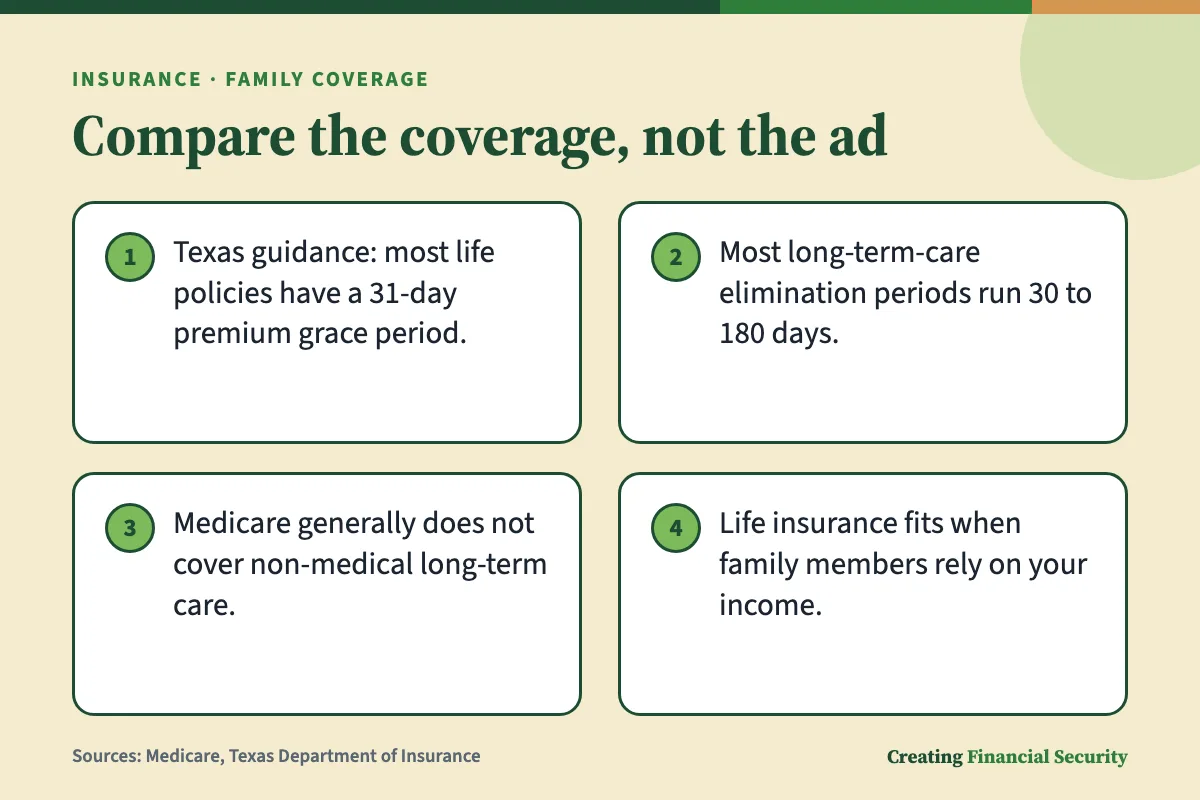
Care costs raise a separate question. Medicare generally excludes the non-medical assistance that makes up most long-term care; most health insurance also excludes it. Skilled nursing facility care is a different category. Medicaid eligibility depends on state requirements.
Gather the records before choosing a benefit amount
Records that can help frame the comparison include:
- Life insurance you or your mother already have, including coverage through work or a group, and who is named to receive it.
- Debts that would remain after a death.
- A written funeral estimate, if your mother has thought about arrangements.
- Savings set aside for final costs, and any prepaid funeral contract.
- A list of care options and local resources where she might someday need them.
Texas guidance says life insurance through an employer typically ends when you leave the job. A basic group policy often pays one or two times annual salary, so it helps to know what would still be in place.
How it works, step by step
- Verify licensing for both the insurer and the selling agent.
- Check financial ratings separately from the number of complaints.
- Compare offers with similar coverage rather than on price alone.
- Use the review window after delivery to read the policy and confirm its benefits.
Match the policy to the job, not the ad
The Texas Department of Insurance separates life insurance into term and permanent coverage. These policy types and features serve different purposes:
| Coverage or feature | Main purpose | Main limit to examine |
|---|---|---|
| Term life | A death benefit during a selected period | Extension beyond that period requires payment; renewal costs rise. |
| Whole life | Permanent death-benefit protection with cash value | Cashing it in or stopping premiums ends coverage; premiums exceed term premiums. |
| Universal life | Permanent coverage with adjustable premiums and death benefit | Coverage has a maturity date and can lapse when cash value runs out. |
| Prepaid funeral insurance | Payment of funeral expenses, with current costs locked in | Premiums may exceed the payout, and early payments may not cover the entire funeral. |
| Accidental-death rider | An extra payment for an accidental death | Restrictions apply; this is an addition to a life policy. |
| Long-term-care insurance | Payment toward covered care services | A claim must meet the contract's benefit triggers and waiting-period rules. |
Which promises last, and which can change?
Term premiums stay level through the term and rise at renewal, since the new price reflects your age at that point. Most companies sell term life only up to an age that is usually 70 or 80.
Cash value is where things can shift. Part of each permanent-policy premium goes into an account that grows at a fixed or variable rate. It takes years to build, and surrender fees may apply if you take money out early.
In universal life, if premiums fall short of the cost of insurance, the gap is taken from cash value, and a policy whose cash value reaches zero could lapse. Some universal policies add a no-lapse feature, but premiums must be paid on time for it to apply.
Some whole-life policies pay dividends, but the Texas agency says they are not promised and may come in below the company's projection. It suggests asking for a history of projected versus paid dividends. Agents' cash-value charts are usually projections, not a promise of performance.
Accident benefits and annuities answer different questions
An accidental-death rider responds to one kind of death. It adds a payment if the insured dies in an accident, so it is narrower than broad life coverage.
Investor.gov describes an annuity as a contract with an insurance company, designed for retirement and other long-term goals. Depending on the contract, it can offer tax-deferred growth, periodic income or a death benefit.
An insurer's obligations under an annuity depend on its financial strength and claims-paying ability. Terms, costs and risks vary, so a licensed financial professional can explain a particular contract.
Burial coverage for an older parent: promises and limits
An ad's use of “burial insurance” does not settle what the contract provides. Ask whether it pays a cash death benefit or covers specified funeral expenses. The Texas Department of Insurance describes prepaid funeral insurance specifically: it covers funeral expenses and locks in current costs. It adds that this coverage can be expensive compared with other life insurance, and that total premiums can end up above what the policy pays out. Many such policies also pay less than the full funeral cost if death comes before a required amount has been paid.
Questions to settle about the ad your mother saw:
- Does the policy pay cash, or arrange particular services?
- Do premiums continue for life, or stop after a set number of years?
- Does the full benefit start right away, or is it limited at first?
- Who receives the benefit?
- What happens if a payment is missed?
Read the early-death benefit before the sales message
Ask whether the contract restricts early payments, which deaths it excludes and when each restriction ends.
Texas guidance also describes a two-year contestable period for life policies. A death during that period can prompt an application review. An omission or incorrect answer can result in denial even when accidental or unrelated to the death; the insurer must refund premiums to the beneficiary. Suicide usually is not covered during the first two years.
Missed payments matter too. For most policies there is a 31-day grace period after a due date. After that, coverage lapses and the beneficiary won't receive the death benefit, though a lapsed policy can usually be reinstated for a time, sometimes with health questions.
Compare insurance with resources already available
Insurance is one way to pay for a funeral, not the only one. The Texas agency says a regular life policy or savings might be a better route than funeral insurance. Ask how any existing policy or prepaid arrangement works before weighing it against a new offer.
Three things are worth asking about each option:
- Access: can the money be reached quickly, and by whom?
- Contract terms: what limits apply, and what happens if plans change?
- Public benefits: Texas guidance says cash value is considered in Medicaid eligibility decisions. The state Medicaid agency or a qualified attorney can explain how applicable rules treat a particular policy.
Long-term care: check the care setting and benefit triggers
The Texas Department of Insurance describes long-term care as assistance when illness, disability or Alzheimer's disease interferes with self-care. Non-medical assistance is available in several settings: a person's home, community programs, assisted living and nursing homes.
The Texas agency lists home health care, adult day care, assisted living and nursing home care among the services a policy may pay for. Whether a given policy pays for assisted living depends on its wording. For each setting, it helps to ask:
- Home care: is it covered, and for how many days a week or hours a day?
- Adult day care: is it a listed service?
- Assisted living: is this type of facility covered, and does it have to meet licensing rules?
- Nursing home: which levels of care are covered, from custodial to skilled?
- Family caregivers: most policies won't pay relatives for care, though some pay for caregiver training.
A covered facility does not automatically mean a payable claim
A covered setting alone doesn't mean a claim will be paid. Policies pay only after you meet their benefit triggers.
The Texas agency lists six daily activities used to assess eligibility: bathing, dressing, eating, toileting, continence and moving around. Cognitive impairment can also qualify. For tax-qualified coverage, the requirement is cognitive impairment or inability to perform at least two listed activities for 90 days or longer. A doctor or another licensed health care practitioner must also provide a care plan.
The elimination period is the wait before benefits start—30 to 180 days for most policies. A contract may count days of actual service or count calendar days instead. Extending that wait reduces premiums but leaves more time for out-of-pocket payments.
Ask about limits, premium changes and eligibility at older ages
The Texas agency suggests asking these questions about any policy:
- Which services and settings qualify?
- Which health or functional conditions trigger payment?
- What daily payment ceiling applies to each service?
- When do payments end?
- Are preexisting conditions subject to a separate wait?
- How would inflation protection increase benefits?
- What value remains through a nonforfeiture benefit if coverage ends?
- Does the contract identify itself as tax-qualified?
Policies may cap payments through a daily limit, a benefit period or a maximum benefit amount. Check how the contract calculates its limit. The agency suggests checking local prices for nursing homes, assisted living and home health agencies before choosing amounts.
Premiums can rise. Texas permits increases only across all holders of the same policy, with notice at least 45 days beforehand. Worsening health or filing claims cannot be the reason for an individual's increase.
The agency says younger applicants usually pay lower premiums. Insurers consider health history when deciding whether to offer coverage and how to price it. A licensed insurance professional can explain availability for an individual applicant.
What health screening can change
Underwriting is the process an insurer uses to decide whether to sell a policy. The Texas Department of Insurance says it often includes a medical exam and questions about health, work and habits. A company can decline to sell if it sees the applicant as high risk.

The agency says cost depends on age, health and risk factors, and a company may charge more for health conditions, smoking or risky hobbies. For long-term care, it advises answering every question truthfully, because leaving something out could lead the company to cancel the policy or refuse a claim.
No exam does not mean no health review
Texas guidance describes less restrictive underwriting for group life coverage: members generally need not answer health questions. Group long-term-care coverage seldom requires an exam, but family members applying for that coverage usually need one.
An exam and health questions are separate requirements. Ask the insurer which ones its application requires.
Check who stands behind the policy
The Texas Department of Insurance suggests a short routine:
- Verify licenses for both the insurer and its agent.
- Check financial ratings separately from complaint records.
- Consider service and financial stability alongside cost.
- Examine the delivered contract during its review period.
The agency describes a guaranty association that handles claims for failed licensed insurers. A beneficiary could go unpaid after an unlicensed insurer fails. The state insurance department can explain the applicable protections.
Separate the seller's name from the insurer's legal name
The business selling a policy may not be the company that issues it. You can buy from an insurer, an agent or a broker, and brokers sell for several companies. Employers and groups may also offer coverage under their own names.
Find the issuing insurer's name on the policy documents, then use it for licensing, rating and complaint checks.
Treat ratings and reviews as different kinds of evidence
A financial-strength rating speaks to a company's ability to pay. A complaint record is separate, and the Texas agency says it can show how many complaints have been filed against a company. A sales review or a familiar name is something else again.
Investor.gov cautions that financial trouble can prevent an insurer from meeting its obligations. A rating or complaint count does not establish whether a particular claim meets the contract's terms.
Put comparable offers and claim terms side by side
The Texas Department of Insurance advises comparing like with like. A cheaper policy may have fewer features or a smaller death benefit, and a pricier one may give more benefit per premium dollar. Price alone shouldn't settle it.

Compare the contract, not just the starting premium
A low starting premium doesn't settle the choice. Match these across offers:
- The benefit amount and what it covers.
- Payment duration and renewal terms, since term premiums rise at renewal.
- Whether cash-value figures are projections or written into the contract.
- The cost of replacing a policy. The Texas agency says surrender fees can reduce cash value and that replacement isn't always wise.
Texas also gives buyers a review window after a policy arrives, at least 10 to 20 days for life policies and at least 30 days for long-term-care policies, with a refund if the policy is returned.
Questions to bring to a licensed insurance professional
Additional questions include:
- Does the full benefit start immediately?
- What happens if a premium is missed, and can the policy be reinstated?
- What are the benefit triggers and the elimination period?
- How have this company's long-term-care rates changed? In Texas, agents share the past 10 years of increases.
Questions families ask before buying coverage
Some life policies offer an accelerated death benefit, allowing part or all of the death benefit to be paid during life for a qualifying illness. Texas guidance says amounts used for long-term care are deducted from the benefit beneficiaries later receive. Ask which illnesses qualify, how much can be paid early and what would remain for beneficiaries. The contract's conditions determine access to this money.
The bottom line
Your household, your mother's final expenses and possible care costs are three separate jobs, and each product handles only some of them. Life insurance pays a death benefit, prepaid funeral coverage targets funeral costs, and long-term-care insurance helps with care during life.

Before comparing offers, gather existing policies, debts, a funeral estimate and care resources. Then read each contract for early-death limits, benefit triggers, waiting periods and what is promised versus projected. Confirm that the issuer and agent are licensed, and treat ratings and reviews as clues, not promises.
A licensed insurance professional can talk through your family's circumstances, and your state insurance department can help you check licensing and understand state rules.
Questions readers ask
Do age limits apply to term life insurance?
Does prepaid funeral insurance always cover the full funeral cost after an early death?
Is a medical exam required for life insurance?
Does Medicare cover non-medical long-term care?
Can care payments reduce a life policy's later death benefit?
Can long-term-care premiums rise after a policy is issued?
Sources