

Your mother saw a burial insurance ad on television, and now there's a phone call, a brochure or a form waiting for her. Four things are worth a closer look: pressure to decide quickly, a seller whose identity you can't confirm, benefit limits nobody explains, and any suggestion to leave something off the application.
None of these proves fraud. Each calls for an independent check. Policy restrictions also need a careful reading: a disclosed limit is different from a promise that contradicts the contract.
Texas rules appear below as examples, since the Texas Department of Insurance publishes plain-language consumer guides. Her state may differ, and its insurance department can say how. She stays the decision-maker; you're her second reader.
This guide is part of our larger one on comparing family policies and promises.
When the sales conversation is a reason to pause
Questions can keep the conversation focused on facts rather than suspicion. These prompts aren't legal tests.
- A deadline. Ask what it is, who set it and where it's written down.
- Talk of guilt over a funeral bill. Notice whether the conversation is about the contract's terms or about her feelings, and ask to see the terms.
- A suggestion to keep the offer private. Ask whether she may show the papers to family or a licensed professional first.
- Reluctance to answer in writing. Send one specific question and see what comes back.
Urgency is not an explanation of coverage
Ask for the deadline and eligibility condition in writing. Then ask the insurer, through an independently found contact, whether it can confirm them.
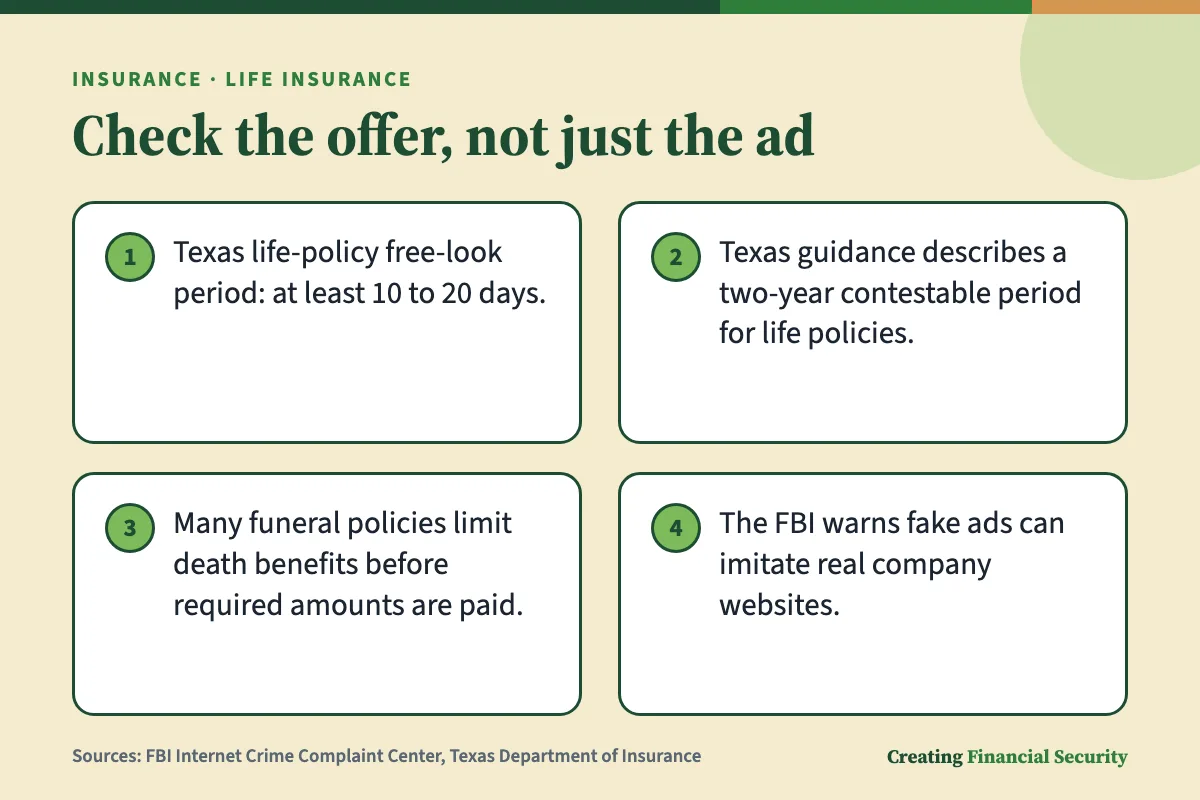
Texas guidance gives life-policy buyers at least 10 to 20 days for review, with a full refund available if they cancel within that window. That's a safety net after a purchase, not a substitute for checking beforehand.
A family member can help without taking over
An offer to look at papers can sound like doubt about her judgment, so it may help to keep the focus on the documents, not on her.
You might ask whether she'd like company while she reads the offer, and what kind of help she wants: a second reader, a note-taker or someone to make a call. Her role depends on the proposed policy, so useful early questions are who would be the owner, who would be the insured person and who would be the beneficiary. A licensed professional can help with her own case.
How it works, step by step
- Write down the seller's name, company and any license number, then check licensing through your state insurance department's own site.
- Type the company's web address into the browser yourself instead of clicking an advertisement.
- Compare an advertised web address closely for typos or a misplaced letter before trusting the page.
- Use the free-look window to read a new policy closely before deciding whether to keep it.
- Report suspected search-ad impersonation to the FBI's Internet Crime Complaint Center.
Verify the contact through a route the seller did not supply
A phone number, web address or license number from the seller is the seller's own material. It may be accurate, but it can't confirm itself. A steadier habit is to find an official route on your own and compare what you learn with what you were told.
- Write down the seller's full name, the company they say they represent and any license number they gave.
- Find your state insurance department's website by typing its address into your browser yourself, and see what lookup tool or consumer line it offers for checking a person and a company.
- Ask the insurer, using a number from a printed policy document or a site you reached yourself, whether it can confirm this person's connection to it.
- Write down what each check said and the date.
Check the person, the insurer, and their connection separately
These are three questions, and a yes to one doesn't answer the others. Is the individual licensed? Is the company licensed? Does this person actually sell this company's policy?
The Texas Department of Insurance says to make sure both the agent and the company are licensed, and it offers an online lookup and a consumer help line for this. Its reason: a beneficiary might go unpaid if an unlicensed company fails, while licensed insurers are members of a guaranty association that steps in to pay claims when a company fails. Questions about which protections apply, and their limits, are worth taking to the state department.
Texas guidance also suggests looking up a company's financial rating and complaint history. Those are different questions from licensing, and none of them settles whether a particular sales promise is accurate.
A real company name does not authenticate a message
A familiar name or a polished page doesn't show who is on the other end. The FBI has warned that criminals buy search advertisements using web addresses similar to those of real businesses. Those ads appear at the top of results with little to tell them apart from ordinary listings, and they lead to pages that look the same as the real page.
This is a general impersonation warning, not a finding about a particular insurance offer. A page reached through an ad isn't proof of who runs it. The FBI suggests checking an address for typos or a misplaced letter before clicking, and typing a business's address into the browser instead of searching for it.
| Offer claim | What to check | Written evidence to request |
|---|---|---|
| No medical exam | Whether an exam or health questions are part of the application | The application and the insurer's written description of how it decides to sell the policy |
| Covers funeral costs | Whether the full cost is paid if death comes before a required amount is paid in | The benefit schedule and any early-death limit in the policy |
| Locks in funeral prices | Whether total premiums could exceed what the policy pays | The premium schedule and the stated benefit amount |
| Also helps with care costs | How care payments reduce the later death benefit | The policy's terms on payments to beneficiaries |
| Growth shown in a chart | Whether the figures are projections rather than promises | The insurer's written explanation of how the chart was produced |
| Swap your old policy | Whether leaving early would bring surrender fees that reduce cash value | The old policy's written surrender terms |
Translate the advertisement into promises the contract must support
For each advertised promise, ask what it means, what restrictions apply and where those terms appear in writing.
Restrictions are not automatically evidence of a scam
A waiting period, an exclusion or a cap on the benefit doesn't prove a seller is dishonest. Many legitimate policies have limits. The concern is a limit that is hidden, described wrongly or contradicted by what the seller said. A fair test has two parts: does the limit appear in the written terms, and does the seller's explanation match them?
Texas guidance adds context on funeral coverage. Prepaid funeral insurance can lock in funeral costs at today's prices, but it can cost more than other kinds of life insurance, and total premiums may end up above what the policy pays. Many of these policies pay less than the full funeral cost if death comes before a required amount has been paid in. The department also says a regular life policy or savings might be another way to cover a funeral. Which fits depends on the family, and a licensed professional can talk through her own situation.
Ask what pays for illness, accidents, and care
Burial coverage and long-term care coverage are different products, so it helps to ask which event triggers a payment and what gets paid.
There is one real overlap. Texas guidance describes an accelerated death benefit that pays part or all of the death benefit while the person is still living, if she has a terminal illness, a specified disease or a long-term care illness. The amount paid for care is subtracted from what beneficiaries receive later, so it's worth asking whether the offer includes one and what triggers it.
Long-term care insurance works differently. Texas describes a delay of 30 to 180 days between starting services and receiving benefits under most policies. A preexisting condition may have a separate coverage delay lasting up to six months after coverage takes effect. If a seller says a policy covers care, ask which kind it is and request the wording in writing.
Watch what happens when the application is filled out
The application is where a conversation becomes a record. A few questions are worth keeping in mind while it's completed:

- Is every line filled in before she signs, or are there blank spaces?
- Are the health answers hers, drawn from her own records?
- Can she read back each answer that was entered for her?
- If bank or login details are requested, is the purpose stated, and who receives them?
No exam is not permission to guess at health answers
Texas guidance explains why accuracy matters. Texas life policies carry a two-year contestable period. If the insured person dies within it, the insurer may review the application, and if it finds wrong or missing information it can deny payment, even when the mistake was honest or unrelated to the cause of death. It must then return the premiums to the beneficiary.
Any instruction to omit or soften a health fact calls for independent review by the insurer or the state insurance department. Texas also says underwriting often includes a medical exam and health questions. If an offer says no exam is required, check the application itself to see whether it asks health questions anyway.
Separate necessary information from an unverified request
Insurers do need information, and they do collect premiums. The questions are who is asking, whether they are who they say they are, and what the request is for. Before she shares a bank account number, a Social Security number or login details, you can check the recipient with the steps above and ask what the written form says about the purpose.
Payments need care in both directions. Pause new payment requests you haven't verified, and ask the existing insurer about any premium that's due so coverage doesn't lapse. Texas guidance says a policy lapses if the premium isn't paid within the grace period, and then coverage ends.
Treat a push to cancel an existing policy as a separate decision
If your mother already has life insurance, a seller may suggest replacing it. That's a separate decision from buying new coverage, with its own risks. Replacement isn't always improper, and Texas guidance says reviewing a policy every few years makes sense, though replacing one isn't always a good idea.
A few questions are worth slowing down for:
- Does the comparison describe the new policy but say little about what the old one has?
- Is anything written that sets the two side by side?
- Is she being asked to end the old policy before the new one is confirmed?
The Texas department says an agent cannot replace a policy solely to collect another commission, and that a person who suspects this happened can file a complaint. Texas also bars agents from luring buyers with a gift, or with a discount tied to an investment or a loan.
A new promise can come with new restrictions
When coverage changes, some history may reset. Texas guidance says a policy that lapses and is later reinstated gets a new contestable period, so it's fair to ask whether a replacement would start one too. Leaving a permanent policy early can also bring surrender fees that reduce its cash value. Ask which features of the old policy, if any, wouldn't carry over, and verify the answer in the documents.
Require the replacement explanation in writing
A written comparison can cover:
- What the old policy pays and what the new one pays.
- The cost of leaving the old policy, including any surrender fee.
- The cost of the new policy, including premiums over time.
- Any waiting or contestable period on the new policy.
- The date new coverage begins.
- Any notices your state requires for replacements, which the state insurance department can describe.
Use a written checklist before money changes hands
A checklist turns a vague uneasy feeling into something specific. Instead of deciding the whole offer seems wrong, you can note that one promise has no document behind it yet. A simple line per promise has four parts: the promise as stated with the date, the document that supports it, the open question that remains, and the verified source that answered it, such as the insurer through a contact you found or the state insurance department.

Match each verbal promise to a document
Suppose a seller says the full benefit starts immediately. The line would record that statement, note that no document supports it yet, list the question of whether the contract has a waiting or reduced-benefit period, and leave the source blank until the insurer answers in writing. A promise with no supporting document stays on the list. That doesn't mean something is wrong; it means the check isn't finished.
Keep unanswered questions visible
Note which paper each promise appears in, such as a quote, an acknowledgment of the application or the policy itself, and ask the insurer which document actually sets out the coverage. Texas guidance says a company should tell a buyer exactly what a policy will cost, and suggests comparing policies with similar coverage rather than choosing on price alone. It also says agents' cash-value charts are usually projections, not promises. If a question is still open when payment is requested, write it down.
If something seems wrong, preserve the record and check your options
If an offer seems questionable, gather the record and ask for independent clarification:

- Gather your records in one place, as described below.
- Pause new requests for information or payment that haven't been verified, and ask the existing insurer about any premium that's due.
- Contact the insurer through a number or site you found independently and ask whether it can confirm the policy and the seller.
- Contact your state insurance department about the seller's license and its complaint process.
- If an ad or web page imitated a company, the FBI encourages reporting to your local FBI field office and to its Internet Crime Complaint Center.
Save the ad, messages, application, and payment records
A factual record gives an insurer or regulator something concrete to review. Screenshots of the ad and its web address, dates and notes from calls, the names the seller gave, copies of everything signed and proof of each payment all help.
Review and complaint rights depend on the policy and state
Windows differ by product and by state. Texas says long-term care insurers must allow at least 30 days to look over a policy, with a refund of any premium paid if it's returned in that time, compared with the shorter window for life policies noted earlier. Another state may set different lengths, so the state department or the policy itself is the place to confirm.
The Texas department takes complaints about improper replacements and runs a consumer help line for improper offers. Your mother's state insurance department can explain its own process, and a licensed professional can look at her particular case.
The bottom line
Warning signs in a life insurance offer, such as pressure, a seller you can't verify, benefit limits nobody explains or an instruction to leave something off the form, call for a pause, not a conclusion. Limits and waiting periods aren't scams by themselves; the question is whether the written terms match what was promised.
Pause before signing a new offer or making an unverified new payment. Verify the person, the insurer and their connection through routes the seller didn't supply, such as your state insurance department. Document every promise and keep unanswered questions on the list. Replacing existing coverage is its own decision and deserves a written comparison.
Your mother stays in charge, and you stay her second reader. If something still seems wrong, her state insurance department, the insurer and a licensed professional can look at her own policy and situation.
Questions readers ask
Does guaranteed acceptance mean the full benefit starts immediately?
Is it suspicious if an agent earns a commission?
Does a complaint or a strong financial rating prove whether an insurer is trustworthy?
Can my mother cancel if she has already bought the policy?
Sources