

If your mother has seen a burial insurance ad on TV and a salesperson has now called her, the useful first move is a small one. Look to the insurance department for the state where the policy would be sold, and check the seller's identity, license status and the kinds of insurance the license covers.
Then treat the insurer connection as a separate question. A license result alone may not establish whether the person may represent the particular company named in the offer, so that link needs its own check.
For example, California’s public license lookup uses the seller’s name or license number. Ask the relevant department what information its check requires. A few names, an official website you find yourself and a notebook are most of what you need.
This guide is part of our larger one on examining family insurance options.
Gather the seller’s details before searching
Before opening a website, collect what the seller has already told your mother. She can read it off a business card, a letter or a voicemail, and you can sit with her while she does. Nothing on this list involves her health, her bank account or her Social Security number.
- The seller's full name, spelled as the seller gave it.
- Any license number the seller mentioned, and the state that issued it.
- The agency or marketing company the seller says they work for.
- The insurance company whose policy is being proposed.
- The state where your mother lives and the state where the sale would happen; ask the insurance department which state’s rules apply.
- The phone number, email or address used, with the date of each contact.
If something is missing, write down the gap. A blank is a question to ask, not a conclusion.
Ask for names that match official records
Several names can surround one sales approach: the individual, the agency, the brand in the TV ad and the company that would issue the policy. They may or may not be the same.
The Texas Department of Insurance notes that people can buy life insurance from a company, an agent or a broker, and that brokers sell for multiple companies. So the brand in an ad is a starting point, not an answer.
Ask for the person's name, the agency's name and the issuing company's name, and write each on its own line. Search the exact spelling first. Keeping marketing names apart from legal names makes every later check clearer.
How it works, step by step
- Use California's official Check a License tool to search by the seller's name or license number.
- Open the matching record and follow its links to read further license details.
- Look up the issuing company too; Texas says its lookup or help line can share a company's financial rating and complaint count.
- Texas directs consumers concerned about an improper sales offer to its Consumer Help Line.
Find the official record for the state where the sale would happen
The right place to look is the insurance department of the state where the sale would happen. It is not an ad-supported directory, and it is not a link the seller sent. Type the department's name into a search engine yourself, and confirm the address belongs to a state government.
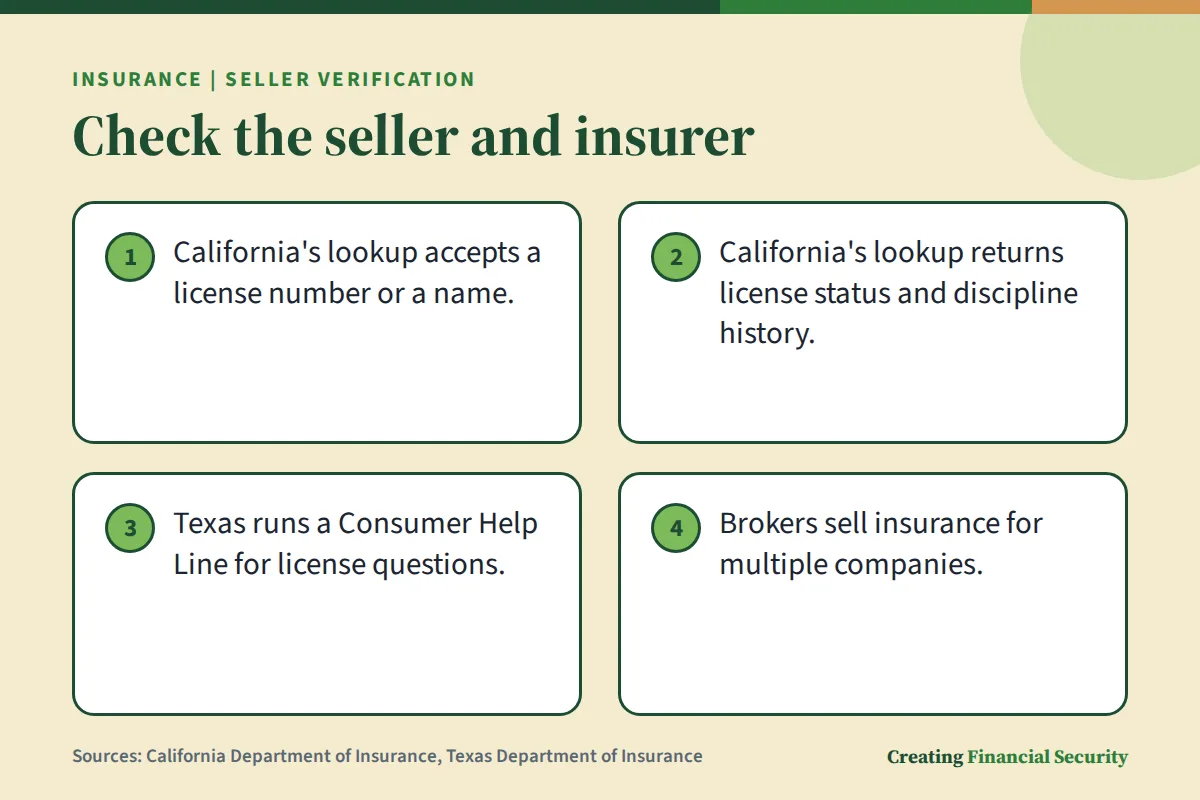
States describe their tools in their own words. The Texas Department of Insurance points consumers to a “Look up a company or agent” feature and a Consumer Help Line at 800-252-3439 for questions about whether an agent or company is licensed. California's Department of Insurance offers Check a License. Consumers can search using a name or license number, then review the matching licensee's status, disciplinary history and linked details. Treat those as two examples of what to look for. Your mother's state may name its tools differently.
A workable sequence:
- Find the state insurance department's own website and open its consumer or licensing pages.
- Look for the license lookup for agents, brokers or producers.
- Search by license number if you have one, or by the seller's name.
- Open the matching record and read its status and any linked details.
- If the tool is confusing or finds nothing, call the department and ask staff what to search.
Match the person, not just a familiar name
A search can return several results, so compare each record with what you know. Look at the name, any license number and any other detail the record lists, and see whether they fit the seller.
A valid license belonging to someone else does not verify the person who contacted your mother. That is an easy slip when a name is common. If the seller gave a license number, check whether the record carrying it shows the seller's name.
Matching a name and number is useful, but it does not by itself prove that the person on the phone is the license holder. Anyone can quote a real name. How to verify the actual seller is a question for the department or the insurer.
A screenshot or PDF the seller sends is not independent verification, because you can't tell who made it or when. A record you pull up yourself on the department's site is different, because you chose the source.
| Check | What a record can show | What it may not show |
|---|---|---|
| Individual license status | License status and discipline history for the person, as California's lookup returns them | Whether the person may represent the proposed insurer |
| Agency or business | California's lookup also covers business entities | Which individuals work there or are authorized; ask the department |
| Issuing company | Texas offers access to financial ratings and complaint counts | Ask separately about the seller's connection to the company |
| Regulatory orders | Texas identifies an open records request as a route to copies of other orders | Ask the department what a relevant order establishes |
Read what the license actually permits
Finding a record is only the start. California describes its lookup as showing the status and discipline history of agents, brokers and other licensees, with links from the record to more detail. Other states may organize this differently, so ask the department what its record shows and what it leaves out.
Three things are worth looking for. First, the current status: does the record describe the license as active, or as something else? Second, the kinds of insurance the license allows the person to sell. A license isn't necessarily a permit for every kind of insurance, so ask the department how to confirm authority for life insurance specifically. Third, any discipline notes or restrictions, along with their dates.
Product matters, too. For variable life sales in Texas, the agent needs both state insurance licensing and a federal securities license. That example concerns variable life, not burial coverage, but it shows that what a seller needs can depend on what is being sold.
An active license is a baseline. It isn't a rating, an endorsement or a judgment on the policy being offered. Whether a burial policy suits your mother is a separate review, and Texas cautions against choosing any life policy on price alone.
Keep license status, insurance authority and appointments separate
Three questions are easy to blur, so it helps to hold them apart. A reassuring answer to one doesn't stand in for the other two.
License status asks whether the state currently licenses this person. The record can answer that, and it may include discipline history. Ask the department whether the result also identifies any insurer relationships.
Insurance authority asks what kinds of insurance the person may sell. A record may describe this, and the department can explain how to read it. It doesn't tell you that one company's product is something this seller is cleared to offer.
Insurer relationship asks whether the insurer has authorized this seller to represent it. Ask the department whether its public lookup addresses that question or whether separate confirmation is needed.
Confirm the agent’s connection to the proposed insurer
This is the check a license record alone may not answer. The aim is a direct reply to one narrow question: can this person represent this company for this proposed policy? Here is a practical order:
- Write down the exact company name that would issue the policy, as it appears on any quote or application.
- Look for that company in the state department's company information, such as the company lookups Texas and California describe, to see how the state treats it.
- Reread the seller's license record for anything it says about insurer relationships.
- Ask the department which authorization or appointment rules apply to this sale, whether its lookup shows a seller's connection to an insurer, and how a consumer can get that confirmed if it doesn't.
- Ask the insurer whether the named person can represent it for the proposed policy in your mother's state, giving the seller's name and license number if you have them.
Texas urges consumers to verify both company and agent licensing. It warns that an unlicensed insurer's failure could leave the beneficiary without payment. It also describes guaranty-association membership for licensed insurers, with associations paying claims when insurers fail. Ask the department what protection applies to the company being checked and what limits or conditions need review.
Check the state’s appointment rules before interpreting a result
Ask the relevant department: Does this sale require an insurer appointment? If so, when must it be filed, and can a consumer see it in the public lookup? If the lookup does not answer those questions, ask how to confirm the seller's authority for the proposed transaction.
Treat an empty spot as an unresolved question. Ask whether the lookup is intended to display that connection and, if it is, how to interpret the missing entry. Keep the question specific to the named seller, issuing company and proposed policy.
Use independently found contact details for confirmation
For the insurer, use a phone number or web address from its own official materials, from an existing policy statement or from the state department's company pages. Rather than relying only on a number supplied by the seller, compare it with contact details you find independently.
If you're asking about a particular application, ask the insurer what information or permission it needs before it can discuss it. That keeps the question about the seller apart from your mother's private details.
Check the agency and issuing company as separate entities
The salesperson, the agency and the company that issues the contract are different parties, and a reassuring result for one doesn't carry over to the others. Work through each on its own:

- The individual: license status and permission to sell life insurance, as described above.
- The agency or business: ask the department whether an agency needs its own license in that state, whether the individuals who work there need theirs, and how to check each. California's lookup covers business entities as well as individuals; what your state does is a question for your department.
- The issuing company: confirm how the state licenses it. Texas says its help line and lookup can share a company's financial rating and its number of complaints.
- The link between them: the connection covered in the previous section.
State company pages can offer more than a license check. California's consumer links cover license searches, company lists, complaint studies, enforcement actions and rate filings, so it's worth looking past the first search box.
Follow the legal name on the proposed policy
Advertising names, agency names and the name of the company responsible for the contract can all differ. The name that matters when a claim is made is the company the policy names as its issuer.
Ask the seller for a written quote or sample policy and find the issuing company's full name on it, then look up that name in the state's records. If the names in the ad, on the quote and on the policy don't line up, ask the seller to explain the relationship in writing, and ask the department or insurer to confirm it.
Texas also says agents can't offer a gift to encourage a purchase, and it asks consumers who suspect an improper offer to call its Consumer Help Line. Your own state may have a similar line.
Resolve missing records, restrictions and disciplinary notices
A search that finds nothing isn't proof of wrongdoing, and a search that finds something isn't always a verdict. It helps to work through the plain explanations before deciding anything.

If you can't find the seller:
- Recheck the spelling and try a shorter version of the name.
- Search by license number, or ask the seller for one.
- Confirm you searched the state where the sale would happen.
- Look for filters, such as a license type, that might narrow the results.
- Call the department's consumer line, describe what you searched and ask staff to look.
If a record shows something concerning, such as an inactive license or a discipline note, write down exactly what it says, with dates, and ask the department how to read it. The seller's own explanation isn't an independent source.
If the seller can't be verified to the family's satisfaction, holding off on sharing personal details until the department or insurer has confirmed what it can is a reasonable pause. The decision stays with your mother, and a licensed professional or the department can help with her own case.
Where to take a concern differs by state. California, for example, has an Investigation Division that looks into suspected fraud by agents and brokers, and a page of alerts for seniors.
Ask what a record means before drawing conclusions
Public records differ in what they disclose. California says its license lookup returns discipline history. The Texas Department of Insurance publishes a list of Commissioner orders, each with an order number, a date and a title that often names the entity involved. Some titles, such as emergency cease and desist orders, name a business directly. Texas says copies of other orders can be requested through an open records request.
Check the named entity, issue date and subject before interpreting a notice. Texas's list includes rate filings as well as cease-and-desist orders, so appearing on the list is not itself a finding of misconduct. Ask the department what any relevant order establishes about the seller or company.
If an entry is old, ask whether anything has changed since. If you can't tell whether an order applies to the person or company you checked, ask the department whether it does, whether it is still in effect and what the current license status is.
Keep a verification file before the application moves forward
A simple file keeps the facts straight and takes pressure out of the conversation. It also helps if your mother speaks with the seller again and details get muddled. A folder, notebook or shared phone note will do.

- The seller's name, any license number and the state you searched.
- The date you searched, the website you used and what the record showed.
- The agency's name and what you learned about its licensing.
- The issuing company's name and what the state's records show.
- Who you spoke with at the department or insurer, the number you called, the date and what they confirmed.
- Any question still unanswered.
A few questions to talk through with your mother before anything is signed: Who exactly is the person, the agency and the company? What did the department say about each? Does the quote name the same company the seller described?
Save the evidence and write down unanswered questions
Keep notes or screenshots of what official records showed on the day you looked, with the date beside each result, since records can change.
Note anything unresolved, such as a relationship you couldn't confirm or a name that didn't match. An open question is useful information, and writing it down keeps it from fading after a friendly phone call.
Verification is not approval of the policy. A seller who checks out is still selling something your mother can review on its own terms. In its discussion of prepaid funeral insurance, Texas says the coverage can be expensive compared with other types of life insurance, and that the premiums might end up being more than the policy pays. Benefits, exclusions, waiting periods and premiums are a separate review, and the department or a licensed professional can help with her own case.
The bottom line
Checking a life insurance seller comes down to separate questions. Is the person licensed, and for life insurance, in the state where the policy would be sold? Is the company that would issue the policy licensed there? And is the seller authorized to represent that company? A good answer to one doesn't answer the others, and a record that is missing or unclear is a reason to ask, not a verdict.
Start with the state insurance department's own lookup, match the record to the actual person and keep dated notes of what it shows. Verification says nothing about whether a policy is affordable or suitable, which is its own review. The department's consumer line, the insurer or a licensed professional can help with your mother's own situation, and the decision stays with her.
Questions readers ask
What if I cannot find the agent in the state lookup?
Can an agent who lives in another state sell insurance to my mother?
Does the agency’s license cover everyone who works there?
Does an active license mean the burial policy is a good fit?
How can I review regulatory orders about a company or agent?
Can I help my mother check records without giving her health information?
Sources
- Texas Department of Insurance: Life insurance types, household coverage needs, underwriting, accidental-death coverage
- Texas Department of Insurance: Commissioner of Insurance orders
- California Department of Insurance: Check license status
- California Department of Insurance: Company and agent/broker information