

When a hospital bill and a car repair land in the same month, a 401(k) can start to look like the only cushion in the house. Before pulling from it, it helps to know that traditional and Roth money can carry different tax costs when they come out early.
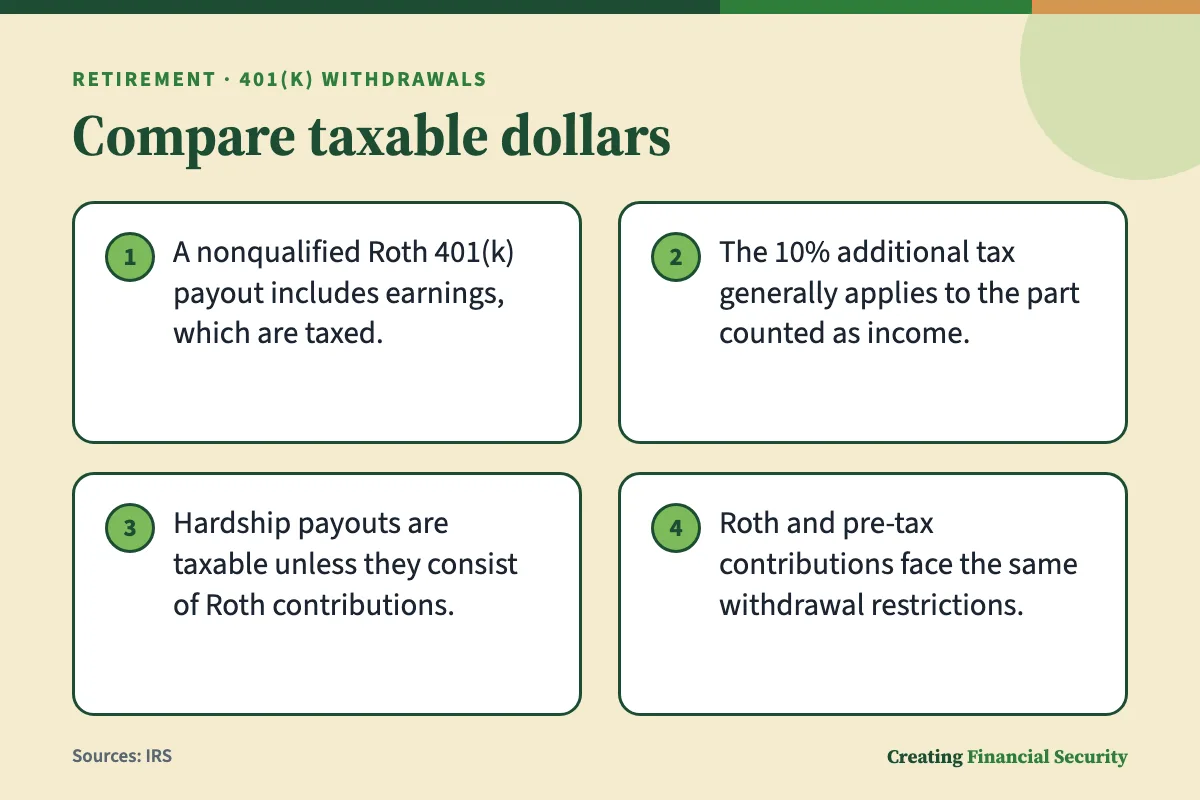
Here's the short answer. Pre-tax 401(k) money generally becomes taxable income when it leaves the plan. An early Roth 401(k) withdrawal that isn't qualified generally includes both contributions and earnings, and only the earnings are taxed. Roth doesn't automatically mean penalty-free, though: the 10% additional tax generally applies to whatever part is taxable, unless an exception applies.
So the useful questions are which dollars would be taxable, whether an exception fits, and what your plan can actually pay out.
This guide is part of our larger one on early 401(k) distribution taxes and exceptions.
Start with the bill, the cash needed and the account breakdown
Begin with one number: the cash you need for the hospital bill and the repair. Writing it down first keeps the comparison fair, because every option gets measured against the same need instead of whatever balance happens to be in an account.
Next, sort what you have by type. A workplace 401(k) can hold pre-tax contributions, designated Roth contributions, the earnings on both, and sometimes employer money or other after-tax money. Your old IRA is a separate account under separate rules, and it might be traditional or Roth.
Then comes the step that's easy to skip: whether the plan will release any money at all. The IRS says a plan may offer hardship distributions but isn't required to. Under an IRS safe harbor, medical care costs for the worker, a spouse, dependents or a beneficiary count automatically as an immediate and heavy need. The employer decides, using the plan's terms and the facts of the situation.
Taxes belong in this first step too. For a hardship payout to be automatically treated as necessary, the IRS says it can't exceed the need, and the need can include the cash required to pay the taxes the payout causes. So the cash you need and the cash the plan sends may not match.
Ask what the plan can actually distribute
Account labels don't show what can leave the plan. These questions help settle it:
- Does the plan allow hardship distributions, and what proof does it want? The IRS says an employer may generally rely on your written statement that other resources can't cover the need, unless it knows otherwise.
- Which balances does the plan permit you to withdraw for hardship? Ask the administrator for the available sources and the plan's conditions.
- Can you choose between traditional and Roth money? The IRS says the same withdrawal restrictions apply to both, but whether a plan lets you pick a source is a plan-document question.
- Does the plan offer loans? A loan runs under different rules and belongs in its own comparison.
How it works, step by step
- Check whether the plan offers hardship distributions; plans are not required to offer them.
- Confirm the Roth holding-period start with the administrator, including whether a direct rollover permits an earlier starting year.
- For a distribution other than a direct rollover, request the administrator's statement identifying basis or confirming qualified status.
What changes when the money is traditional or Roth?
The cleanest comparison asks three things about each dollar that would come out: is it taxable, could the 10% additional tax attach to it, and will the plan pay it at all?
Traditional, pre-tax dollars were never taxed on the way in, so they're treated as income on the way out. The IRS says hardship payouts are taxed as income unless they consist of Roth contributions, and a pre-tax balance holds none.
Designated Roth dollars work the other way. You were taxed on them when you earned and contributed them, and a qualified payout is generally left out of income, earnings included. The important distinction is whether the payout is qualified. When a payout is nonqualified, the IRS says the earnings portion goes into gross income and the contributions portion stays out.
The additional tax is the third piece. The IRS treats a payout from a qualified plan before age 59½ as an early distribution, and the portion counted as income generally carries the 10% additional tax. For a nonqualified Roth payout, that portion is the earnings share, so the extra tax generally follows it rather than the full amount.
A past in-plan Roth rollover can complicate this. The IRS says a distribution of part of an in-plan Roth rollover within five taxable years can trigger a special recapture rule, and a licensed tax professional can review any rollover history.
Keep other after-tax contributions separate
Not every after-tax dollar is Roth. A plan can hold other after-tax employee contributions too, and the IRS says designated Roth distributions are treated separately from the rest of the plan, so the plan's records decide which rule applies to which money.
Employer money needs checking as well. The IRS explains that certain matching and nonelective employer contributions can be designated as Roth. Rather than assuming all employer money is pre-tax, ask the administrator how each employer contribution is recorded and which balances are available for distribution.
The old IRA is its own case. The IRS instructions say borrowing from an IRA, or pledging its assets as security for a loan, counts as a distribution that is generally subject to the additional tax. So it isn't a way around the cost, and whether the IRA is traditional or Roth changes the answer.
Before treating Roth money as tax-free, check its status
For Roth 401(k) money paid out and kept rather than rolled over, qualified status generally determines whether the earnings escape income tax. The IRS says that generally takes both a five-taxable-year period of participation and an age, death or disability condition. If either is missing, the payout is nonqualified.
If you're under 59½, the age test isn't met, so the question becomes whether disability applies. Three things are worth pinning down:
- The first year you made designated Roth contributions to this plan.
- Whether five consecutive taxable years have passed since then.
- Whether the age, death or disability condition is met.
The account's tax-year clock is only part of the test
The clock starts with the opening day of the tax year tied to your first designated Roth contribution to the plan, and it requires five consecutive tax years. Some contributions don't start it: a year in which the only money in was an excess deferral doesn't count.
A finished clock doesn't make a withdrawal qualified by itself. Even for a Roth hardship payout, the IRS says the earnings are taxed unless the account has reached five years and you are disabled or past 59½. Both pieces have to be in place.
An earlier start is possible after a direct rollover. If Roth money arrived by direct rollover from another plan's designated Roth account, the IRS says the clock can count from the earlier year you contributed there. The plan administrator is responsible for tracking the date of your first designated Roth contribution, so that's who to ask.
A Roth 401(k) does not use Roth IRA withdrawal ordering
If you've read about Roth IRAs, you may have seen that contributions come out first. The IRS instructions for Form 5329 describe that ordering for Roth IRAs: an early payout is assigned to contributions first, then to conversions and rollovers in the order they happened.
A Roth 401(k) doesn't work that way. For a nonqualified payout from a designated Roth account, the IRS says the contributions portion is found by multiplying the payout by the ratio of Roth contributions to the whole Roth balance. The rest is earnings.
The IRS gives one illustration. A nonqualified payout of $5,000 from an account holding $9,400 of Roth contributions and $600 of earnings consists of $4,700 of contributions and $300 of earnings, and only the $300 is included in gross income. Those are the IRS's numbers for its example, not a forecast for any account.
For a nonqualified Roth 401(k) payout, selecting Roth money does not mean selecting contributions alone: the payout includes earnings in proportion to the account's earnings share.
| Question | Traditional pre-tax | Designated Roth |
|---|---|---|
| Income tax on a hardship payout | Subject to income tax | Not on Roth contributions |
| Nonqualified designated Roth allocation | Not a designated Roth account | Contributions and earnings in proportion |
| 10% additional tax | Generally on the part counted as income | Generally on the part counted as income |
| Past in-plan Roth rollover | Not applicable | Special recapture rule may apply |
| Withdrawal restrictions | The baseline restrictions | Same restrictions as pre-tax contributions |
Compare taxable dollars before comparing tax costs
The amount you withdraw and the amount that's taxable aren't always the same number, and the tax follows the second one. A taxable withdrawal adds to your income for the year, and the federal cost depends on your whole return, which can involve more than one rate. Any single percentage is a simplification.
A made-up pre-tax withdrawal with its assumptions shown
Here's a simplified scenario to show the mechanics, using pre-tax money because that's the case where the whole payout counts as income.
| Amount | |
|---|---|
| Withdrawal | $10,000 |
| Federal income tax (22%) | $2,200 |
| Additional tax (10%) | $1,000 |
| Left after these taxes | $6,800 |
The whole withdrawal is taxed at a 22% federal rate and no exception to the 10% additional tax applies; state tax is not included. In the made-up example above, the whole $10,000 withdrawal is taxed at a 22% federal rate, no exception to the 10% additional tax applies, and state tax isn't included. After $2,200 of income tax and $1,000 of additional tax, $6,800 is left. A real case can differ: the rate depends on all your income, and an exception could remove the additional tax from some or all of the amount.
Why the Roth estimate needs an earnings breakdown
A Roth estimate requires the plan's contributions-and-earnings allocation. The taxable base depends on how much of the designated Roth balance is earnings, and a made-up percentage would only hide the real answer.
The IRS describes a statement that helps. For payouts other than direct rollovers, the plan administrator must give the employee, on request, the part of the distribution that is basis, or confirm it was qualified, within a reasonable time and no later than 30 days after the request. With the earnings share in hand, the same two steps apply: income tax on the taxable part, and the additional tax generally on that same part.
How an additional-tax exception changes this comparison
A hospital bill raises separate questions about access and taxes. Medical care expenses can establish a hardship need under the plan's rules, but that does not establish an additional-tax exception. The IRS instructions for Form 5329 explain exception reporting; eligibility requires a separate check using the instructions applicable to the withdrawal year.
What an exception does is remove the additional tax from the covered amount. It doesn't remove ordinary income tax. The IRS treatment of in-plan Roth rollovers shows how separate the two are: untaxed amounts must be included in income, yet the 10% additional tax doesn't apply to the rollover.
The effect differs by account type. With pre-tax money, an exception covering the whole withdrawal would remove the additional tax but leave the amount as taxable income. With nonqualified Roth money, the earnings stay taxable, and the additional tax that would have followed them could be removed.
Reporting follows the tax year. Under the IRS's 2025 instructions, an exception generally requires Form 5329. A different rule allows direct reporting on Schedule 2 when every Form 1099-R correctly shows code 1 in box 7 and the additional tax applies to each full reported amount. The edition for the year of the withdrawal is the one to check.
Permission to withdraw is not a tax waiver
Hardship eligibility and tax treatment are separate questions. Eligibility decides whether the plan may pay. The IRS says hardship payouts are subject to income tax, except to the extent they consist of Roth contributions, and may also face the 10% additional tax.
A hospital bill can count as a qualifying need under the plan and still leave the withdrawal taxable. Neither the bill nor a hardship approval establishes an exception on its own. A licensed tax professional can look at your own case, and the IRS's hardship distribution page covers the eligibility rules in full.
Compare the deposit now with the tax bill later
Four different numbers tend to get mixed together:

- The gross withdrawal: what the plan distributes.
- Withholding: federal tax the plan sends to the IRS on your behalf.
- Final tax: what you owe once the return is figured, including any additional tax.
- State tax: a question for your state tax agency. The made-up federal example does not include it.
The IRS says federal income tax withholding applies to retirement plan payouts, so the deposit that reaches your bank can be smaller than the gross amount. Form W-4R is the withholding certificate for nonperiodic payments and eligible rollover distributions, and the administrator can say which forms and choices apply to your payout.
Withholding does not settle the final cost
Withholding is a payment toward the bill, not the bill itself. The final tax is figured on your return, and any additional tax is reported with it. Your other income, filing status and any exception all feed into the result, so the amount withheld can land above or below what you owe.
The IRS requires Form 1099-R reporting when a designated Roth account pays a distribution. Its guidance on in-plan Roth rollovers also distinguishes withholding from tax liability: employees may need more tax withheld or may need to pay estimated taxes so that an underpayment does not trigger a penalty. That rollover guidance does not set the withholding treatment for a hardship payout.
Build a side-by-side estimate before deciding
Here is how to compare traditional and Roth 401(k) early withdrawals for your own case: fill in the same lines for each source. For each one, write down:

- The cash you need, the same number for both.
- Whether the plan can pay from that source.
- The taxable amount shown in the plan's distribution estimate.
- Exception status: whether one might apply, and how Form 1099-R would code it.
- The withholding the plan would take, and the form that controls it.
- Timing: when the money arrives and when the tax is due.
Use the same cash need and record unknowns
Leave a blank wherever you don't have an answer yet, rather than guessing. Blanks become your questions.
For the plan administrator, the list is the account breakdown by source, the earnings share of your Roth balance, the year of your first Roth contribution, any in-plan rollover history and the distribution options. For a licensed tax professional, it's how your income, any exception and your state's rules change the result.
Working out how large a withdrawal would leave a target amount after tax depends on your rate and any exception, so it's a calculation for someone who can see your whole return.
Keep alternatives visible without assuming they are cheaper
Two other paths are worth keeping on the page, without assuming either is cheaper. One is asking the hospital's billing office what payment arrangements it offers. The other is whether your plan allows loans. The IRS says that when a plan permits loans, you may be able to name the account the loan comes from, including a designated Roth account, and a Roth-account loan counts toward the same combined borrowing limit as other plan loans. Each path has its own costs and risks, and each deserves its own comparison.
The bottom line
Traditional and Roth 401(k) money are compared by what's taxable, not by what the account is called. Pre-tax money generally comes out as taxable income. For Roth money, the plan's own allocation of contributions and earnings sets the taxable portion, and whether the payout is qualified decides whether earnings are taxed at all. The 10% additional tax generally follows the taxable part unless an exception applies, and an exception can remove that tax without removing income tax.
Before deciding, it helps to have three things in writing: what the plan can actually pay, the contributions-and-earnings breakdown from the administrator, and what would be withheld. A hardship approval tells you the plan may pay, not what the tax will be. Because the final cost depends on your income and exception status, a licensed tax professional can run your own numbers, and the IRS instructions for the year of the withdrawal can show whether an exception fits.
Questions readers ask
Can I choose Roth money instead of traditional money for a hardship withdrawal?
Does a traditional 401(k) withdrawal have a separate penalty on investment earnings?
Does moving Roth 401(k) money to a Roth IRA make it immediately available tax-free?
Does federal withholding tell me the final tax cost?
How is an early-distribution tax exception generally reported?
Sources