

If a hospital bill and a car repair land in the same month, a retirement account can start to look like the only cushion within reach. Whether you can get at it early depends first on your plan's rules. And a taxable withdrawal before age 59½ generally brings ordinary income tax plus an additional 10% tax, unless an exception applies.
Plan approval doesn't change that. Even when a plan agrees the need is real and releases the money, the IRS settles the extra tax under a separate set of rules. Hardship approval answers whether you can get the money, not how it will be taxed.
What could an early withdrawal cost?
People say 'penalty' for what is really several different costs. Seeing them one at a time makes the total easier to size up.
Income tax. Most retirement distributions are taxable. Pretax withdrawals generally add to the income reported on your return. The applicable federal rate depends on your taxable income; the example's assumed rate isn't a prediction of your tax bill.
The additional tax. The IRS calls withdrawals before age 59½ 'early' distributions and applies an additional 10% tax to the part included in income unless an exception fits. It's a different tax from income tax, and the exceptions are written to remove it, not the income tax. A different rate applies to certain SIMPLE IRA distributions, covered in the IRA section further down.
Withholding. Money withheld from a distribution counts toward federal tax on the return; it isn't a separate tax. The IRS lists Form W-4R for withholding on nonperiodic payments. Ask the administrator what will be withheld and a tax professional whether it will cover the expected tax.
Lost retirement savings. Money spent from the account is no longer set aside for retirement, even when a distribution avoids tax.
| Amount | |
|---|---|
| Withdrawal | $10,000 |
| Federal income tax (22%) | $2,200 |
| Additional tax (10%) | $1,000 |
| Left after these taxes | $6,800 |
The whole withdrawal is taxed at a 22% federal rate and no exception to the 10% additional tax applies; state tax is not included. The table taxes the whole withdrawal at one assumed federal rate, assumes no exception to the additional tax applies, and leaves state tax out.
A made-up withdrawal example, with the assumptions visible
In the made-up example above, income tax and the additional tax come out of the withdrawal separately, which is why what's left is noticeably smaller than what was taken. The income tax figure rests on an assumed rate. It's a number chosen to show the arithmetic, not your tax rate, which depends on your whole income for the year. A tax professional can estimate your real figure.
How it works, step by step
- Compare qualifying unreimbursed medical expenses with the threshold of 7.5% of AGI.
- If an exception fits but the seventh box of Form 1099-R doesn't identify it, indicate the exception on Form 5329.
- Use the Form 5329 version and instructions for the tax year of the distribution.
- For a hospital covered by Section 501(r), request its financial assistance policy and application instructions.
Can your plan release the money now?
The practical access question belongs with the plan administrator: can this account pay a distribution now, and what paperwork is required? The IRS exception chart addresses additional tax, not an individual plan's payout procedures.
Ask the administrator to identify the pretax and designated Roth portions of the account. The IRS gives designated Roth distributions separate tax treatment, so the account's composition matters as well as the amount requested.
While you still work there
Ask whether the plan permits the requested withdrawal while you're employed. If it does, check the tax treatment separately rather than treating permission as a tax exception.
After you leave the employer
Ask what payout options apply after employment ends. For tax purposes, leaving a job alone isn't enough: the separation exception has an age condition.
At age 59½
The IRS lists reaching 59½ as relief from the age-based additional tax for employer plans and IRAs. Ask the administrator whether a payout is available; pretax distributions generally remain taxable.
Hardship approval answers a different question from a penalty exception
Hardship approval doesn't establish an exception to additional tax. The IRS identifies qualifying circumstances, including certain medical expenses, disability and qualifying separations from employment. The relevant question is which exception matches the facts—not simply whether the plan approves payment.
Read next: reading your plan's summary description.
Does the hospital bill qualify for an exception?
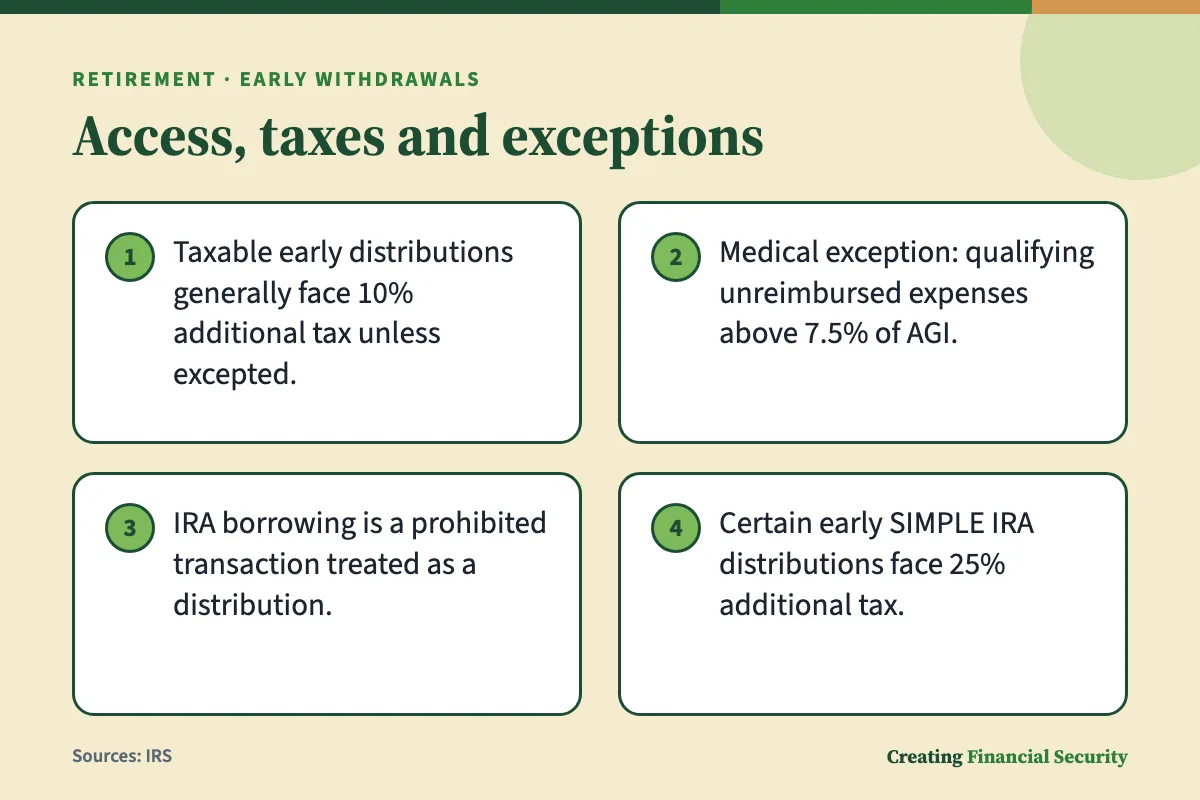
The IRS chart lists an exception for unreimbursed medical expenses above 7.5% of AGI. It's marked as applying to both employer plans like a 401(k) and to IRAs. AGI is adjusted gross income, a figure that comes from your tax return.
The wording is narrow. It points to the amount of qualifying unreimbursed expenses above that line. It isn't written as 'the whole bill' or 'the whole withdrawal.'
Here is a sequence of questions that follows the way the rule is written:
- Which unreimbursed expenses qualify, and when were they paid? A balance still owed after insurance isn't automatically a qualifying expense, so insurer statements, pending claims and payment dates all matter. A tax professional can confirm which expenses and which dates count.
- What AGI figure should be used for the withdrawal year? Ask a tax professional how to estimate it before the return is complete.
- How much do the qualifying expenses exceed 7.5% of that AGI?
- How does that excess compare with the withdrawal? Any part of the withdrawal beyond it isn't covered by this exception.
- How will the plan report the payment? The IRS says to look at box 7 of Form 1099-R. If a distribution meets an exception but box 7 doesn't show one, Form 5329 is the form used to indicate the correct exception.
A car repair isn't a medical expense. A separate emergency-personal-expense exception may apply under its own requirements. For distributions after December 31, 2023, the chart permits one each calendar year, capped at $1,000 and further limited by the vested balance exceeding $1,000. Ask the administrator about access and a tax professional about eligibility.
The records and timing that matter
Useful records to gather include:
- The itemized hospital bill and the insurance statements showing what was paid and what wasn't.
- Proof of what you paid yourself, with payment dates.
- Your latest tax return, for AGI, plus a note of how this year's income may differ.
- The Form 1099-R the plan sends, especially the code in box 7.
- The plan's withdrawal paperwork showing the amount and date.
Which payment dates count for a given withdrawal year is a good question for a tax professional. An unpaid bill alone doesn't establish the exception.
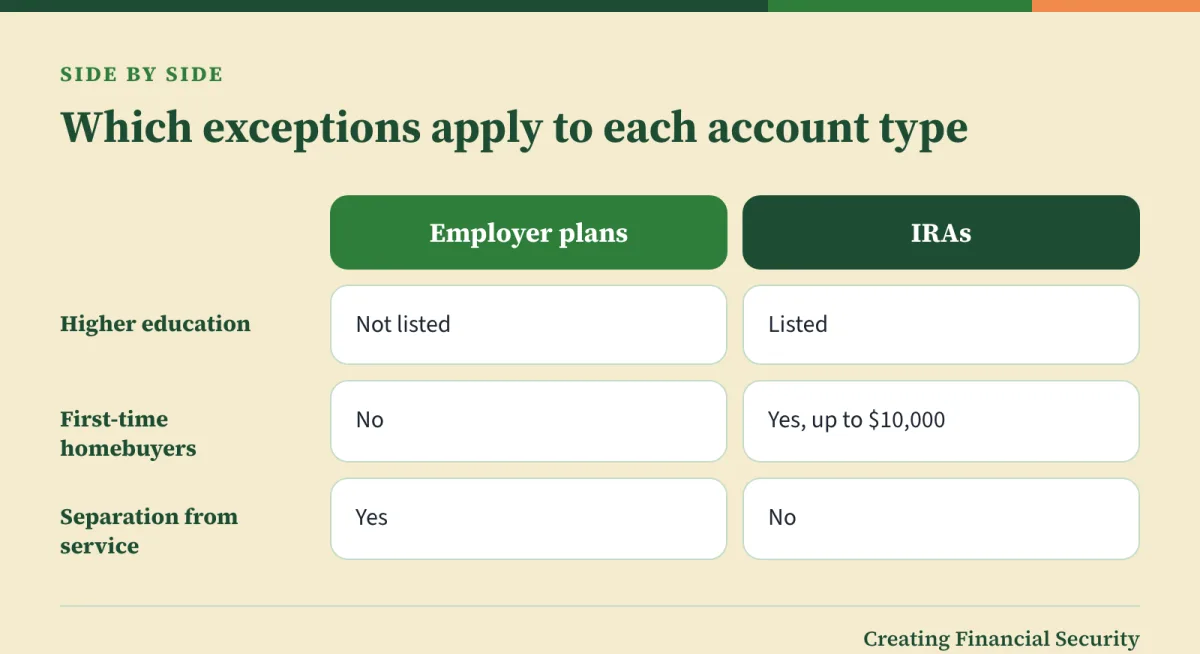
| Exception | 401(k) and similar plans | IRA, SEP, SIMPLE IRA |
|---|---|---|
| Unreimbursed medical expenses above 7.5% of AGI | Yes | Yes |
| Emergency personal expense: one annual distribution, capped at $1,000 and limited by vested funds exceeding $1,000; after December 31, 2023 | Yes | Yes |
| Ordinary separation exception: employment ends no earlier than the calendar year of the employee's 55th birthday | Yes | No |
| Qualified higher education expenses | No | Yes |
| Qualified first-time homebuyers, up to $10,000 | No | Yes |
| Series of substantially equal payments (conditions apply) | Yes | Yes |
Which other exceptions are worth checking?
The IRS distinguishes employer-plan exceptions from IRA exceptions. Selected entries include:
- Birth or adoption expenses and certain federally declared disaster losses: listed for both account types, each with its own dollar cap.
- Total and permanent disability, and distributions after the owner's death: both.
- Qualified higher education expenses: not listed for employer plans, listed for IRAs.
- Qualified first-time homebuyers, up to $10,000: not for employer plans, yes for IRAs.
- Separation from service at certain ages: yes for employer plans, no for IRAs.
- Emergency personal expenses and a series of substantially equal payments: both.
Some exceptions apply to IRAs but not employer plans, while others apply to employer plans but not IRAs. An exception generally removes only the additional tax. The taxable part of a distribution is still income, so a penalty exception doesn't make pretax money tax-free.
Why the old IRA follows different rules
A 401(k) and an IRA are both retirement savings, but the tax code treats them as different kinds of accounts. The same life event can open a door in one account and not the other, which is why the chart has separate columns.
Borrowing is another difference. The IRS treats IRA borrowing and using IRA assets as loan collateral as prohibited transactions that count as distributions and generally trigger additional tax. An IRA loan isn't an alternative to an employer-plan loan.
SIMPLE IRAs have a special early-participation rule: during the initial 2 years, the applicable additional-tax rate is 25% rather than 10%. Exceptions still matter. Confirm the IRA type and participation dates before estimating its cost.
Periodic payments are a commitment, not a one-time cash fix
The IRS chart lists a series of substantially equal payments as an exception for both account types. It can sound like a way around the extra tax, but it's a payment schedule, not a lump sum for this month's bill.
Publication 575 describes special transfer and rollover rules involving these schedules. Before starting, ask a tax professional about employer-plan eligibility, how long payments must continue and what taxes could follow a change. The chart's brief entry isn't enough to establish those details.
What changes if you leave your job?
A job departure and a penalty exception aren't the same event. The separation year matters.
For the ordinary employer-plan separation exception, employment must end no earlier than the calendar year of the employee's 55th birthday. It isn't an IRA exception. The IRS lists separate provisions for certain public safety workers.
Because the rule looks at the year of separation, someone who leaves well before the year they reach 55 doesn't meet it. Without another exception, a taxable early withdrawal generally still carries the extra 10%.
The same goes for money paid out without your asking. The IRS instructions for Form 5329 say an involuntary cashout counts as an early distribution, so its taxable part is generally subject to the additional tax unless an exception applies.
A few things to settle after leaving:
- Which payout forms the plan offers, which the administrator can explain.
- Whether any exception on the chart matches your facts.
- Whether the money stays put, moves or is paid out as cash. That depends on your situation, and a licensed professional can help with it.
Moving money and spending money have different tax consequences
Money leaving a plan can go in two very different directions.
An eligible rollover generally preserves tax deferral by moving retirement money into an eligible retirement account. When a distribution is received first, the usual rollover deadline is 60 days, although certain waivers are available. The rolled-over portion avoids the early-distribution additional tax.
By contrast, a taxable portion kept rather than rolled over counts as income and may also trigger additional tax.
Two trade-offs follow. After a move into an IRA, the IRA's exceptions apply, not the plan's, so the separation exception no longer fits. And the IRS says taxable plan money rolled into a Roth IRA is included in income, though the 10% additional tax doesn't apply to that conversion.
What can you compare before taking retirement money?
Hospital assistance, any available plan loan and a withdrawal raise different questions. None is automatically the right choice.

The bill itself. For hospital facilities covered by the IRS's Section 501(r) rules, a written financial assistance policy is required for emergency and other medically necessary care. The policy has to state who is eligible, whether help means free or discounted care, and how to apply.
The IRS also says a person found eligible can't be charged more than the Amounts Generally Billed for that care. Whether a particular hospital is covered, whether a given provider is on its list, and whether you'd qualify are questions for its billing office.
Either the assistance policy or a separate billing and collections policy must describe the reasonable efforts the facility makes to decide eligibility before it takes extraordinary collection actions. That's worth asking about before a bill goes anywhere.
A plan loan, if your plan has one. A loan isn't the same thing as a withdrawal, and it has its own rules.
A withdrawal. The cost is the income tax and any additional tax described above, plus the lost savings.
A plan loan avoids an immediate withdrawal only if its rules are met
Whether a plan offers loans, what repayment requires and what happens if employment ends are all plan-level questions for the administrator.
The IRS describes qualified plan loan offsets involving a loan that was in good standing. Qualification requires the offset to result solely from plan termination or a repayment failure caused by severance from employment. If those requirements are met, the rollover deadline is the return-filing deadline for the offset year, with extensions included. Ask how these rules affect any outstanding loan.
That's a very different thing from borrowing against an IRA, which the IRS treats as a prohibited transaction.
What to confirm before authorizing a distribution
A short checklist can turn a worrying decision into facts to gather:

- Plan permission. Ask whether the plan will pay this withdrawal and in what form.
- Account type. Find out which part of the balance is pretax and which is Roth. The IRS says designated Roth contributions are included in income, while qualified distributions from the account aren't.
- Withholding. Ask how much will be withheld, remembering it's a prepayment and not the final tax.
- Exceptions. Compare each possible exception with your facts, using the chart.
- Reporting. Check how the plan will code the payment on Form 1099-R.
Form 5329 generally reports additional tax or an exception. Use instructions for the distribution's tax year. Under the supplied 2025 instructions, a Schedule 2 alternative is available only when every relevant Form 1099-R correctly carries distribution code 1 in its seventh box and additional tax is owed on each form's entire reported amount. Otherwise, don't assume that alternative applies.
Questions for the plan administrator and a tax professional
The administrator can say what the plan allows and how it will report the payment. Final tax treatment, including whether an exception applies, is decided under IRS rules, not by the plan.
For the administrator:
- Does the plan allow this kind of withdrawal now, and what paperwork is required?
- How much would be withheld, and how will the payment be coded?
- How is my balance split between pretax and Roth money?
For a tax professional:
- Does any exception fit my facts, and for how much of the withdrawal?
- What do my AGI and qualifying medical expenses look like for the year, and which payment dates count?
- Would a rollover, or the other account, change the answer?
Read next: requesting an early plan distribution.
The bottom line
Three questions sit under 'can I pull from my 401(k) early?': will the plan release the money, what income tax follows, and does an exception remove the additional 10% tax. Hardship approval answers only the first.
For a hospital bill, the IRS exception for unreimbursed medical expenses applies above 7.5% of AGI, so it may reach only part of what you owe. A car repair isn't a named exception, though a separate emergency-expense provision exists with its own limits. Your 401(k) and your old IRA follow different rules, so each needs its own look.
The calm order is to confirm access, check exceptions, estimate costs and compare the alternatives before authorizing anything. The plan administrator can explain what the plan allows, the hospital's billing office can explain its assistance policy, and a tax professional can check your own numbers.
Questions readers ask
Can I cash out my 401(k) whenever I need money?
Does turning 59½ automatically let me withdraw from my 401(k)?
Are 401(k) withdrawals still taxable after 59½?
When is a 401(k) withdrawal actually tax-free?
What happens if I leave a 401(k) withdrawal off my tax return?
Can a former employer force money out of my 401(k)?
Does a car repair qualify me for a penalty-free withdrawal?
Sources