

When a hospital bill and a car repair land in the same month, one question comes before any form: how much of this 401(k) is actually mine? The figure to look for is the vested balance, the part of the account that belongs to you. Your plan's website or statement may show it, and the plan administrator can confirm it.
Hold one limit in mind from the start. Money that belongs to you isn't automatically money the plan will let you withdraw or borrow today. And an amount a page calls available isn't the same as cash in your hand after taxes.
This guide is part of our larger one on 401(k) withdrawal costs and access rules.
Find the ownership figure before starting a money request
Vesting is the IRS term for ownership. Being 100% vested means the entire account belongs to the employee; the employer cannot reclaim that vested money.
Until then, the part you own can be smaller than the total at the top of a page. That's why the vested line matters more than the headline balance.
The IRS points employees with vesting questions to three places: the employer or human resources department, the Summary Plan Description and the annual benefits statement. A sequence built from those involves no request form:
- Find your annual benefits statement and look for a vested amount or vested percentage, along with the date the figures cover.
- Read the Summary Plan Description for how the plan describes vesting.
- Ask your employer or human resources department to confirm your vested balance, and ask who the plan administrator is if you aren't sure.
If your plan has a website, check whether it shows a vested amount. If it doesn't, use the statement or ask the administrator. Read the instructions before selecting anything that starts a transaction.
Where to look online or on a statement
Look for labels such as these, and ask the administrator to explain any unfamiliar wording:
- Vested balance or vested amount: the portion you own.
- Vested percentage: the share of a contribution source that you own. It may be listed for one source rather than the whole account.
- Total or account balance: the whole account, which can include money you don't own yet.
- As-of date or statement period: the dates the figures cover. Check it before comparing any two numbers.
If you can't identify a vested figure, ask for help finding it rather than treating the missing label as a zero balance.
What to ask when no vested amount appears
A call or written note to the benefits office or plan administrator is one route, and it fits where the IRS sends employees with vesting questions. Ask for a figure you can write down: the amount, the date it was calculated and the contribution sources behind it.
Note the date, who answered and what they said. If the answer comes by phone, asking for it in writing gives you something to compare with later statements.
How it works, step by step
- Look for the vested amount and its date on your annual benefits statement, and read the Summary Plan Description.
- Ask your employer or human resources department to confirm your vested balance if the documents don't show it.
- Ask how the plan counts your service, because employers can choose different counting methods.
- If a claim is denied, note the date you receive the notice, because the appeal period runs from receipt.
- When appealing, ask for copies of documents relevant to your claim; the rules say they come free of charge on request.
Read the account labels without confusing ownership with access
Ownership and access are two separate questions, and an account page can blur them. Four ideas are worth keeping apart:
- Total balance: everything the account holds, including money you may not own yet.
- Vested balance: the part you own, which the employer can't take back.
- Loan availability: whether the plan offers loans at all, and how much it would lend.
- Withdrawal availability: whether the plan allows a hardship distribution or another kind of withdrawal, and from which contribution sources.
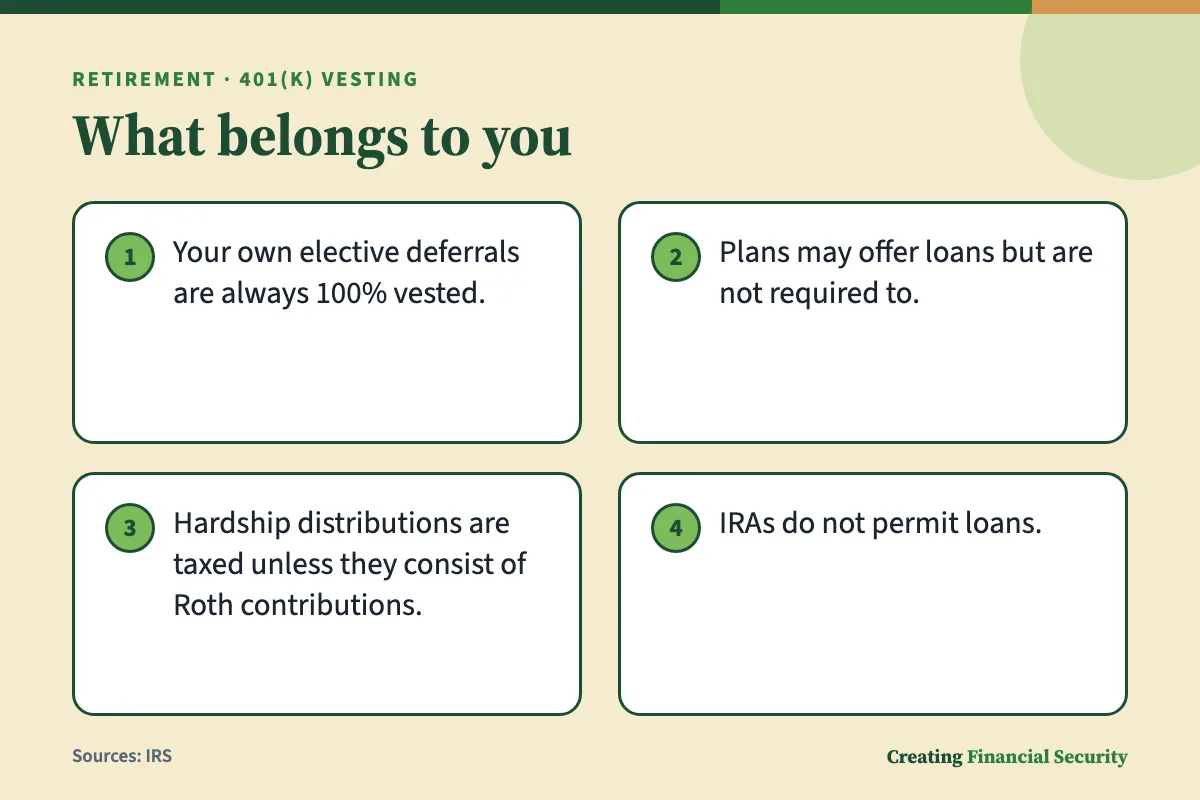
Plans can choose whether to offer loans and can impose a lower borrowing limit. The IRS describes a federal ceiling using two figures: $50,000, and whichever is larger—$10,000 or half (50%) of the vested balance. The lower of those two figures is the ceiling before any adjustment for existing or recent loans. The administrator can explain the limit that applies under the plan.
A plan can also choose whether to permit hardship withdrawals. Under IRS rules, the employer evaluates the need using the plan's provisions and the circumstances. The IRS safe harbor treats medical expenses for an employee, their spouse, dependents or beneficiary as meeting the immediate-and-heavy-need test. That does not require every plan to offer a payout. The withdrawal cannot exceed what is needed, including money needed to cover taxes caused by the withdrawal.
These describe how the rules work, not a path anyone has to take. The plan administrator can say what your plan allows.
An available amount is not a take-home estimate
Ownership does not determine tax treatment or remove plan restrictions. The IRS says a hardship payout is generally taxable income, with an exception for Roth contributions. An early payout may also trigger an additional tax of 10%.
Borrowing follows a different tax rule. According to the IRS, a loan avoids distribution treatment when it meets the applicable limits, repayment period and payment requirements. Default generally makes the remaining loan balance taxable as a distribution.
So when a page shows an available figure, it's fair to ask what it represents and what taxes or other costs could apply to that kind of transaction. A number on a screen describes what a plan might release, not what lands in your checking account.
Separate your contributions from your employer's money
The IRS says employees always own 100% of their own plan contributions, including salary deferrals. That money does not have to be earned through additional service.
Employer contributions work differently. In a 401(k) or profit-sharing plan, the plan document sets the vesting schedule, and the IRS says schedules can range from immediate vesting to one that raises your vested percentage with each year of service.
So one account can hold money with different rules attached. Sources you may see listed:
- Your own elective deferrals
- Employer matching contributions
- Employer nonelective contributions, sometimes called profit-sharing contributions
- Money that came from somewhere else, such as an earlier plan, if the plan tracks it as its own source
For rolled-in money, ask the administrator how the plan identifies and reports that contribution source.
Contribution source can also affect access. The IRS allows a plan to use the hardship conditions for employee deferrals when handling employer nonelective or regular matching money, but does not require identical conditions for those sources.
Check each contribution source rather than one percentage
A single vested percentage can hide a lot. If your own deferrals are fully vested and employer money isn't, one account-wide number can mislead in either direction. Ask for the vested amount source by source.
An urgent bill can tempt anyone to assume that a pressing need changes who owns what. Hardship rules describe when a plan may release money, while vesting describes ownership. They're separate questions, so ask about both.
Check which work history the plan counts
For employer contributions, the schedule runs on years of service, and the plan document sets how service is counted. The IRS warns that this can get complicated, because employers can choose different methods of counting it. The plan's tally may not match a simple count of calendar years.
Three steps keep the check tied to the plan's own records:
- Find the Summary Plan Description and read the vesting schedule and how it defines a year of service.
- Ask your employer or human resources department for the service record the plan has on file.
- Compare the two, and ask the administrator about any year that looks short.
Find the schedule in the plan documents
Three kinds of schedule come up in plain words:
- Immediate vesting: employer money is yours as soon as it goes in.
- Cliff vesting: an employer contribution subject to this schedule becomes fully owned at a specified service point, rather than in stages. This does not apply to your own salary deferrals.
- Graded vesting: the share you own rises step by step as your credited service grows.
One schedule the IRS describes reaches 100% after 3 service years. The plan defines a service year; the general measure is 1,000 work hours within 12 months. A separate IRS example concerns an employer-only account with a graded schedule lasting 6 years. With 5 service years credited under that plan, the worker owned 80% of the account.
Unvested money can be forfeited, the IRS says, when an employee receives an account payout, including after leaving a job. Another listed circumstance is five years during which annual work does not exceed 500 hours.
Ask about service dates, breaks and earlier employment
Ask the administrator how the plan treats your work history rather than assuming every calendar year counts:
- What start date does the plan have on file?
- How does the plan count hours of service?
- Was any year credited with fewer hours than the plan requires?
- Is there a gap in employment, and how does the plan treat it?
- Does earlier work for the same employer count?
A wrong start date or a missing year of credited hours could change the vested percentage, so the plan's own record is worth seeing.
Resolve a balance that looks missing or wrong
If the number surprises you, a calm paper trail beats a rushed assumption. A plain order of steps:
- Gather the website screen if there is one, your latest statement and any earlier one, and note the date or period on each.
- Compare figures for the same date and by contribution source.
- Check the vesting schedule in the plan documents against the plan's service record.
- Ask the administrator for the calculation and the plan provisions behind it, and ask for the reply in writing.
- Keep every reply, and hold off relying on a figure nobody has explained.
Ask whether the difference involves service credit, the dates being compared or a record that needs correction. An unexplained difference is a question to resolve, not proof of an error.
Compare records from the same date
Figures from different dates or for different contribution sources may not be directly comparable, so ask the administrator to explain any gap. Useful questions: were the total and the vested amount calculated as of the same day, and does one cover only your deferrals while the other covers everything?
Mention any loan history too. The IRS says a plan can offset an unpaid loan against the account, reducing its balance by the amount still owed. A vested percentage that doesn't fit the schedule and your service record is a different kind of question, and one to raise in writing.
Request the calculation and the correction process
Ask for the plan provision used, the service record the plan relied on and a written explanation. You're asking how the number was reached, not for a particular outcome.
Department of Labor rules require covered plans to keep reasonable procedures for benefit claims, notices of decisions and appeals, and a procedure can't require a fee as a condition of making a claim or appealing. The rules define a claim for benefits as a request for a plan benefit made under the plan's claims procedure, so whether a plain balance question counts as a formal claim is something the plan can tell you.
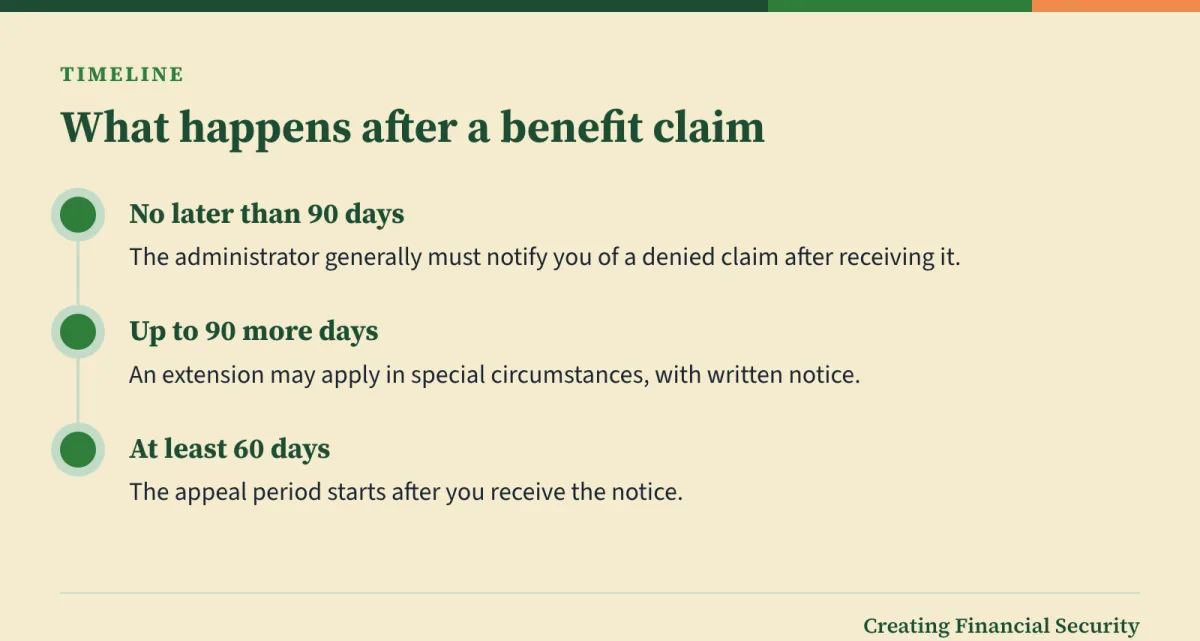
If a claim is wholly or partly denied, the administrator generally must notify you within a reasonable time, no later than 90 days after receiving it, unless special circumstances call for an extension of up to 90 more days with written notice. The notice must give the specific reasons and refer to the plan provisions used. For an appeal, the procedure must allow at least 60 days after you receive the notice, plus free access to relevant documents on request. These are the general timing rules; group health and disability plans have their own.
Get written confirmation before using the balance for bills
Once you have a vested figure, the next step is turning it into focused questions about access, timing and cost. These are worth putting to the administrator:

- Does the plan offer loans, and does it allow hardship distributions?
- Which vested contribution sources can each one use?
- What proof does the plan require? The IRS permits an employer to accept an employee's written statement about lacking other resources to meet the need, unless the employer has contrary knowledge.
- How long does processing take, and what fees apply?
- Is a spouse's consent required, if I'm married?
The IRS requires a loan-offering plan to spell out its application process and payment terms. Generally, the repayment period cannot exceed 5 years. Payments must include principal and interest, be substantially equal and occur at least quarterly. Borrowing to purchase a main home may allow a longer period. A plan can also require spousal consent from a married borrower. Ask for these terms before signing; failing to repay as required can make the loan taxable.
A message to send the plan administrator
A short note like this keeps the inquiry on ownership:
I'm checking my account before deciding whether to make any request. Please tell me my vested balance and the date it was calculated, with a breakdown by contribution source. Please also tell me which plan provisions and service dates were used to work out my vested percentage. Does the plan permit loans or hardship distributions, and from which vested sources? Please list any fees and the documents the plan requires. I'm not requesting a distribution or a loan at this time.
Keep a balance inquiry separate from a distribution request
Asking for a vested balance doesn't authorize a withdrawal or accept a loan. Say so in your message, and it helps to leave alone any form or button that starts a transaction until the written answer arrives.
The decision stays yours, made with the plan's paperwork in front of you.
Keep the old IRA out of the workplace-plan vesting check
An IRA is a personal savings plan, so the vesting schedules above belong to employer plans, not to it. The IRS says SEP and SIMPLE IRA plans, which employers sponsor, require every contribution to be 100% vested at all times. Which kind of IRA yours is, and what its access rules say, are questions for the custodian that holds it.

Access works differently. The IRS permits use or withdrawal of traditional IRA assets at any time, but generally imposes an additional tax of 10% before age 59½. Borrowing is not an IRA option: an owner's borrowing disqualifies the account, making its entire value includible in the owner's income. Using part of the IRA as collateral instead causes that pledged portion to count as a distribution. SIMPLE IRAs have additional distribution restrictions during the initial two years of participation.
Ownership does not settle the tax question
Ownership does not tell you the cost of taking money out. The IRS generally defers tax on traditional IRA money until a distribution. A workplace-plan hardship payout is generally taxable income, except for Roth contributions. A licensed tax professional can help apply the tax rules to an individual case.
The bottom line
The order matters. Start by locating the vested figure and the date it covers, using your annual benefits statement, the Summary Plan Description, your employer or human resources department, and the plan's website if it has one. Then check that figure against the vesting schedule and your service record. If something looks off, compare records from the same date and ask for the calculation in writing.
After that, ask what the plan allows. Owning money and being able to use it now are different questions, and an available amount isn't necessarily a take-home figure, so ask what taxes or other costs could apply. The old IRA runs on its own rules and has its own questions for the custodian.
Confirming ownership commits you to nothing. The plan administrator can answer questions about your plan, and a licensed professional can look at your own numbers before you authorize a withdrawal or accept a loan.
Questions readers ask
Does being fully vested mean I can withdraw the whole account today?
Can my vested balance go down?
Do I lose my own contributions if I leave my job?
Is the vested balance also the amount I can borrow?
Will paying a hospital bill make unvested money available?
What if the website and the plan administrator show different amounts?
Sources