

When a hospital bill and a repair bill land in the same month, the 401(k) can start to look like the nearest pile of money. Before anything gets requested, the first job is a quieter one: finding out what your plan actually allows.
The summary plan description, usually called the SPD, is the plan's own summary of how it works. Start with the current SPD and any later changes to it, then find the parts on taking money out, loans, fees and claims. You don't need to read every page in order.
Think of it as a map, not a test. You're collecting a few passages, a few unknowns and a few questions for the plan administrator.
Nothing here says whether you should take money out, borrow, or leave the account alone. That choice is yours, and a licensed professional can look at your own numbers.
This guide is part of our larger one on the rules for early 401(k) withdrawals.
Start with the current documents, not an old download
Plans change, and a copy saved from a website or found in a drawer may not show every change. The Department of Labor's disclosure rules include a separate provision for summaries of material modifications, which report changes to the plan and to what an SPD must contain. An SPD and its later updates are meant to be read together.
So the first question isn't what the old PDF says. It's which version applies today. An older publication date doesn't by itself mean the rules are out of date; it means there's something to confirm.
A practical order:
- Write down the plan's name and the date on your copy.
- Find the plan administrator's contact details. A plan's investment comparison chart may list the administrator or a person designated to provide investment information.
- Ask in writing for the current SPD and any summaries of changes made since the date on your copy.
- Ask which provisions would apply to a request made today. Keep a copy of what you send and the date you sent it.
Ask the plan administrator for the SPD and later changes
Several papers surround a 401(k), and they answer different questions.
- The SPD summarizes the plan's rules.
- A summary of material modifications reports later changes.
- A benefit statement reports information about your own account, and fees charged to it may be reported there.
- The full plan document: ask the administrator whether a provision there is relevant to your question and how it relates to the SPD.
If the SPD points to another document, ask for it by name. The Department of Labor's rules also have a section on charges for documents, so it's reasonable to ask whether copies cost anything.
How it works, step by step
- Ask the plan administrator in writing whether summaries of material modifications have been issued since the date on your copy of the SPD.
- Find the part of the SPD that describes the plan's claims procedures and time frames, and mark any reference to another document.
- Note any written statement the plan asks you to sign about other available resources, and read it closely before signing.
- Check the fee explanation for charges on individual accounts, such as loan processing, and ask where the amounts appear.
- If a request is denied, check the notice for the plan provisions it relies on.
Use your money question to find the right passage
You can start with a question and look for the words that answer it.

Try close cousins of each word, because plans don't all use the same labels. Taking money out might be called withdrawals, distributions, payments or hardship.
When a passage points to another document, mark it. It means the SPD isn't the whole answer.
Finding a heading isn't the same as being eligible, and the SPD describes the plan's rules; it can't see your personal tax situation.
Translate the terms that control access to your money
- Participant: a person covered by the plan.
- Vested account balance: the balance used in the IRS loan-limit calculation. Ask the administrator how much of your account counts.
- Distribution: money paid out of the plan. A loan that isn't repaid properly can be treated as one.
- In-service withdrawal: if this term appears, ask whether money is available while you still work for the employer and what restrictions apply.
- Hardship distribution: one kind of withdrawal. The IRS says a plan may offer it but doesn't have to.
- Plan administrator: the person or organization responsible for the plan's disclosures and for notifying you of claim decisions.
- Adverse benefit determination: the formal name for a denial.
| Your question | Search the SPD for | Follow up with |
|---|---|---|
| Can I take money out for a bill? | hardship, distribution, withdrawal | Plan administrator |
| Can I borrow from the plan? | loans, repayment, application | The plan's loan provisions |
| What charges might apply? | fees, charges, loan processing | Individual-fee disclosure |
| What if I miss loan payments? | default, deemed distribution, offset | Plan administrator, in writing |
| What if I'm turned down? | claims procedure, appeal, review | Denial notice and plan administrator |
Mark the conditions attached to taking money out
Once you find the distribution section, treat it like a checklist and highlight as you go.
- Eligibility. Who can take money out, and from which parts of the balance?
- Permitted reasons. Does the plan name situations, or follow a particular IRS list?
- Documentation. What proof or statements does it ask for?
- Limits. Is there a cap, and does it account for taxes?
- Application. Where are the forms, and who reviews them?
The IRS says hardship withdrawals are an optional plan feature. If offered, the employer must evaluate the participant's financial need under the plan's rules, considering the circumstances and whether the need meets the IRS standard of immediacy and severity.
The IRS also says the amount must stay within what the need requires, which can include money for taxes the distribution itself triggers. The employer may rely on your written statement that other resources can't meet the need, unless it knows otherwise. If your plan asks for one, read it closely before signing.
Look for conditions, exclusions and references to other documents
A heading that mentions hardship is not proof that a particular request qualifies. It tells you the plan may have a process, nothing more.
Read the passage under it for conditions. The IRS safe harbor includes medical expenses incurred for an employee or for that employee's spouse, dependents or beneficiary. Whether your plan uses that list, and whether a specific hospital bill fits, are questions for the administrator.
A car repair is a different case. The IRS describes rules permitting hardship money for repairs to a primary home without requiring eligibility for a casualty-loss deduction. That's about a home, not a vehicle, so the repair bill is better recorded as an open question than assumed to fit.
Separate plan permission from the tax question
The first question is whether the plan will pay money out; the administrator can explain how the plan applies to a request. The second is how the payment is taxed.
The IRS describes hardship payouts as taxable income, except for Roth contributions. An early payout can also trigger an additional 10% tax. The IRS also describes exceptions, including one for certain emergency personal expenses in distributions made after December 31, 2023, when its requirements are met.
Whether a given bill meets those requirements is a tax question, and plan approval wouldn't settle it either way. IRS Publication 575 explains how retirement plan distributions are taxed and points to Form 1099-R and Form 5329. A tax professional can look at your own return. For now, put the tax question in the unknown column of your worksheet.
If loans are mentioned, find the separate loan policy
Some SPDs mention loans in a line; others may point elsewhere. Either way, don't assume your plan offers them.
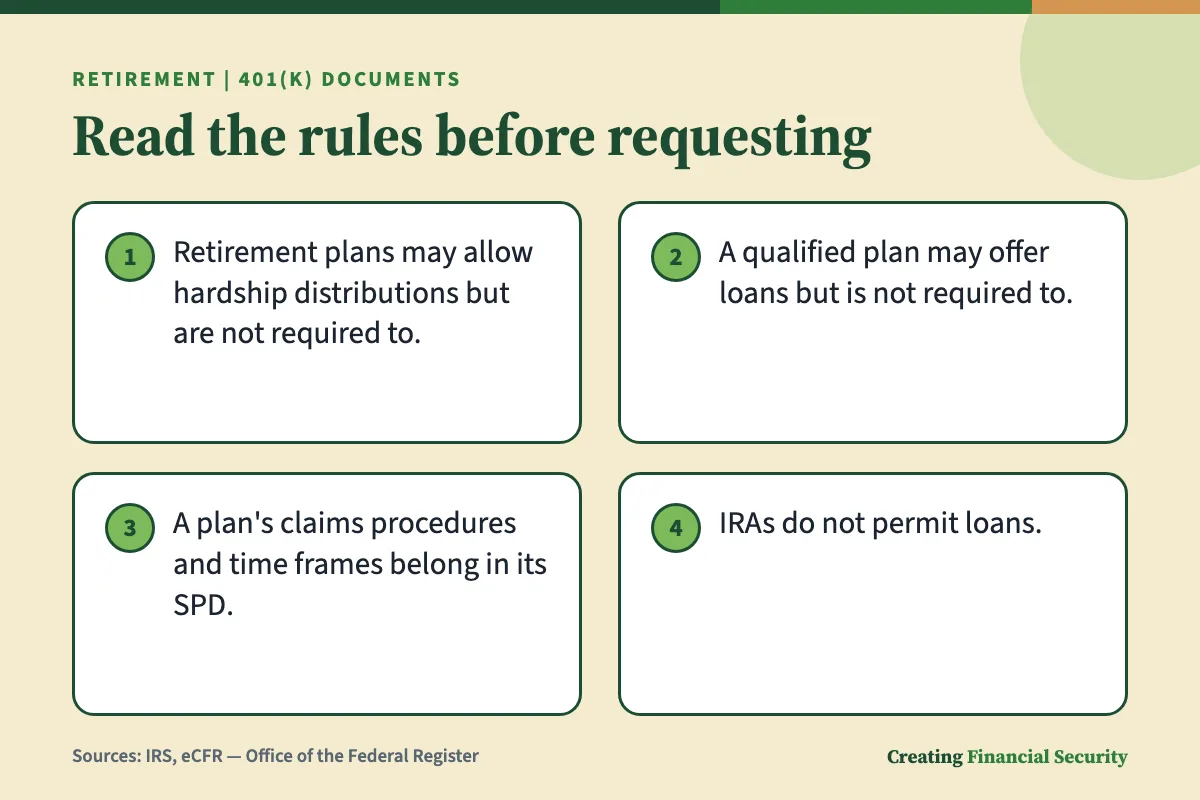
The IRS says a qualified plan may provide for loans but isn't required to. A plan that does must specify how to apply and the repayment terms, and it may set its own cap. The IRS describes the ceiling as the lesser of $50,000 or the greater of $10,000 and 50% of the vested account balance. Earlier loans can reduce what's available for a new one, so ask how your plan figures it.
Unlike hardship withdrawals, loans don't depend on the reason for borrowing, the IRS says, as long as the plan provides for them. A plan may also ask a married participant's spouse to consent.
The IRS says repayments generally need to finish within 5 years. Installments must be substantially equal, include both interest and principal, and come at least quarterly. A loan to purchase the employee's principal residence may have a longer repayment period. Also look for any loan processing fee.
All of this concerns the employer plan. It says nothing about your old IRA. The IRS prohibits loans from IRAs, including SEP-IRAs. Borrowing from one's own IRA ends its IRA status and makes its full value count toward the owner's income.
Record what changes if paychecks or employment stop
The loan section is also where to look for what happens when pay stops. The IRS says that, in general, a default can make the full unpaid loan balance taxable as a deemed distribution. Depending on the plan, a missed payment may not become one until the end of the next calendar quarter.
For military service, plans may pause repayments. They may also allow a repayment pause during other leave, lasting up to one year. After that leave, the missed installments must be caught up within the original loan term. A plan may also reduce your account balance by an unpaid loan, which the IRS calls a plan loan offset.
Ask the administrator how the plan handles an unpaid loan, including any deemed distribution or account offset and the possible tax consequences. Ask for the answer in writing.
Find the costs and timing the SPD leaves elsewhere
An SPD may not list every charge or say how long a request takes. Other documents often carry those details.
For plans where participants direct their own investments, Department of Labor rules call for an explanation of plan-wide administrative fees, such as legal, accounting and recordkeeping costs, and how they are spread across accounts. They also call for an explanation of charges that hit one participant's account rather than the whole plan; the rule's examples include fees for processing plan loans. This information may appear in the SPD or in a benefit statement.
The rules also call for a quarterly statement showing the dollar amount actually charged to your account for individual services, such as loan processing. When covered fee information changes, notice generally must arrive at least 30 days and no more than 90 days before the change, unless unforeseeable events or circumstances beyond the administrator's control prevent it.
Timing is different. The fee-disclosure rule sets no processing time for withdrawal or loan requests, so look in the application materials and ask in writing if there's no stated timeline.
Match each missing detail to a document or contact
No single paper holds every answer, so matching the gap to the likeliest source saves time.
- Permitted reasons and conditions: the SPD's distribution section, then the administrator.
- Account-specific charges: your benefit statement.
- Plan-wide and per-transaction fees: the fee disclosure.
- Loan terms: the SPD's loan section or a loan policy, if there is one.
- Processing steps and forms: the application materials.
- Tax treatment: the IRS or a licensed tax professional.
Know how to get a written answer or challenge a denial
The Department of Labor's claims rule says a plan's claims procedures and time frames are described in its SPD, so that is where to find your plan's version. It treats a claim as a request for a plan benefit made under the plan's reasonable filing procedure, and a plan can't require a fee as a condition of making a claim or appealing a denial.
The timelines below are general. Collectively bargained plans, certain board or committee reviews, group health plans and disability benefits follow different procedures, so check your SPD and any denial notice.
- Make the request the way the plan's procedure says. Keep copies.
- Watch the clock on a denial. The administrator generally must notify you within a reasonable time, no later than 90 days after the plan receives the claim, unless special circumstances call for more time. A written extension notice must arrive before the 90 days end, and the extension can't exceed 90 more days.
- Read the denial notice. It must give the specific reasons, point to the plan provisions relied on, describe any further material needed, and explain the review steps and time limits.
- Appeal within the window. The procedure must give you at least 60 days after you receive the notice, plus a chance to submit written comments and documents.
- Ask for the file. On request and free of charge, you can get reasonable access to documents and records relevant to your claim, and copies.
- Expect a decision on review. Generally the plan must answer within 60 days of your review request, with up to 60 more days if special circumstances apply and you get written notice.
When documents conflict, ask which provision applies
Sometimes an old summary says one thing, a website estimate another, and a phone representative a third. None settles the question alone.
A denial notice must refer to the specific plan provisions behind it. When sources seem to conflict, ask the administrator in writing which provision applies to your request and which document it comes from, including that document's date. A written reply gives you something to compare with the SPD and to show a licensed professional. A verbal explanation can be a useful lead; just ask for it in writing.
Build a short worksheet before requesting money
A separate worksheet for each bill can organize the relevant passages and unanswered questions.
For the hospital bill, the worksheet might show that medical care appears among the IRS's safe harbor categories while your plan's own wording is still unconfirmed. For the repair bill, it might show nothing, which is useful to know. Neither goes down as qualifying until the administrator says what the plan permits.
A good worksheet includes:
- The name and date of each document, and whether it's current.
- The passage on taking money out, with page or section.
- The conditions and proof the plan asks for.
- Any loan terms and fees named, and where the amounts would appear.
- The tax question the SPD can't answer, plus the administrator's contact details and the date you asked each question.
Capture the passage, the unknown and the question
For each item, write what the document says, what it doesn't say, and the one question you'll ask. For example: the plan says hardship withdrawals are allowed in some circumstances; it doesn't say whether the hospital bill counts; ask whether that bill type is permitted and what proof is wanted.
The bottom line
A 401(k) summary plan description isn't a test. It's a map to the rules that decide whether retirement money is available, what asking for it involves, and what happens if the answer is no. Start with the current version and any later changes, then follow your own questions to the distribution, loan, fee and claims sections.
A hardship heading isn't proof that a hospital bill or a car repair qualifies. Plan permission, tax treatment and the choice to use retirement money are separate things, and the SPD speaks mainly to the first. Questions about your own taxes belong with the IRS or a licensed professional.
If the paperwork leaves gaps, write them down and ask the plan administrator in writing. Understanding the current rules comes before authorizing anything, and having done that reading is a steadier place to decide from.
Questions readers ask
Is the SPD the same as my account statement?
What if the SPD on the website is several years old?
Does a hardship section mean my hospital or repair bill qualifies?
Can this SPD explain whether I can borrow from my old IRA?
What if I cannot get the document or understand the answer?
Sources
- IRS: Publication 575, Pension and Annuity Income
- eCFR — Office of the Federal Register: 29 CFR Part 2520 -- Rules and Regulations for Reporting and Disclosure
- IRS: Retirement topics - Hardship distributions
- IRS: Retirement plans FAQs regarding loans
- eCFR — Office of the Federal Register: 29 CFR 2550.404a-5 -- Fiduciary requirements for disclosure in participant-directed individual account plans
- eCFR — Office of the Federal Register: 29 CFR 2560.503-1 -- Claims procedure