

When a hospital bill and a car repair land in the same month, the 401(k) statement in the drawer can start to look like an answer. Before filling anything out, ask your employer or plan administrator to confirm the request process, the correct contact and which kinds of payments the plan permits.
Ask about eligibility, required information, withholding choices and processing stages before choosing a form. Plan permission and federal tax treatment are separate questions.
This guide is part of our larger one on requesting retirement money before retirement age.
Start with the plan contact—not an IRS application
Ask your employer or plan administrator who receives distribution requests and how to submit one. Confirm the correct form or online channel before entering personal information.
The plan's summary plan description is a good document to ask for. The Labor Department's claims rule says a plan's claims procedures and their time frames are described there for plans the rule covers. Check any account statement or participant website you already use for contact details, and confirm them with your employer if anything is unclear.
If you can't find any of these, a call to the human resources or benefits office is a fair first move. You aren't asking for the money yet. You're asking how the process works.
Find the person who can explain your plan's process
Ask who does what: can the benefits office answer the question, should it go to the plan administrator, or is another company handling records? Request the correct contact rather than guessing.
If another company handles records, ask the administrator how to reach it. Then write down which organization receives your request and who to call if it stalls.
Use this short opening message
A short script keeps the first contact focused. Here is one you can adapt:
Hello, I'm a current employee with an account in the company 401(k) plan. I have a hospital bill and a car repair, and I'm trying to understand what my plan allows. Which kinds of distributions or loans does the plan offer to someone who is still working? Is there a form or a portal for each? What documents do you need from me, and what are the stages between submitting and getting paid? Could you send the answers in writing or point me to the page in the plan document?
Note the name of the person who answers, the date and any reference number. If the answer comes by phone, ask for a written follow-up.
How it works, step by step
- Ask your employer or plan administrator how the plan accepts distribution requests and which categories it offers to a current employee.
- Describe the hospital bill and the car repair separately and ask how the plan decides whether each need qualifies.
- Ask which withholding election applies and whether the requested amount is gross or net of withholding.
- For a covered benefit-claim denial, request the notice explaining the reasons and review process.
Ask which request category fits before filling anything out
Needing money is not the same as qualifying for a particular kind of payout. Before you complete a form, ask which categories your plan offers to someone who is still employed. The main ones to ask about:
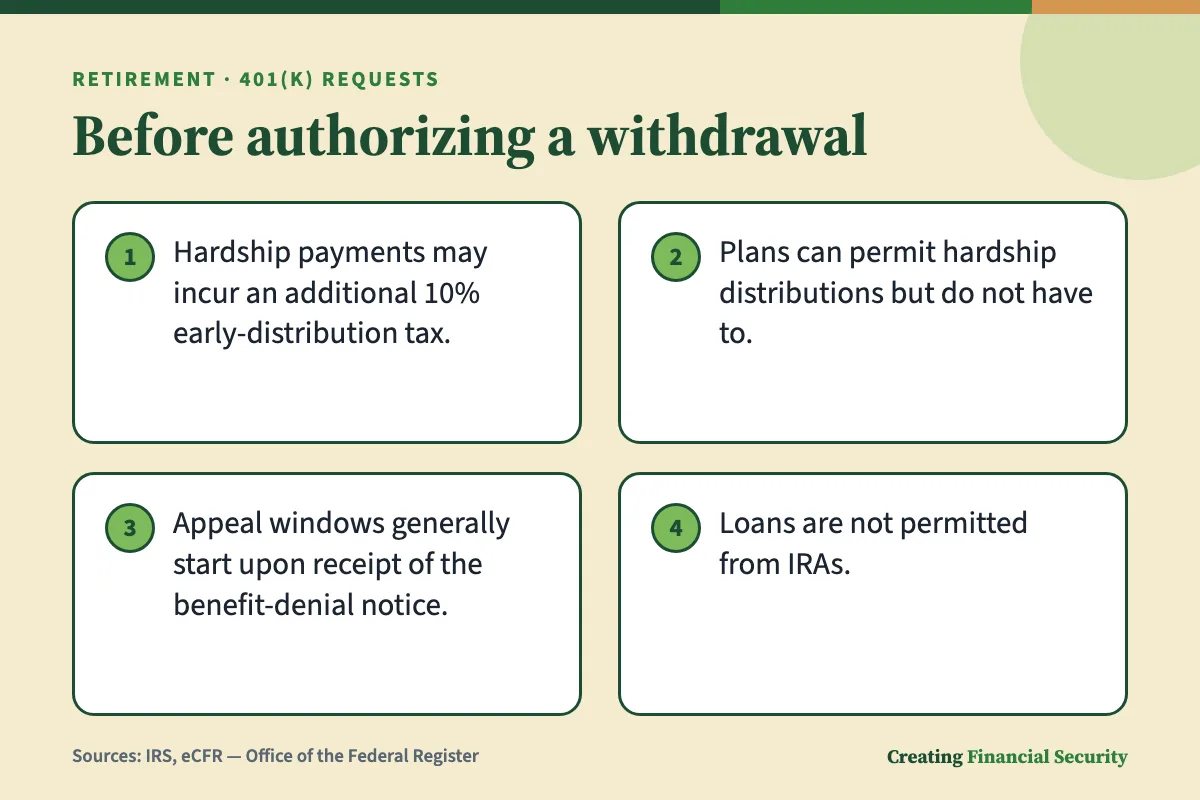
- A hardship distribution. The IRS says a plan can permit these but isn't obliged to.
- A plan loan. A qualified plan may offer loans, or not, and the IRS says loans aren't tied to hardship.
- Any other payout for current employees. The plan document controls, so ask the administrator directly.
For a hardship distribution, the employer looks at the plan's terms and the facts of your situation to decide whether you have an immediate and heavy financial need. A loan works differently. A plan that offers loans has to spell out how to apply and what the repayment terms are, so read those closely before you sign.
The IRS also says a loan that isn't repaid as agreed is generally treated as a taxable payout of the balance still owed. That is one reason the repayment schedule matters as much as the amount.
Describe the hospital bill and car repair separately
Two expenses can get two different answers, so describe them one at a time. IRS guidance lists medical care expenses for the employee, a spouse, dependents or a beneficiary among the needs it treats as automatically immediate and heavy. The same list names certain home-purchase costs, tuition, preventing eviction or foreclosure, and funeral expenses.
A car repair isn't on that list. That doesn't settle the question by itself, because the employer decides using the plan terms and the facts. It does mean the two bills may be treated differently, and neither one establishes eligibility alone. The IRS adds that everyday consumer purchases generally don't count.
Ask the administrator how the plan wants each expense described and totaled. The IRS says the payout can't exceed what the need actually requires.
Confirm which account and employment status the form uses
Confirm the account named on the paperwork. Is it the current employer's 401(k), a former employer's plan or an IRA? Ask whether the form applies to that account and your employment status.
Tell the administrator that you still work for the employer and ask which options apply. For tax purposes, the IRS treats designated Roth account payouts separately from other payments under the plan. Ask which money source the request draws from.
One point about the old IRA: the IRS says loans aren't permitted from IRAs, and an IRA owner who borrows from one turns it into something that is no longer an IRA, with the whole value counted as income.
Gather the information your application may need
Use these questions to build a checklist with the plan contact. Ask which identity, account, expense, payment and tax details the request requires:

- Identity. Your name and whatever the plan uses to match you to the account.
- Account. The plan name and, if it holds several money sources, which one the request draws from.
- Request type. The distribution or loan category you confirmed with the plan.
- Amount. The figure you're asking for, and whether the plan wants it before or after withholding.
- Expense details. A description of each expense, if the plan asks for one.
- Payment. Where the money should go, as the plan allows.
- Tax election. A withholding choice, which the form may word in its own way.
To keep the call short, ask one plain question: which of these items go in with the request, and which are just for my own file?
Separate submission requirements from records to keep
Some plans may not ask for every bill. IRS guidance says that, unless the employer knows otherwise, it can accept the employee's written statement that other resources can't cover the need. The IRS also says 401(k) plans may choose a streamlined method, called summary substantiation, for the six hardship types it lists.
That is a permission, not a rule every plan follows. Ask what yours does. Whatever the plan requires at submission, it is sensible to keep your confirmation, the payment statement and your tax documents, plus any expense records the plan asks you to retain.
Send sensitive documents only through verified channels
The IRS urges people to protect financial and personal information, including account credentials and Social Security numbers. As practical precautions when handling retirement paperwork:
- Type the plan's web address from a statement or plan document instead of following a link in a message.
- Look up the phone number on paperwork you already have, then call that number.
- Ask the administrator which upload or mailing method the plan accepts.
- Ask whether a bill total will do, so you don't send more medical detail than needed.
- Be wary of anyone who contacts you first and offers to speed things along.
Read the amount, withholding and payment choices carefully
Before signing, locate the requested amount, withholding election, payment method and any disclosed fee. Ask how each affects the payment and the records the plan will provide.
Ask whether the amount entered is before or after withholding
The amount distributed and the payment received may differ because of withholding. Federal withholding rules apply to retirement payments, but the available election depends on the payment and applicable rules; a no-withholding choice can sometimes be available. Ask whether any fee also affects the payment.
Three plain questions help. Is the number I enter the gross amount or the amount I'll receive? Does withholding come out of it? Are there fees, and will I see them before I authorize? The plan's answers let you see what will arrive without making your own estimate.
The IRS notes that one of its automatic-qualification tests counts the amount needed to cover taxes caused by the payout, so ask how your plan treats that piece.
Check the tax election for this distribution type
The IRS lists Form W-4R for withholding on certain retirement payments. Ask the plan which withholding choices and tax notice apply to your request.
The type of payment can change the rules. For example, the IRS says a deemed distribution from a defaulted loan can't be rolled over, while a plan loan offset can be eligible. When you see a tax election, ask which distribution type it covers and what the plan's notice says about rollovers.
Keep plan approval separate from tax treatment
Two questions often get blended. One is whether the plan will pay. The other is how the IRS treats the payment.
The IRS says hardship distributions are taxed as income, except to the extent they are Roth contributions, and a 10% additional tax on early distributions can also apply. A plan's approval doesn't tell you whether an exception to that extra tax fits, and the amount withheld isn't necessarily your final bill. IRS guidance covers the exceptions, and a licensed tax professional can help with your situation.
Review the request before authorizing payment
Before you press submit or sign, read the whole request once from top to bottom. Here is one order to follow:

- Account. Confirm the plan and money source named on the form are the ones you meant.
- Category. Check that the request type matches what the administrator said is available.
- Amount. Note whether the number is gross or net, and that it fits the need.
- Elections. Read the withholding choices and the tax notice that comes with them.
- Delivery. Check the account number or mailing address character by character.
- Disclosures. Read any fee, repayment term or statement you're certifying.
- Copy. Save or print what you're submitting.
Pause on fields or certifications you cannot confirm
If you're asked to certify something you aren't sure about, such as whether other resources could cover the need, stop and ask. The administrator can explain what a field means and what the plan accepts. Ask for clarification before signing a statement you cannot confirm.
Ask what can still be changed after submission
Ask the plan whether a submitted request can be changed or canceled, and up to what point. Request the applicable procedure in writing. Ask who to contact and how the plan will confirm a change in writing.
Don't assume a payment can be stopped once it has been released. If something needs to change, contact the plan promptly and keep a record of the response.
Track the request from submission to payment
Submitting a form is one event and getting paid is another, with steps in between. Saving evidence at each stage makes the process easier to follow and easier to fix.

Right after you submit, save the confirmation page or message and note the date. Then ask the plan what the next step is and how it will tell you the request is complete. If you're working with someone by phone, ask for a name and a reference number.
Ask for a current processing estimate in writing and whether it covers review, approval or payment delivery. Treat an estimate as an estimate, not a promised arrival date.
Ask when processing actually starts
Submitting a form, having a complete request, getting approval and having the payment released can all be different moments. Ask which of those the plan counts as the start of processing.
For benefit claims covered by the Labor Department's rule, the decision period starts when the claim is filed through the plan's reasonable claims process, even if information is missing. Ask whether your submission is such a claim. That decision period is not a deadline for receiving payment.
Keep a simple contact and status log
A one-page log keeps the story straight if you have to call back. It's worth noting:
- The date you submitted and how you submitted it.
- The confirmation or reference number.
- Each call or message: the date, who you spoke to and what they said.
- Any item the plan says is missing, and the date you sent it.
- Any follow-up the plan promised, with the date it was due.
- The date the payment was released and the amount you received.
Resolve missing information and keep the final records
If the plan says information is missing, ask what to send, how to send it and whether sending it changes the timing. Record the answer in your log.
If a benefit claim is denied, ask whether ERISA's claims rules cover the plan and submission. The Labor Department's rule provides notice and review protections for covered claims, with special provisions for certain collectively bargained plans.
If the request is delayed or denied
For a covered benefit claim subject to the general notice requirements, the administrator must provide a denial in writing or electronically. The notice has to state the specific reasons, point to the plan provisions relied on, describe any extra material needed and why, and explain the plan's review steps and time limits.
The general appeal rule allows at least 60 days from receipt of the denial notice to seek review. It also lets you submit written comments and documents and ask for free copies of records relevant to your claim. Special provisions can apply to certain collectively bargained plans, so ask how the appeal works for yours.
None of this promises approval. It does mean you can ask in writing for the reason and for the way to have the decision reviewed.
Save the payment statement for tax time
Form 1099-R reports retirement distributions and certain other payments. If an error leads to a corrected form, the IRS says to use the correction rather than the original figures.
Compare Form 1099-R with the payment statement, including the distribution and withholding figures, and use your log to check the payment record. Do not expect a reported distribution to equal the net payment after withholding. Ask the plan about unexplained differences. Form 5329 concerns certain additional retirement-account taxes, not an application for payment. Check the IRS instructions to determine whether that tax form applies.
The bottom line
Ask your employer or plan administrator to confirm how to request an early 401(k) distribution and which categories the plan permits. Before filling out paperwork, establish the correct contact, submission channel and required information. Needing money does not by itself establish eligibility.
Before authorizing payment, check the account, amount, withholding election, delivery details and any disclosed fee. Keep the confirmation and payment statement so that later tax documents can be checked against those records. If a covered benefit claim is denied, ask for the reasons and applicable review instructions.
Approval does not settle the tax question: hardship payments generally face income tax except for Roth contributions, and an additional 10% tax may apply. A licensed tax professional can help assess the consequences for an individual situation.
Questions readers ask
Can I submit a withdrawal request online?
Can I apply while I still work for the employer?
How long will it take to receive the money?
Does my employer's approval mean I avoid the early-distribution tax?
Can I cancel after submitting the application?
Do I file Form 5329 to ask for the withdrawal?
Sources