



When a hospital bill and a car repair land in the same month, money set aside for one thing suddenly has to cover two. A credit card hardship letter is a short written request asking your card company for temporary help, such as a lower payment, a lower interest rate or waived fees.
The letter says what happened, what you can pay, what you are asking for and for how long. Keep it to one page and keep a copy. Whether the company agrees is its decision, and nothing here promises it will.
This guide shows how to write a credit card hardship letter step by step: the number to work out first, what goes in each part, what to leave out and what to do after you send it. It also explains, using what the IRS says, why the 401(k) and old IRA are the costly last stop.
This guide is part of our larger one on requesting manageable credit card payments.
What a hardship letter is, and what it can ask for
A hardship letter is a written request for temporary help while money is tight. There is no standard form. It is a plain note saying that a hospital bill and a major car repair hit at once, and asking whether the company has anything that could ease the next few months.
Relief is the company's choice, not a right. Which options a particular card company offers is up to that company, so the letter is a way to ask. Extension educators say creditors are usually open to working with people who reach out before they fall behind. That is a good reason to write early.
These are common things to ask about. Treat each as a question, not a promise:
- A lower monthly payment for a set period
- A lower interest rate
- Waived late fees or other fees
- A written plan that spells out the new terms
You can ask about one or several. A specific ask gives the company more to work with than a general plea, and a specific ask needs a number behind it. The letter is a calm request, not a confession, so you can stop at the facts.
How it works, step by step
- Add up essential monthly costs, subtract other required payments, and keep a small buffer to find the payment you can offer.
- Write a short letter telling the company how much you can pay and when, and what help you are asking for.
- Ask the hospital about its financial assistance policy, which tax-exempt hospitals must have in writing.
- Request your free credit reports from the official site to see what is listed.
Before you write: what can you actually pay each month?
The most useful sentence in a hardship letter names a monthly payment you can really make. Extension educators suggest looking at your situation first and deciding how much you can pay each creditor and when. They say food, housing, utilities, transportation and medical care usually come first.
Start with the essentials: rent or mortgage, groceries, utilities and whatever it takes to get to work. Extension educators note that if you need a vehicle to keep or find a job, the vehicle payment may be a priority. Add any monthly bill from the repair shop or the hospital.
Next, subtract other required payments, such as minimums on other accounts, and leave a small cushion so one surprise doesn't undo the plan. What remains is the most you could offer. The made-up budget example on this page walks through that with invented numbers.
Extension educators also caution against leaning on more borrowing to cover bills, because unless things improve quickly it can leave you further behind. They add that paying only the minimum adds to finance charges and lengthens the payoff, so a lower payment is worth weighing against its effect on the total.
If the number that comes out is smaller than the card's minimum, that is useful to know. It is the honest figure to bring to the company, or to a nonprofit credit counselor who can look at your own numbers.
Why a lower rate can matter more than a lower payment
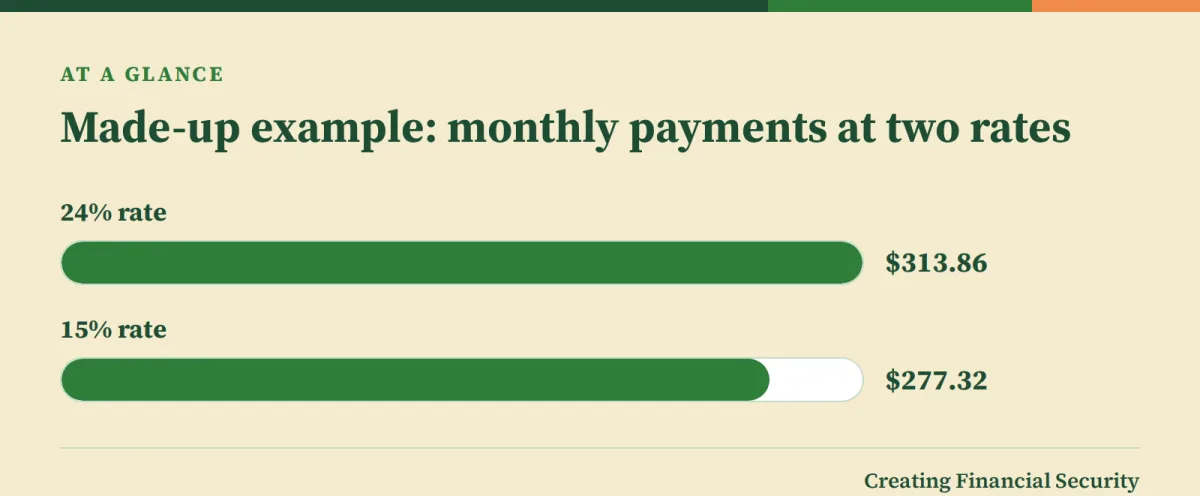
A smaller payment feels like relief right away, but the interest rate decides how much the balance costs over time. This table shows a made-up balance at two rates.
| Interest rate | Monthly payment | Total interest |
|---|---|---|
| 24% | $313.86 | $3,299.06 |
| 15% | $277.32 | $1,983.61 |
Fixed rate, equal monthly payments of principal and interest; taxes, insurance and fees are not included. These figures assume a fixed rate and equal monthly payments of principal and interest, with no fees.
In the made-up example, the payment at 24% is $313.86 a month and the total interest is $3,299.06. At 15%, the payment is $277.32 and the total interest is $1,983.61. The lower rate trims the payment a little and the interest paid much more.
That is why a letter can ask about the rate as well as the payment. If a company offers only a smaller payment at the same rate, it is fair to ask how long the balance would take to pay off at that payment, since a smaller payment stretches the repayment out.
The parts of a hardship letter, one at a time
A hardship letter has six small parts. Each can be a sentence or two.
- What happened. Name the event in plain words: a hospital bill and a major car repair came due in the same month. State it as a fact, with no apology.
- What changed. Say how it affects your money: costs went up, you are paying part of it yourself, and your budget no longer covers the card's current payment.
- What you can pay. Give the monthly figure from your budget. Extension educators suggest telling each creditor how much you can pay and when, and this is that sentence.
- What you are asking for. Name the specific help: a lower payment, a lower rate or waived fees, whichever applies.
- For how long. Offer a time frame, such as a number of months, and say you will be in touch if your situation changes.
- How to reach you. Give a phone number and the best times to call, and ask the company to confirm any agreement in writing.
Things to leave out are just as useful. Skip blame, long backstories and details about other creditors. A reference line with just the last few digits of the account number can identify the account without writing it all out. Keep the tone steady and polite.
How much to say about the medical bill
Say enough to explain, and no more. One plain sentence saying you had an unexpected hospital bill is usually enough. A diagnosis, treatment details or doctors' names aren't needed to explain why a bill is hard to pay.
If the company asks for proof, you can decide then what to send. You can ask what documents it accepts, and keep a copy of anything you send. Offering to provide documents if the company asks shows good faith without sending them up front.
A sample letter you can adapt
Here is a fill-in-the-blank model. Everything in brackets is yours to fill in with your own figures. It shows structure only and does not promise any result.
[Your name] [Your address] [Phone number and best times to call] [Date]
[Card company name] [Address or secure-message location shown on your statement]
Re: Request for hardship assistance, account ending in [last four digits]
Dear [Card company] Customer Care:
I am writing to ask for temporary help with my account. In [month], I had an unexpected hospital bill and a major car repair in the same month. These costs have reduced what I have for my other bills, and I want to keep this account in good standing.
After my essential expenses, I can pay [your monthly amount] a month toward this account. I am asking whether you can lower my monthly payment to that amount, lower my interest rate, and waive [late fees or other fees] for [number] months. If you have other hardship programs, please tell me about them.
I will gladly provide documents if you ask. Please send your decision and any new terms to me in writing, and tell me how the account will be reported to the credit bureaus during the program. You can reach me at [phone number].
Thank you for your time.
[Your name]
One page and three short paragraphs is plenty. Stay calm and factual, and leave out anger, threats and medical detail. Ask only for what your budget supports, because a plan you can't keep makes things harder.
Sending it and following up
Look on the statement or the company's website for where hardship requests go: a mailing address or a secure message option. Then work through these steps.
- Send it the way the statement says, and keep a copy. Save the letter and any confirmation you receive.
- Keep paying what you can in the meantime. Extension educators say minimum payments keep card accounts current and avoid negative marks on your credit report. Late and missed payments are recorded on your credit record, and paying something on each debt as agreed makes it less likely your troubles will be reported.
- Pick a follow-up date. Choose a date that fits your own planning, call if you haven't heard back, and write down the date, the person's name and what was said.
- Get the terms in writing. Before relying on anything promised by phone, ask for the payment amount, rate, fees, length of the plan and what will be reported.
Extension educators point to both phone and letter as ways to reach creditors. A letter leaves a record and a call can be faster, so you can use both and keep notes.
If the answer is no or only part of what you asked
A no is not always the end. You can ask what other programs exist, whether another review is possible, and what would change the answer. A partial yes can be compared with the table above: ask whether the offer lowers the rate or only the payment, and how it changes the length of repayment.
Extension educators say a nonprofit consumer credit counseling service can help when card debt is hard to pay. A licensed professional or a nonprofit counselor can look at your own numbers, which no general guide can do.
What a hardship plan can do to your credit
A hardship plan may come with changes to the account, so these are fair questions to put to the company before accepting one:
- How will the account be reported to the credit bureaus while the plan is active?
- Will the account be closed, or will the credit limit be lowered?
- Will new charges be blocked?
- What happens to the rate and payment when the plan ends?
The stakes of missing payments are real. Extension educators say late and missed payments are recorded on your credit record, which can hurt your ability to get credit or make it cost more. A written plan you can keep is worth comparing with an informal promise.
It also helps to see what is on your reports. By law, free reports are available each year from the three credit reporting agencies, and AnnualCreditReport.com is the only site the federal government authorizes for them. In most cases the report will not include your credit score. Reading your reports shows which accounts and debts are listed, and whether anything looks wrong.
Check the hospital bill before the card
The bill that started this may have more flexibility than the card. The IRS requires tax-exempt hospital organizations, under Section 501(r)(4), to have a written financial assistance policy for each hospital facility they operate. Whether your hospital is covered is a question for its billing office.

Under IRS rules, the policy must spell out who qualifies, whether help is free or discounted, and how to apply. It must also say that once someone is found eligible, they may not be charged more than Amounts Generally Billed for emergency or medically necessary care. The IRS also says help may not be denied over missing paperwork the policy did not specifically require.
Here is what you can ask the hospital:
- For an itemized bill, so you can see each charge
- Whether it has a financial assistance policy, and for the application
- Whether it offers a payment plan
- What happens to the account while an application is being reviewed
- What actions it may take if the bill goes unpaid, which its billing and collections policy describes
Moving the hospital bill onto a card turns it into debt that carries a rate. Extension educators describe added borrowing as generally unwise unless the situation turns around quickly. Your free credit reports and the hospital billing office are the places to see how your bill is being handled.
Why 401(k) and IRA money should be the last stop
Pulling from retirement savings can feel like the quickest fix. The IRS describes it as one of the costlier ones.
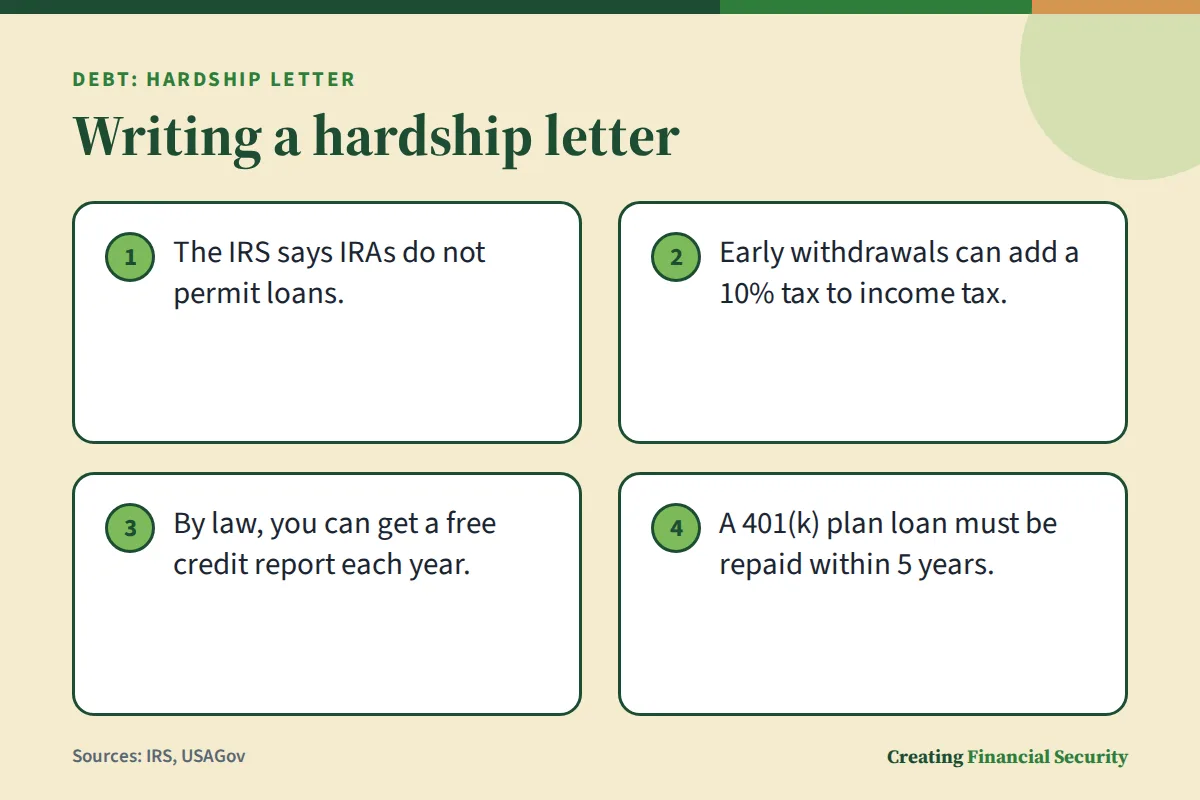
For most retirement plan distributions, the IRS says, income tax applies and an additional 10% tax may apply. Amounts taken before age 59½ are called early distributions, and the 10% additional tax applies unless an exception fits. For a SIMPLE IRA in its first 2 years of participation, the additional tax is 25%.
The IRS says IRA owners can take money out at any time without showing hardship, but it lists no early-withdrawal tax exception just for hardship. Its exception chart does include unreimbursed medical expenses that are more than 7.5% of adjusted gross income. Whether that applies depends on a tax return, so a tax professional can help with your own case.
| Amount | |
|---|---|
| Withdrawal | $10,000 |
| Federal income tax (22%) | $2,200 |
| Additional tax (10%) | $1,000 |
| Left after these taxes | $6,800 |
The whole withdrawal is taxed at a 22% federal rate and no exception to the 10% additional tax applies; state tax is not included. These figures assume the whole withdrawal is taxed at a 22% federal rate and no exception to the 10% additional tax applies. State tax is not included. In the made-up example, a $10,000 withdrawal has $2,200 in federal income tax and $1,000 in additional tax, leaving $6,800.
Borrowing from an IRA, and the 60-day rule
The IRS says IRAs do not permit loans. If an owner borrows from an IRA, it stops being an IRA and its whole value is included in income. Pledging part of it as collateral treats that part as distributed.
The IRS chart treats money moved into another retirement account within 60 days as an exception to the 10% additional tax. That is a rule about moving money from one account to another, not about borrowing it.
What the IRS says about 401(k) loans
A qualified plan may offer loans but is not required to. If it does, the IRS says the plan can cap a loan at $50,000, or at half the vested balance with $10,000 as a floor, whichever comes out lower. Loans are not tied to hardship. Repayment is due within 5 years, in substantially equal payments made at least quarterly.
A loan in default is generally treated as a taxable distribution of the whole unpaid balance. The IRS says a deemed distribution counts as an actual one for tax purposes, including any early distribution tax. Your plan administrator can say whether loans are offered and on what terms.
The bottom line
A hardship letter is a short, calm request, not a confession. Work out what you can pay each month after essentials, then ask for something specific: a lower payment, a lower rate or waived fees. Say what happened in a sentence and leave out medical detail. Ask for the answer in writing, along with what will be reported to the credit bureaus.
Before the card, check the hospital's financial assistance and payment plan options. Keep retirement money for last: early withdrawals can bring tax costs, and the plan administrator can say whether a 401(k) loan is offered at all.
The company decides whether to help, and no letter can promise it. If the answer is no, a nonprofit credit counselor or a licensed professional can look at your own numbers and options.
Related guides
Questions readers ask
Will a hardship letter hurt my credit score?
Do I need to attach proof of the hospital bill?
Should I write a letter or call?
How long should a hardship letter be?
Can I borrow from my IRA instead?
What if the card company says no?
Sources
- IRS: The 10% additional tax before age 59½ and the exception chart distinguishing qualified plans and IRAs
- IRS: Retirement plans FAQs regarding loans
- IRS: Financial assistance policy and emergency medical care policy – Section 501(r)(4)
- USAGov: Learn about your credit report and how to get a copy
- University of Minnesota Extension: Deciding which bills to pay first
- IRS: Retirement plans FAQs regarding IRAs: distributions (withdrawals)