



If a hospital bill and a car repair landed in the same month, the credit card you reached for may now hold more than your paycheck can comfortably carry. You can call the card issuer and ask what payment arrangements it offers. Whether it agrees is the issuer's decision, and the answer can be no.
That call is not the same as settling for less than you owe. Asking about interest, fees or a revised payment is about the terms of paying. A settlement is about the balance itself, and it can raise credit and tax questions a simple payment change may not.
Start with payment relief, not a promise to settle
Three things sound alike on the phone but work differently.
- Payment relief changes how you pay while the balance is still owed. You can ask about interest, fees, due dates or the payment amount.
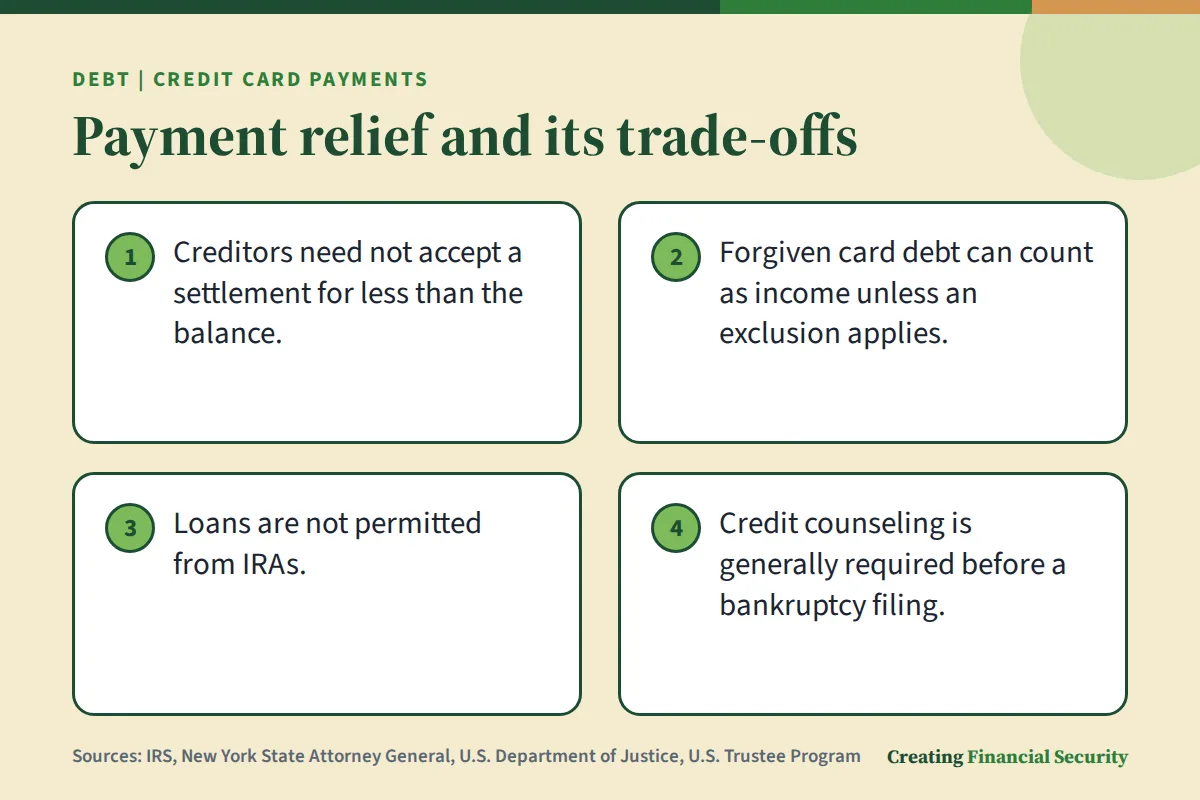
- A settlement means the creditor accepts less than the full balance. The New York State Attorney General says creditors have no legal obligation to take that kind of offer.
- Outside help can mean nonprofit credit counseling or a for-profit settlement service. Help with repayment is different from seeking forgiveness.
When a medical bill and a repair bill arrive together, the practical question is usually how to keep paying without sliding further behind. The New York Attorney General suggests talking to the card issuer or other creditor yourself before bringing in a third party. Treat these as questions, not promises that a particular change is available.
How it works, step by step
- Start by speaking directly with the card issuer or other creditor about the account before involving outside companies.
- Request your free credit reports from the one website the federal government authorizes for them.
- If you are served with court papers, respond to them even if you are unsure you owe anything.
Prepare a payment proposal that leaves room for essential bills
A proposal only helps if you can keep it. An arrangement that falls apart next month can add a missed payment to the original problem. So preparation is mostly about knowing what you can pay once the basics are covered.

Gather these before you call:
- Statement details. The balance, interest rate, minimum payment, due date and any fees listed.
- Income. What actually arrives each month. If your hours vary, picture a typical month and a slow one.
- Essential bills. Housing, utilities, food, transportation and insurance. The repair may belong here.
- The hospital bill. Note what's owed and whether a payment plan has come up there too, since it draws on the same dollars.
- A monthly amount you can name. One you could keep paying through a tight month.
Writing these down lets you answer calmly instead of guessing.
Your credit reports can help too. Federal law provides access to a free report each year from each of the three credit bureaus through a federally authorized request service. USAGov notes that a report usually doesn't include your credit score. If you find an error, check the CFPB's current guidance on disputing credit report information.
Describe the hardship without sharing more than necessary
You can describe the situation briefly and ask what information the issuer needs. A short, factual summary usually covers the basics: two large unexpected bills in one month, a gap between income and expenses, and what you expect going forward.
Note whether the shortfall seems temporary or ongoing and when, if known, income and expenses might become steadier.
If the issuer requests income or expense information, ask what is needed to review the request and how to submit it.
Read next: calculating an affordable card payment.
| Route | What the sources say | Watch for |
|---|---|---|
| Direct contact with the issuer | Suggested starting point | Discuss the outstanding account before involving a settlement service |
| Nonprofit counseling | New York guidance points to licensed agencies | Assistance is generally free or low-cost |
| Debt settlement company | For-profit firms that say they can win settlements for a fraction of the debt | Results and fees can disappoint |
| Settlement plan that stops payments | Creditors may step up collection | Judgments, wage garnishment and frozen accounts are possible |
| Bankruptcy-related counseling | Generally required before an individual files | A case could be dismissed if the course is skipped |
Use a short call script to ask for specific changes
For direct contact, use the issuer's contact information on the card or account statement.
Use these conversation prompts in your own words:
- Open with the situation. Briefly explain the unexpected bills and ask whether hardship assistance is available.
- Explain the shortfall. Describe whether it appears temporary or ongoing and name a payment that fits after essential expenses.
- Ask about interest. Find out whether a reduced rate is possible and when it would end.
- Ask about fees. Ask whether any charges could be waived or reduced.
- Ask about the payment. Request the amount and first due date of any smaller or delayed payment option.
- Ask about the account. Find out whether use of the card would be restricted or the account closed.
- Ask for written terms. Request the complete offer to review before deciding.
Note the date, the time and the representative's name or ID. If an answer is unclear, ask again in different words, and say so if you need time to decide.
Ask what changes now and what happens when relief ends
The next payment is only one piece. Before the call ends, ask about the rest:
- Interest: Does it keep adding during the arrangement, and what rate applies afterward?
- Fees: Are late fees stopped, reduced or only delayed? Will new ones be added?
- Payment amount: What is it, and when is the first one due?
- Duration: How long does the arrangement run, and what happens on its last day?
- Account access: Can you keep using the card, and will the limit change?
- Reporting: How will the arrangement appear with the credit bureaus?
- A missed payment: If one payment is late or short, does the arrangement end?
Compare offers by their full terms, not just the next payment
A smaller payment can feel like relief, but the full terms decide what an arrangement costs. Ask the issuer how the payment schedule, interest rate and fees affect the total cost. Not every issuer offers every kind of change, so ask about each by name rather than assuming.
- A lower interest rate: ask how long it lasts and what rate applies afterward.
- Fee relief: ask how the change affects your balance and required payment.
- A smaller or postponed payment: ask whether interest keeps building and what the payment becomes afterward.
- A fixed repayment schedule: ask whether the payment stays predictable and how the schedule affects total cost.
- A reduced balance: this is a settlement, not payment relief, and it raises the credit and tax questions covered below.
The New York Attorney General adds a caution that fits settlements: a settlement plan can still leave interest, late fees and other charges running, and it doesn't rule out a collection lawsuit. For any arrangement, read what it stops and what it doesn't.
Separate temporary breathing room from a lasting repayment plan
These can look alike on the first statement and behave differently later.
Temporary breathing room is a reduced or postponed payment for a stretch. It can ease a rough month. Ask whether interest continues during the break, since the amount owed could be higher when it ends, and what the payment becomes afterward.
A lasting repayment plan is built to pay the balance down over a set period. Ask how the schedule, the rate and the fees work together before comparing it with another offer.
The question to hold onto is whether you can keep up the payment through the whole arrangement, with essentials covered. A nonprofit credit counselor can walk through your own numbers.
Check the credit and tax consequences before accepting
Some costs show up later. Before you say yes, look at four things:
- Where the account stands now. The New York Attorney General says failing to make required payments will negatively affect a credit score, so any missed payments may already be showing.
- What the arrangement does to the account. Ask whether the card will be limited or closed and how the arrangement will be reported. Nobody can promise a score outcome in advance.
- Whether any balance is forgiven. If so, tax rules can come into play.
- What the written terms say. They are the record of what was agreed.
Once an arrangement is running, your free credit reports show how the account is listed.
Forgiven debt can create a separate tax question
The IRS explains that when a creditor cancels part of what you owe, so you pay less than the full amount, you are generally treated as having income and may owe tax on it. That's why forgiveness isn't the same as a lower bill.
Not every forgiven balance produces a tax bill. The IRS describes exclusions for qualifying bankruptcy cancellations and for insolvency. For the insolvency test, compare total debts with the market value of all assets just before cancellation. Debts exceeding assets may allow an exclusion, limited to that excess.
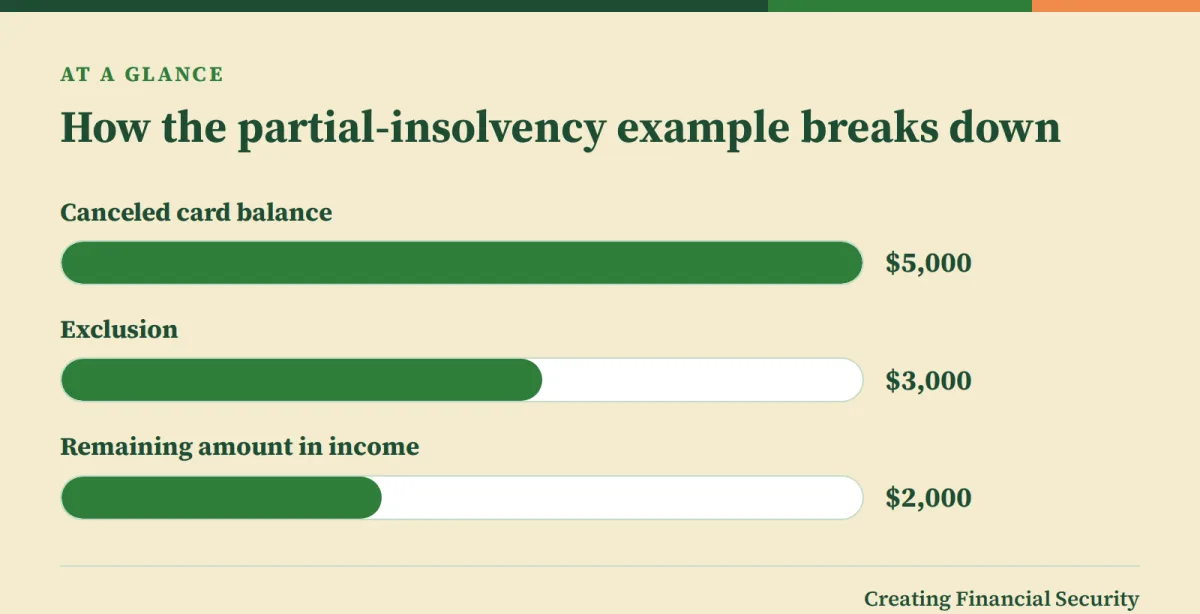
In the IRS's partial-insolvency example, the canceled card balance is $5,000 and debts exceed assets by $3,000. The exclusion covers $3,000; the remaining $2,000 enters income unless another exclusion applies. Excluding debt can also require adjustments to tax attributes, including credits, losses and asset basis.
Retirement savings count in the insolvency calculation. The IRS includes retirement-account value and pension interests among assets, even when creditors cannot reach them.
On Form 1099-C, box 2 includes canceled principal and can also contain interest or charges. The absence of that form does not remove a reporting obligation: forgiven amounts generally belong in income unless an exception or exclusion qualifies them for different treatment. For an individual case, consult IRS Publication 4681, the IRS Interactive Tax Assistant or a licensed tax professional.
Confirm the agreement and track the first payment
Treat the weeks after the call as paperwork with a purpose: proving what was agreed and checking that it happens.
- Get the terms in writing. A letter or an online-account message should list the payment, dates, interest, fees and what happens if something changes.
- Compare it with your notes. If anything differs from the call, contact the issuer before you pay.
- Find the effective date. Learn when the new terms begin and which statement shows them first.
- Confirm the payment instructions. Check the amount, the due date, and where and how to send it.
- Keep a folder. Save notes, written terms, payment confirmations and statements.
- Check the first statement. See whether the payment was applied and whether interest and fees match the agreement. Ask about any difference right away.
If the answer is no, ask what other assistance exists
A no is disappointing, and it isn't always final. You can ask what led to the decision, whether another team handles hardship requests, and whether you can apply again later.
If an offer exceeds the amount left after essential expenses, explain the gap and ask about alternatives. The New York Attorney General also points people struggling with bills toward nonprofit credit counseling.
When direct negotiation is not enough, compare help before using retirement money
If the issuer can't offer anything affordable, other routes exist, and they are not interchangeable.
- Nonprofit credit counseling. The New York Attorney General says licensed not-for-profit agencies in that state generally offer help for free or at minimal expense in paying back debts. For services elsewhere, ask about applicable licensing and fees.
- Debt settlement companies. These for-profit firms say they can win settlements for a fraction of the debt. The Attorney General says many accomplish little and charge hefty fees.
- Bankruptcy-related counseling. The U.S. Trustee Program says credit counseling must be completed before an individual files for bankruptcy, with very limited exceptions, and it keeps lists of approved agencies.
If a debt collector is the one contacting you, collection disputes, older debts and lawsuits bring separate legal questions, and state-specific guidance or legal aid can help. The New York Attorney General warns that anyone served with legal papers should respond even if they doubt they owe anything.
Know whether a service manages payments or seeks debt forgiveness
The New York Attorney General describes counseling agencies as help with paying back what you owe. A settlement company is about getting creditors to accept less. The risks differ.
The attorney general describes the settlement model as telling consumers to stop paying and set money aside until there's enough to make an offer. It warns that stopping payments can bring more frequent collection efforts, judgments, wage garnishment and frozen bank accounts. It also says only a small number of enrolled consumers finish, and it advises avoiding firms that charge before delivering a settlement.
Before signing with anyone, ask who gets paid and when, whether your creditors have agreed to take part, where your money is held and what happens to your accounts if you stop paying. Written answers beat verbal ones.
Do not treat an old IRA like a borrowing account
An IRA cannot serve as a borrowing account. The IRS explains that an owner's borrowing ends the account's IRA status and brings its full value into the owner's income.
A qualified workplace plan can allow borrowing, but offering loans is optional. The IRS generally requires repayment within 5 years; a loan to purchase the employee's principal residence may qualify for longer repayment.
Default generally makes the unpaid loan balance taxable as a distribution. An early-distribution tax may also apply. A licensed tax professional can help assess those consequences for an individual case.
A withdrawal is a separate transaction from a loan, with its own rules, taxes and possible penalties. Current IRS guidance on withdrawals and early distributions explains them, and a licensed tax professional can apply them to your situation.
Questions about negotiating card payments
Does a missing tax form mean forgiven debt is tax-free? No. The IRS generally requires reporting canceled debt even without Form 1099-C, unless an exception or exclusion applies. Whether a form arrives and whether the cancellation is taxable are separate questions.

How is an insolvency exclusion reported? The IRS directs qualifying taxpayers to attach Form 982 to their federal return. The exclusion cannot exceed either the canceled amount or the amount of insolvency just before cancellation. Tax attributes may also need adjustment. IRS Publication 4681 explains the filing requirements; a licensed tax professional can help apply them to an individual cancellation.
The bottom line
The steadiest order is simple. Ask the card issuer about payment relief first, with your numbers written down and a payment you can keep up after essential bills. Use the call to ask about interest, fees, payment amounts, how long relief lasts, account access, reporting and what happens when it ends. Then compare offers by their full terms and ask for them in writing.
Settling for less than the balance is a different step, with credit and possible tax consequences. The IRS says forgiven debt may count as income, though exclusions can apply, so that question is worth checking before you accept.
If the issuer can't help, a nonprofit credit counselor is one place to compare options, and a licensed tax professional can speak to canceled debt. Retirement money is its own topic with its own costs, and an IRA can't be borrowed from at all. If a payment feels hard to keep, that's a reason to ask for more help, not a reason for shame.
Questions readers ask
Can I ask for help before I miss a payment?
Will asking for a lower payment hurt my credit?
What if the issuer will not reduce my interest rate?
Can I negotiate if a collector is handling the account?
Does forgiven card debt always create a tax bill?
Can I borrow from my IRA to fund a settlement?
Sources
- New York State Attorney General: Debt settlement
- Internal Revenue Service: Publication 4681 (2025), Canceled Debts, Foreclosures, Repossessions, and Abandonments
- IRS: Retirement Plans FAQs regarding Loans
- U.S. Department of Justice, U.S. Trustee Program: Credit Counseling & Debtor Education Information
- USAGov: Learn about your credit report and how to get a copy