



A hospital bill and a big car repair can land in the same month without anyone having done anything wrong. When they do, two ideas tend to show up fast: roll everything into one payment, or pull the money out of the 401(k).
Here, debt consolidation means using new financing to pay off existing debts, which usually leaves one payment where there used to be several. It doesn't erase what you owe, and a smaller monthly payment doesn't automatically mean a smaller total cost.
The order of the questions matters. What the hospital itself can do about the bill comes first, the full cost of any new loan comes next, and retirement money is a separate question with its own IRS rules.
What changes when debt is consolidated?
Consolidation replaces one set of debts with another. If a hospital and a repair shop are owed money, a new loan pays them, and from then on the new lender is the one you owe. The total hasn't shrunk. What changed is the terms: who gets paid, the interest rate, how long repayment lasts and when each payment is due.
That's different from a debt being forgiven. The IRS explains that when a creditor cancels a debt for less than the full amount, you're generally treated as having income for tax purposes. Consolidation cancels nothing, so it's only a change in terms for the same obligation.
Which bills can be rolled in is up to the lender and the loan's terms. A hospital bill is a special case, because paying it with borrowed money can close off options that exist while it's still a hospital bill.
How it works, step by step
- Ask the billing office how to apply for financial assistance, and request the written policy and application.
- Ask what the hospital's collection policy says it may do if a payment is missed.
- Request your free credit report from each agency before applying for any new account.
- Ask the plan administrator what the plan's terms say about handling a missed loan payment.
Start with the hospital bill and the next payment dates
Before adding a lender, it helps to learn what the hospital itself offers. The IRS ties extra requirements to hospital organizations that want to be treated as tax-exempt charities. Under Section 501(r)(4), such an organization has to adopt two written policies for each facility it runs: one on financial assistance and one on emergency medical care.
The assistance policy has to explain who qualifies and whether help means free or discounted care. The IRS says a patient found eligible can't be charged more than the Amounts Generally Billed for emergency or medically necessary care. Whether your hospital is covered is a fair question for the billing office, since these rules are tied to the organization's tax-exempt status.
Check what is owed before moving the balance
It's easier to compare options once you know the real number and what it covers.
- The policy and application. The IRS says covered hospitals must give out paper copies of the policy documents on request, free of charge, and must put a notice about assistance on billing statements.
- What the application needs. Assistance can't be denied over an item the policy or form never required, and a hospital may grant help based on an applicant's own statement.
- The balance, in writing. A loan offer is only as useful as the figure it's measured against.
- Anything that looks wrong. An itemized bill and the insurer's explanation of benefits are the documents to compare, and a charge you question is a conversation with the billing office first.
Ask what a payment arrangement would actually cost
A payment arrangement and a loan can look alike on a monthly statement. A few questions tell them apart:
- Is there interest, and does it start right away or only after a missed payment?
- Are there fees for setting up the plan or paying late?
- What may the hospital do after a missed payment? The IRS says the assistance policy, or a separate billing and collections policy, must describe those actions, including extraordinary collection actions.
- Does a financing company outside the hospital open a credit account in your name? That would make it a new loan rather than a hospital arrangement.
It helps to ask about assistance early, before agreeing to anything.
Compare ways to combine debt without hiding the risks

Each common way of combining debts has its own costs and its own consequences for a missed payment. Which one fits, if any, depends on your finances and the offer itself, and a nonprofit credit counselor or licensed professional can go through an offer with your paperwork.
An unsecured personal loan. Worth asking: What's the annual percentage rate? Is there an upfront fee, and is it taken out of what you receive? How many months will it run? Is the rate fixed?
A balance transfer to a credit card. Worth asking: Is there a transfer fee? Does a low starting rate end, and what is the rate after that? What's the minimum payment?
Borrowing against a home. This pledges the house as collateral, so the stakes differ, as the next part explains.
Side by side, the same four facts sort the routes: the rate, the fees, the length of the term and what happens if you fall behind.
When simplifying bills puts an asset at risk
A loan secured by property works differently from one that isn't. The IRS describes foreclosure and repossession as remedies a lender may use when payments stop on a loan backed by a mortgage or other security interest in property. Those remedies let the lender seize or sell what secures the loan.
So pledging property to pay other bills changes what a missed payment can mean. The bills are the same, but now a lender holds a claim on something you own. Unsecured creditors may have other ways to collect, so a housing counselor or an attorney can explain what a default would mean where you live.
Check the full cost, not just the monthly payment
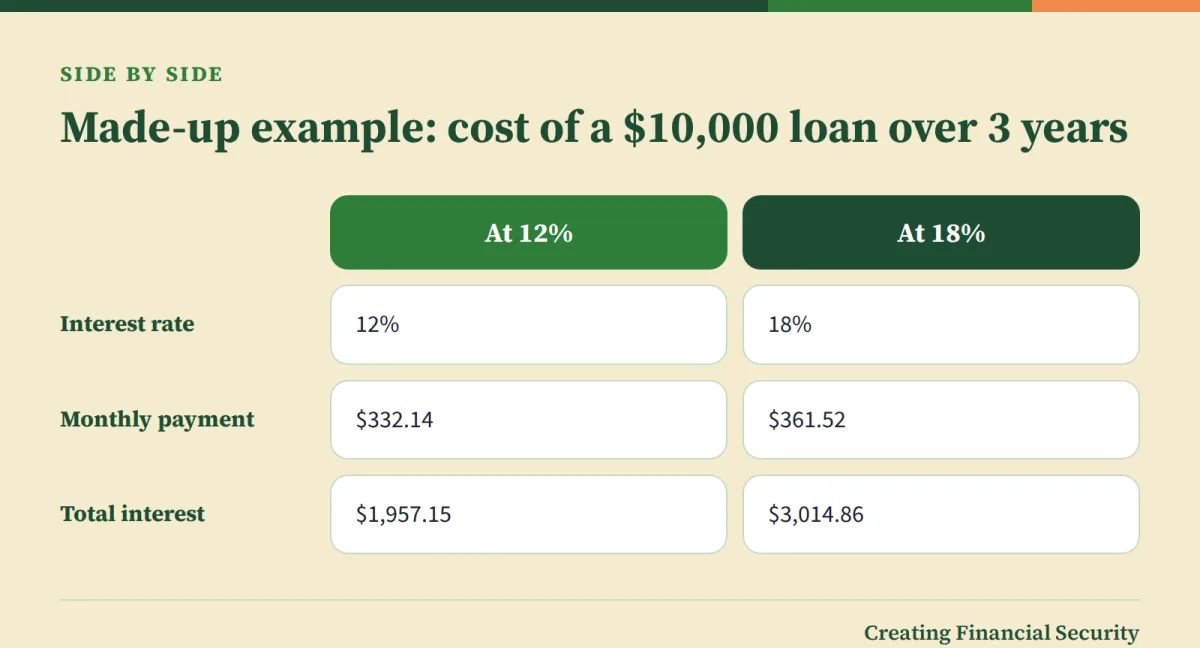
A lower payment feels like relief, and sometimes it is. The question is what it costs to get there. The table compares a made-up $10,000 loan over 3 years at two different interest rates.
| Interest rate | Monthly payment | Total interest |
|---|---|---|
| 12% | $332.14 | $1,957.15 |
| 18% | $361.52 | $3,014.86 |
Fixed rate, equal monthly payments of principal and interest; taxes, insurance and fees are not included. These figures assume a fixed rate and equal monthly payments of principal and interest. Taxes, insurance and fees are not included.
Read the two columns separately. Between the rows, the monthly payment changes by a small step, while the total interest changes by much more. That's why the payment alone can be a poor guide to what a loan costs.
Fees add to the cost too, and the table leaves them out on purpose, so the annual percentage rate and total repayment in a lender's own disclosures are the figures to compare.
An affordable payment is one that fits next to rent, food, fuel and the cost of getting to work.
Read the offer alongside the existing bills
Before accepting any offer, set it next to the bills it would replace:
- Balances. Do the amounts the lender plans to pay match what each creditor says is owed?
- Payoff amounts. Ask each creditor for a payoff figure, since interest or fees may have been added since the last statement.
- Fees. Look for upfront, transfer and late fees.
- Payment dates. Check when each old creditor gets paid, and what happens if a payment comes due before the payoff arrives.
- Total repayment. Compare the offer's total with what the current bills would cost at their current pace.
What a new account could mean for your credit
A credit report lists a history of your finances, and lenders and other organizations may use it when deciding whether you qualify for credit. You can request a free report every year from each of the three credit reporting agencies, and only one website is authorized by the federal government to issue them. A mail-in request form is another way to ask.
It's worth reading yours before applying for anything. In most cases a report doesn't include your credit score, so what you see is accounts and history rather than a number.
A consolidation loan or a new card adds an account, and paying off old ones changes your list of accounts. How that nets out for a score depends on your whole file, and no outcome is certain in either direction. If an agency denies your request for a report, the first step is to contact that agency, and then the Consumer Financial Protection Bureau if the problem isn't resolved.
Keep medical collections separate from ordinary loan debt
How a medical bill is reported, and whether that differs from an ordinary loan, is worth checking in the Consumer Financial Protection Bureau's current guidance and with the hospital's billing office. Confirm what applies today rather than assuming.
Here's why it matters for this decision. If a new loan pays the hospital, the hospital is paid, but what's owed is now an ordinary loan with its own terms. Whatever treatment the medical bill had may not carry over to the new account.
Keep retirement money separate from the debt decision
A 401(k) and an old IRA can look like the closest money. The IRS draws firm lines around both, and the costs differ for each, so it helps to take them one at a time.
An IRA is not a loan account
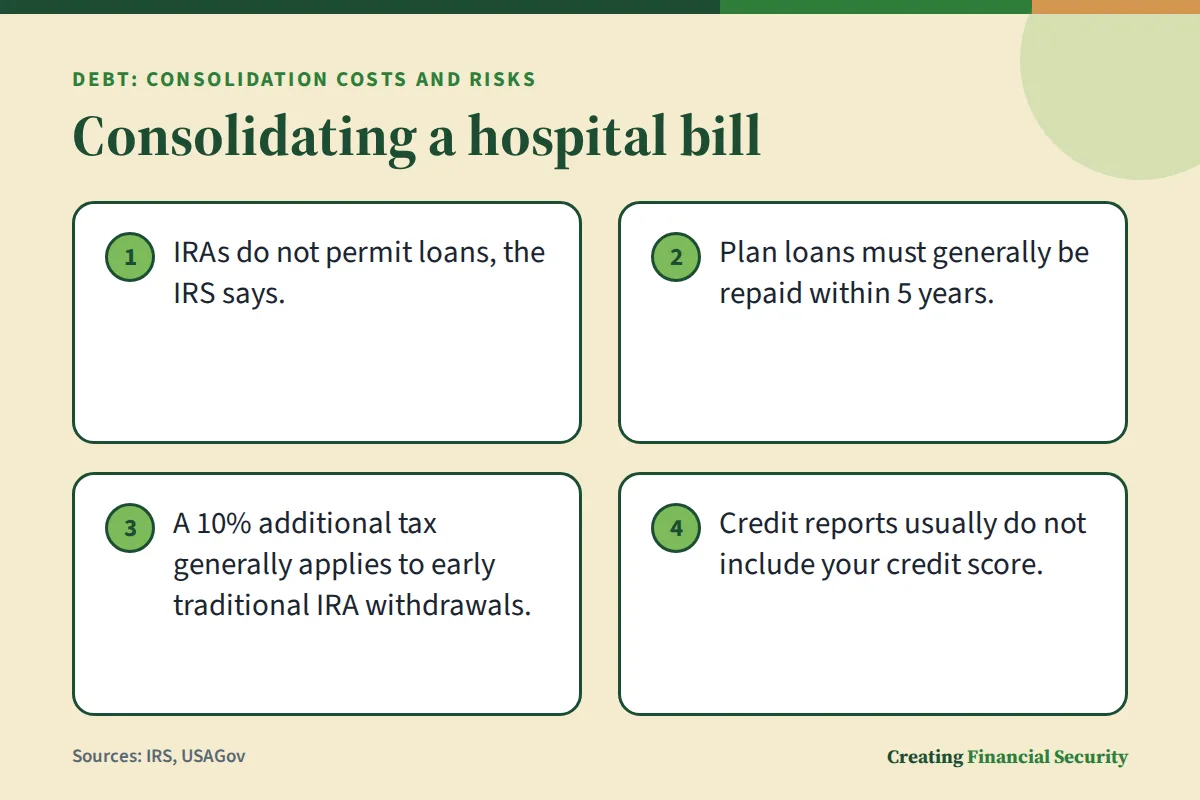
The IRS says an IRA can't be used for loans, and the same goes for SEP, SARSEP and SIMPLE IRA arrangements. An owner who actually borrows from an IRA ends its status as an IRA, and the value of the whole account counts as income. Pledging part of an IRA as collateral means the pledged part is treated as distributed.
Taking money out is a separate matter. IRS Publication 590-B says traditional IRA assets can be withdrawn at any time, but a 10% additional tax generally applies before age 59½.
A rollover is a different thing from a loan. Only eligible distributions can be rolled over, the usual rollover period is 60 days, and the IRS points to Publication 590-A for the requirements. If the requirements aren't met, the money is simply a distribution, with the tax questions that come with it. A tax professional can explain the rules for a particular distribution.
A workplace-plan loan depends on the plan
A 401(k) works differently. The IRS says a qualified plan may offer loans but isn't required to, and a plan that does can set a lower limit than the law allows. The legal ceiling is the lesser of two figures: $50,000, or the larger of $10,000 and 50% of the vested balance. Other loans from the same plan count toward the ceiling, so the plan administrator is the one to ask what's available.
Repayment has rules, too. The IRS says a plan loan must generally be repaid within 5 years in substantially equal payments of principal and interest, made at least quarterly. The IRS also says plan loans don't depend on hardship, so the reason for borrowing isn't what decides it.
The risk sits in a missed payment. If payments stop, the IRS says the unpaid loan amount generally counts as a taxable distribution from the plan, known as a deemed distribution. A deemed distribution is treated like an actual one when figuring tax, including any early distribution tax, and it can't be rolled over.
Leaving a job matters too. A plan may reduce your account by the unpaid part of a loan, which the IRS calls a plan loan offset. When the offset comes from leaving the job or the plan ending, the IRS allows more time than the usual 60 days to roll the amount over. The plan's terms generally say how it handles a default, so the administrator can explain what would happen to your balance.
A medical exception does not automatically make a withdrawal tax-free
Having a medical bill doesn't by itself settle the tax on a withdrawal. Three questions are worth keeping apart: Does the plan or account let you take the money out? Does the amount count as income? Is an additional tax added on top?
The first is about access. The IRS notes that some plans provide for hardship withdrawals, which require showing a need. The second is ordinary income tax, which generally applies when money leaves a traditional IRA. The third is the 10% additional tax that generally applies before age 59½. Exceptions to that additional tax have their own rules, and IRS Form 5329 covers additional taxes on qualified plans, including IRAs.
An exception to the additional tax isn't the same as an exclusion from ordinary income tax, and neither one makes a plan allow the withdrawal. Whether a particular medical expense qualifies is a question for the IRS's current instructions or a tax professional, who can check the rules against your own facts before money moves.
Build a payment plan that can last
Whether or not consolidation fits, the aim is a plan that holds up month after month. Here is one way to put the questions in order, following the sections above:

- List what's owed. Note each balance, minimum payment, due date and whether any property secures it.
- Work out which payments protect the basics. Housing, utilities, food and getting to work are worth sorting first, and a nonprofit credit counselor can go through it with you.
- Ask the hospital about assistance and payment terms before adding a lender.
- Talk with the other creditors about hardship options and what a changed due date would cost.
- Price any new loan in full: the rate, fees, length and total repayment, not the payment alone.
- Check the retirement rules last, including plan terms, taxes and the additional tax, before touching that money.
When another loan does not solve the shortfall
If the numbers still don't work after the hospital and other creditors have been asked, another loan may only move the problem. A nonprofit credit counselor can review a budget with you, and a licensed attorney can discuss legal options when repayment isn't realistic. It's reasonable to ask any service to put its fees and process in writing before you agree.
Settling a debt for less than owed is a different idea from consolidation, and it has tax consequences. The IRS says canceled debt is generally treated as income. Canceled nonbusiness credit card debt may be excludable if the cancellation happens in a bankruptcy case, or to the extent you were insolvent right before it. In the IRS's insolvency test, assets include the value of retirement accounts. A tax professional can say whether an exclusion applies to you.
Recognize promises that could make the debt worse
Some offers add to the problem. These questions are worth asking about any debt-relief pitch:
- Does the offer promise a result without explaining its conditions?
- Are all fees written down, including when they're due?
- Am I being told to stop paying? Ask in writing what that could mean for late fees, collection activity and my credit report.
- Do I understand what happens to the debts if the plan ends early?
Terms in writing, and time to read them, are a reasonable thing to expect.
The bottom line
Debt consolidation swaps several debts for one new one. It doesn't forgive anything, and a lower payment can come from a longer term, fees or a rate that changes. The made-up table shows how much the interest rate alone can move total interest, so the full cost is the number to look at.
For a hospital bill and a car repair, the hospital's financial assistance policy and payment terms come first, because they can exist before a bill turns into a loan. Pledging property raises what a missed payment can cost. Retirement money is a separate question with its own taxes, additional tax and plan rules, and an IRA can't be borrowed from at all.
Manageable payments, protected essentials and an honest look at the total matter more than having one bill. A nonprofit credit counselor, a tax professional or your plan administrator can look at your own case.
Questions readers ask
Can I consolidate debt if my credit has already slipped?
Can a hospital bill be included in a consolidation loan?
Is borrowing from an IRA allowed if I pay it back quickly?
Does a medical hardship make a retirement withdrawal tax-free?
Is debt settlement the same as consolidation?
Sources
- IRS: Financial assistance policy and emergency medical care policy – Section 501(r)(4)
- IRS: Retirement Plans FAQs regarding Loans
- IRS: Publication 590-B (2025), Distributions from Individual Retirement Arrangements (IRAs)
- USAGov: Learn about your credit report and how to get a copy
- Internal Revenue Service: Publication 4681 (2025), Canceled Debts, Foreclosures, Repossessions, and Abandonments