



When a hospital bill and a car repair land in the same month, the first instinct is often to look at the 401(k). There's a smaller, calmer move to try first: getting your papers in order so you can ask the card company for help.
A hardship request usually rests on a short list of documents: proof of what changed (the bill, the repair invoice, any drop in pay), a picture of your income and monthly expenses, and your card statements. The sources used here give no single official checklist, so the card company's own instructions are the thing to follow.
You can start gathering the same papers today, before you call anyone. This guide walks through them in order, with a made-up budget and a table for the math, and keeps retirement money at the back of the line.
This guide is part of our larger one on preparing a card payment request.
What a card company usually wants to see, and what it decides
Think of a hardship request as a small case file. It answers three questions: what happened, what you can afford now, and what the account looks like today.
Here's a short list to start from. It's a practical starting point, not an official list:
- Proof of what changed: the hospital bill, the repair invoice, and pay stubs or an employer note if your hours or pay dropped.
- Your income: recent pay stubs, or bank statements that show your deposits.
- Your monthly expenses: rent or mortgage, utilities, food, transportation, insurance and medical costs.
- The card side: recent statements, the balance, the interest rate, the minimum payment and the account number.
- Your other debts, so the whole picture is on the table.
Because no source gives one format for every issuer, your first call can be partly a question: what papers do you want from me? Their answer outranks any checklist, including this one.
University of Minnesota Extension educators say that lenders and other creditors tend to be open to working something out when you reach them early, before payments slip. That isn't a promise that a particular company will say yes. It's a reason to gather papers now rather than after a missed payment.
The same educators caution that piling on new borrowing to cover bills usually deepens the hole unless your situation turns around fast. That's why this guide stays with paper and conversation instead of new debt.
How it works, step by step
- Work out what you owe each creditor and what you can afford to pay, before you make contact.
- Ask the hospital for its financial assistance policy; it must explain how to apply for help.
- Add up essential monthly costs from your bills and statements, then see what remains for debts.
- Reach out to the card company early and describe what has changed.
Start with proof of what changed
A hospital bill and a repair bill in the same month is a clear reason for strain, but it helps most when the dates are easy to see. A simple folder, paper or digital, with everything in date order does much of the work.

- Gather the hospital papers: the itemized bill and the insurer's statement (more on those just below).
- Add the repair invoice showing the date, the work done and the amount.
- Add pay records from before and after any change in hours or pay, or a short note from your employer.
- Write a short, factual summary: what happened, on which dates, and what it cost. A few sentences is plenty.
- Note anything still missing, such as a final bill, so you can tell the card company what's coming.
Extension educators note that when your job depends on having a car, the loan or lease payment on it may deserve high priority. If that describes your situation, the summary is a good place to say so in a line.
Keep the summary calm and factual. It's there to show dates and amounts, not to make a case for sympathy.
Hospital bills: ask for the itemized bill and the insurer's statement
Two hospital papers do most of the explaining. An itemized bill lists each charge instead of one total. The insurer's statement, often called an explanation of benefits, shows what insurance covered and what's left for you. Side by side, they let you compare what you've been billed with what the insurer says is yours.
The hospital itself is worth contacting before the card company. The IRS says hospital organizations that are tax-exempt under Section 501(c)(3) must meet extra requirements under Section 501(r), including a written financial assistance policy for each hospital facility. That policy must be widely publicized and must state who is eligible and whether the help is free or discounted care.
The IRS also says the policy or its application form must describe how to apply and what information or documentation may be required. A hospital facility may not deny assistance because an applicant left out something the policy or form didn't specifically require. And a person found eligible may not be charged more than Amounts Generally Billed for emergency or medically necessary care.
Whether a particular hospital's policy covers your bill is for the hospital to say, so the billing office is the place to ask for the policy and the application. The IRS adds that the policy must list which outside providers working in the hospital are covered and which aren't, so a separate doctor's bill may fall under different rules.
A hospital is also a creditor, so the Extension advice about reaching out early applies there too. Any payment plan or assistance answer can go in your folder next to the card papers.
As for credit reports, the law lets you get a free report each year from each of the three credit reporting agencies, and USAGov says AnnualCreditReport.com is the only website the federal government authorizes for them. Pulling your reports is one way to see what is listed. The sources used here don't cover today's rules for medical debt on credit reports. USAGov says that if a credit reporting agency denies a request for a credit report, you contact it first, and if the complaint isn't resolved, you can contact the Consumer Financial Protection Bureau.
Show what comes in and what goes out each month
A card company can't judge a payment without knowing what's left after the essentials. So the next stack of papers shows the monthly picture.
For income, gather recent pay stubs. If your pay varies, bank statements showing deposits fill the gap. Take-home pay, the amount that actually lands in your account, is the number that matters for a budget.
For expenses, Extension educators suggest starting with a plain question: what does it cost each month to cover the basics your household can't go without? They say food, housing, utilities, transportation and medical care usually come first. Pull a lease or mortgage statement, utility bills, insurance premiums, the car payment, fuel receipts, and bank or card records that show what you spend on groceries.
Two cautions come from the same Extension guidance. Falling behind on a car loan can lead to repossession when the vehicle secures that loan. And they urge care about letting health coverage lapse when money is tight, since a household can be hit hard by medical bills that insurance doesn't cover.
Also list every creditor and what you owe each one. Extension points to a "How Much Do I Owe?" worksheet as one way to do it. Then the monthly picture and the debt picture line up on one page.
A made-up monthly budget, worked step by step
Here is how the papers turn into a number. Take-home pay, minus essentials, minus the minimums on other debts, leaves the most you could propose.
That leftover amount is a ceiling for a proposed payment, not a target. A proposal below it leaves a cushion for the next surprise bill. The made-up example below shows each step.
Extension educators say each creditor should hear what amount you can pay and on what schedule. This arithmetic is what sits behind that sentence.
Pull the card side of the file together
Now gather what the card company already has, so you're looking at the same numbers it is:
- The most recent statements for each card.
- The balance, the interest rate (APR) and the minimum payment shown on each statement.
- The account number and the payment due date.
- Any hardship options the issuer describes for the account, on its website or by phone.
- Your own notes on any earlier hardship request: the date, who you spoke with and what was said.
Statements are a practical place to read the rate and minimum, since they come from the issuer. Your credit reports, mentioned above, show how each card is listed.
Extension says that making at least the minimum on credit and store cards keeps the accounts current and helps you avoid negative marks on your report. It also says that sending only the minimum adds to finance charges and stretches out the payoff. And it notes that late or missed payments are recorded in your credit history, which can make credit harder or costlier to get.
That's a real tension: the minimum protects the record but is slow to shrink the balance. A hardship conversation is where you ask what the issuer can change, and the issuer decides.
What a card-sized payoff looks like at different rates
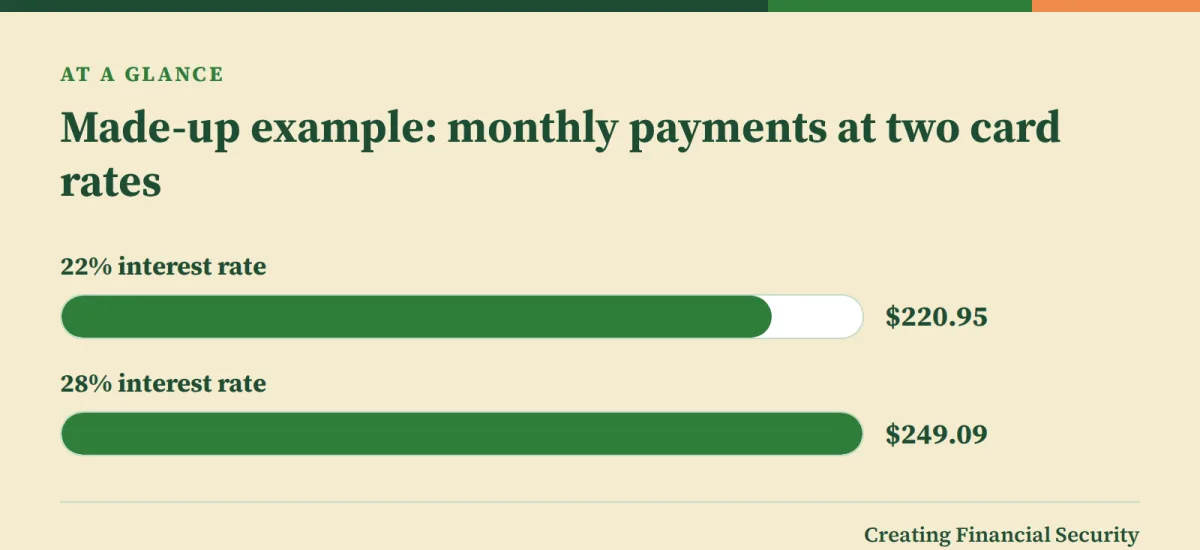
Before proposing a payment, it helps to see why the rate matters as much as the payment. The table below is a made-up example of an $8,000 balance paid off over a fixed term.
| Interest rate | Monthly payment | Total interest |
|---|---|---|
| 22% | $220.95 | $5,257.08 |
| 28% | $249.09 | $6,945.19 |
Fixed rate, equal monthly payments of principal and interest; taxes, insurance and fees are not included. These figures assume a fixed rate and equal monthly payments of principal and interest, with no taxes, insurance or fees included.
In the made-up example above, $8,000 over 5 years at 22% comes to $220.95 a month with $5,257.08 in total interest. At 28%, it's $249.09 a month and $6,945.19 in total interest. Real cards have variable rates and changing balances, so this shows the stakes rather than a prediction. If a card company proposes new terms, the rate, the monthly payment and the length are three things worth understanding before agreeing.
How to list your 401(k) and old IRA, and why to ask for relief before tapping them
If you're asked about savings, accuracy is what matters. Extension educators suggest taking stock of your own assets, such as savings, when you work out what you can pay. A 401(k) and an IRA are assets. A licensed professional can help with how retirement balances fit a particular case.
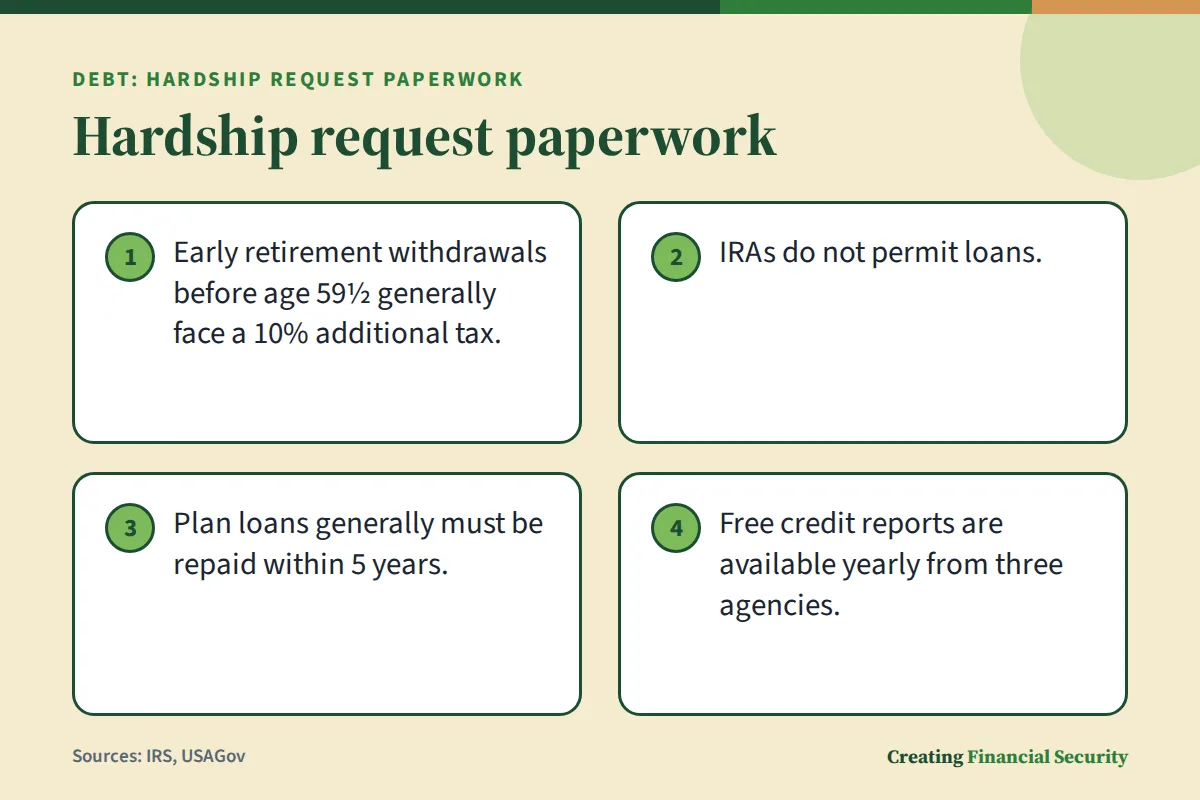
Listing money is different from spending it. The IRS says money taken out of a 401(k) or traditional IRA before age 59½ is usually taxed as income, and it can also bring a 10% additional tax, unless one of the listed exceptions fits.
The IRS lists those exceptions. Two that touch a medical month: unreimbursed medical expenses above 7.5% of AGI, and a single emergency withdrawal each year for a personal or family need. That second one is capped at $1,000, or at the vested balance over $1,000 if that is less, and it applies to distributions made after 12/31/2023. The IRS page presents these as exceptions to the 10% additional tax only. Whether either fits your year is a question for a tax professional.
Borrowing works differently for each account. The IRS says loans are not permitted from IRAs. Borrowing from one means it stops being an IRA, and the whole value counts as income.
A 401(k) may offer loans, but the IRS says a plan isn't required to. If a plan does, it may cap the amount, and the cap is whichever is smaller: $50,000, or the larger of $10,000 and 50% of the vested balance. The IRS says repayment generally has to be finished within 5 years, in level payments of principal and interest made at least every quarter. Loans to buy a main home may allow longer.
The IRS also says a loan that goes unpaid is generally treated as a taxable distribution of everything still owed on it.
So the choices have different costs. Asking for relief costs paper and time. Tapping retirement money can cost tax now and savings later, and which path fits depends on your situation. A tax professional or a nonprofit credit counselor can look at your own numbers.
Share only what is needed, and keep your own record
This section is common-sense habit rather than a rule from the sources. A hardship file holds sensitive details, so many people send what the card company asks for and no more. If a request seems broader than the situation needs, it's fair to ask why. You can also ask how the company wants papers delivered and use that route.

If you start by phone, a follow-up in writing leaves a trail. Extension points to sample wording for calls and letters on its "Talking with creditors" page.
A simple record can look like this:
- Make a copy of everything you send, and keep the originals.
- Log each call: the date, the name or ID of the person, and what was said.
- Save the card company's answers, any new terms in writing, and payment confirmations.
- Keep it all until the account is settled as agreed.
Extension educators say that acting as though nothing is wrong won't make a money problem fade, and that facing it honestly helps. For a paperwork file, that means accurate numbers.
If the answer is no, or they ask for more
A "no" or a "send more" isn't the end of the process. It's reasonable to ask what is missing or what led to the decision, and to write down the answer. A new pay stub or an updated bill may be all that's needed. It's also fair to ask whether the decision can be reviewed.
Extension guidance says that, however hard things are, ignoring bills and creditors is a luxury nobody has. It suggests paying something toward each debt on the agreed terms if you can, since that makes it less likely your troubles show up on your credit record.
If the card debt feels bigger than a phone call can fix, Extension suggests a nonprofit consumer credit counseling service.
If a card company ever cancels part of a debt, the IRS explains in Publication 4681 that forgiven debt may be treated as income, and a Form 1099-C may arrive. The IRS also describes exclusions, including for bankruptcy and for being insolvent just before the cancellation. A tax professional can say whether they apply to you.
You don't have to solve everything in one conversation. A clear file makes each next call easier.
The bottom line
A credit card hardship request rests on a handful of papers: proof of what changed, your income and monthly expenses, and your card statements. No single official list applies to every issuer, so the card company's own request is the one to follow. Your folder gives you a head start on whatever it asks for.
A hospital bill can be checked before it is paid: the itemized bill, the insurer's statement, and the hospital's financial assistance policy. A simple monthly budget turns your papers into a payment amount that leaves room for essentials.
Your 401(k) and old IRA can be listed honestly without being spent. The IRS says early withdrawals before age 59½ are usually taxed as income and can carry a 10% additional tax, and IRAs don't allow loans. Asking for relief first costs paperwork, not savings.
A next small step is the folder: bills in date order, then pay records, then statements. For help with your own numbers, a nonprofit credit counselor or a tax professional can sit down with them.
Related guides
Questions readers ask
Do I need a letter explaining my hardship?
Will a hardship request hurt my credit?
Do I have to tell the card company about my 401(k) or IRA?
Will medical bills hurt my credit?
What if I do not have pay stubs or a bill yet?
How long should I keep my hardship records?
Sources
- IRS: The 10% additional tax before age 59½ and the exception chart distinguishing qualified plans
- IRS: Financial assistance policy and emergency medical care policy – Section 501(r)(4)
- IRS: Retirement plans FAQs regarding loans
- Internal Revenue Service: Publication 4681 (2025), Canceled Debts, Foreclosures, Repossessions, and Abandonments
- University of Minnesota Extension: Deciding which bills to pay first
- USAGov: Learn about your credit report and how to get a copy