



A hospital bill and a big car repair landing in the same month doesn't mean you were careless. A lot of cost showed up faster than a paycheck can absorb, and now you're wondering whether to pull from your 401(k) to cover it.
Bankruptcy is one legal tool the federal courts describe for people who can no longer pay what they owe. Whether it fits depends on your whole picture, not on one balance.
The part to slow down for is your retirement money. A withdrawal can bring tax costs, and whether those accounts would be protected in a filing is worth settling before the money moves.
When the bills no longer fit the money coming in
It helps to name the warning signs without shame. A few come up often:
- Rent or mortgage, utilities, food, transportation and medicine are all competing for the same dollars.
- One credit line is covering the minimum payment on another.
- Retirement money is starting to look like the only way to stay current.
- Collection calls, letters or court papers are arriving, and you can't tell which ones carry deadlines.
None of these is a dollar figure, and that's deliberate. The federal courts say that, apart from the means test for individuals, Chapter 7 relief is available whatever the size of the debts. So no single balance decides whether bankruptcy deserves a conversation. A better question is whether the debts are realistically payable from your income once the essentials are covered.
One practical first step is to write down what you spend each month on the basics. The court forms ask for the same list: food, clothing, shelter, utilities, taxes, transportation and medicine. It shows how much room there is, if any, and it's the list an attorney or credit counselor will want to see.
How it works, step by step
- Ask the hospital for its financial assistance policy; covered hospital facilities must provide paper copies on request at no charge.
- Write down your monthly living costs, such as food, shelter, utilities, transportation and medicine.
- Gather your most recent tax return or transcript to bring to a consultation.
- Collect proof of recent pay and note any expected change in income or expenses.
Check whether the hospital bill and other payments can change

The hospital bill is where this started, so it's a sensible place to look. The hospital's assistance policy is one option to check alongside any payment or court deadlines.
The IRS explains that a hospital organization that qualifies as a tax-exempt charity must adopt a written financial assistance policy for each facility it operates. The policy has to cover emergency and other medically necessary care, spell out who qualifies, and say whether the help is free care or a discount.
For a patient found eligible, the IRS says the hospital may not charge more than the amounts generally billed for that care. Hospitals must publicize the policy on a website, offer paper copies on request at no charge, and put a notice about it on billing statements.
A few more details from the IRS description matter to a patient:
- The policy must explain how to apply and what paperwork may be requested.
- Help can't be denied over missing documents the policy never required.
- The policy, or a separate billing and collections policy, must describe what the hospital may do about unpaid bills, including the efforts it makes to check eligibility before the most serious collection actions.
- A short plain-language summary must say where to find the full policy and who can help with the application.
Not every hospital falls under these rules, and not every discount counts as financial assistance. So the questions are plain ones. Is the hospital run by a tax-exempt organization? Can you get a copy of its policy? Does it cover the doctors who treated you, or list some as outside it? The IRS says the policy must name the providers working in the hospital and say which are covered.
Other payments can sometimes change too. The federal courts note that out-of-court agreements with creditors, and debt counseling services, may be alternatives to filing. A licensed professional can look at your own case.
Separate useful help from another expensive promise
Credit counseling has its own rules when bankruptcy is involved.
Credit counseling. Bankruptcy requires counseling from an approved agency within 180 days before filing, with exceptions for emergencies or a shortage of approved agencies. If a repayment plan is worked out during that counseling, the court requires a copy to be filed.
Reading your own credit reports costs nothing. By law you can get a free report each year from each of the three credit reporting agencies, and the federal government authorizes one service for that.
Which bills could disappear, and which could remain?
The federal courts describe a discharge as a fresh start for an honest individual debtor. It releases the person from personal liability for most debts and bars creditors from collecting on them. But the right to a discharge isn't absolute, and some debts survive it, so it isn't a clean sweep.
Debts that can be discharged. The courts describe unsecured debts as ones where the creditor extended credit based on the borrower's ability to pay, not on a right to take collateral. Whether a particular bill is covered is a legal question for your case.
Debts that can remain. In Chapter 7, the courts list alimony and child support, certain taxes, certain educational loans or benefit overpayments tied to government, debts from death or injury caused by intoxicated driving, and certain criminal restitution. Chapter 13's list adds some long-running obligations, a home mortgage among them. A Chapter 13 discharge is somewhat broader than a Chapter 7 discharge in a few ways, such as debts from property settlements in a divorce.
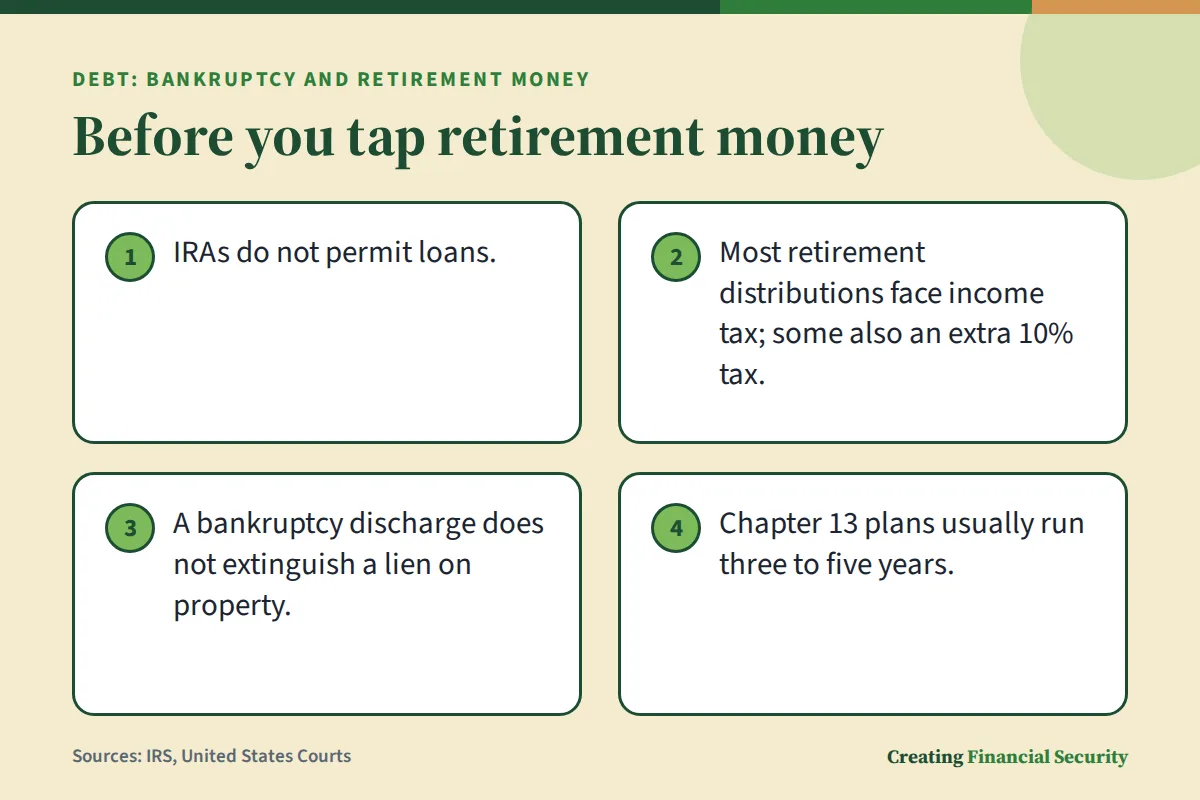
Secured debts. A car loan is tied to the car. The courts say a lien survives a discharge, so a lender may keep rights over the vehicle even when you're no longer personally liable. Some people choose to “reaffirm” a debt, agreeing to stay liable and keep paying so the lender won't take the car back.
The automatic stay. This is the pause people hear about. Filing generally stops most collection actions, so creditors generally may not start or continue lawsuits, wage garnishments or demand calls. But the courts say some kinds of actions aren't stopped, and in certain situations the pause may last only briefly.
The courts themselves advise talking with legal counsel before filing about how far a discharge reaches in a particular case.
Two household paths: selling nonexempt property or following a court plan
For most households, the two chapters in play are Chapter 7 and Chapter 13.
Chapter 7: a trustee sells what isn't protected
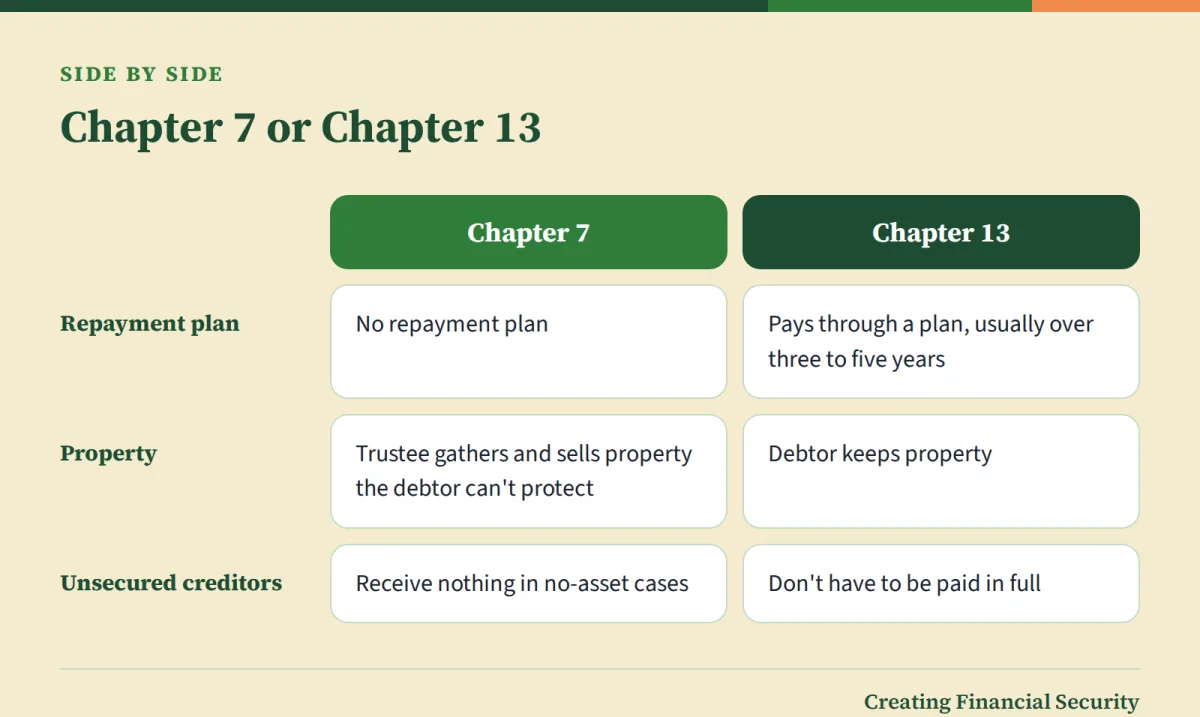
Chapter 7 has no repayment plan. A trustee gathers the property the debtor can't protect, sells it and shares the proceeds with creditors. Exempt property can be kept, though the courts warn that a filing may cost a person property that isn't exempt. Some property is also tied to liens or mortgages.
The courts say most Chapter 7 cases involving individuals are “no asset” cases. Everything is exempt or tied to valid liens, so unsecured creditors receive nothing.
The trustee holds a meeting of creditors between 21 and 40 days after filing, where the debtor answers questions under oath. Leaving out cases that were dismissed or converted, more than 99 percent of individual Chapter 7 cases end in a discharge. The order usually comes about 60 to 90 days after the creditors' meeting was first scheduled, unless someone objects.
Chapter 13: a court-approved plan
Chapter 13 is for individuals with regular income. The debtor keeps property and pays through a plan, usually over three to five years, and the plan may repay all or part of what's owed. While the plan runs, creditors are barred from beginning or carrying on collection efforts.
Unsecured creditors don't have to be paid in full. But the plan must commit the debtor's projected disposable income for the required period, and creditors must receive at least what they would in a Chapter 7 liquidation. A judge holds a confirmation hearing within 45 days after the meeting of creditors.
Why income and state law change the comparison
Two things make one person's filing a poor template for another's.
First, income. For an individual whose debts are primarily consumer debts, income above the state median triggers a means test to determine whether a Chapter 7 filing is presumed abusive. The courts define “current monthly income” as an average over the six calendar months before filing. It counts regular household contributions from others and, in a joint case, a spouse's income, but not Social Security. In Chapter 13, comparison with the state median also shapes the length of the plan.
Second, state law. The Bankruptcy Code lets people protect certain property under federal bankruptcy exemptions or their home state's. Many states require their own list; others let the debtor choose. The courts say whether property is exempt is often a state-law question, and an attorney can explain what applies where you live. A coworker's story or an online list may not match your state.
Before touching the 401(k), IRA or car title
Some moves with retirement money are worth understanding before they happen.
Whether your 401(k), your old IRA and your car count as exempt, and up to what amount, is the question to put to a bankruptcy attorney before any money leaves an account. Exemptions come from federal bankruptcy law or your state's, and in some states you choose between them.
The courts also describe a trustee's “avoiding powers.” These include setting aside certain payments made to creditors in the 90 days before a petition and pursuing fraudulent-transfer claims under state law. A court may refuse a discharge if property was fraudulently transferred, hidden or destroyed.
In plain terms, shuffling money or titles in a panic can create a new problem. Paying back a relative, retitling a car or emptying an account are questions to ask an attorney first.
A short list of what to check:
- The 401(k). Which rule would protect it, if any, and what would a withdrawal cost in taxes? Does the plan offer loans?
- The old IRA. The same questions, plus the fact that IRAs have no participant loans.
- The car. How much is owed, who holds the lien, and how does each chapter treat the loan? In Chapter 13, a plan that keeps collateral must give the lender at least its value, and for some recent purchase loans, full payment.
- Timing. Would any move happen shortly before a filing?
A retirement withdrawal can create a different bill
The IRS says income tax applies to most retirement plan distributions; some also trigger an extra 10% tax. Money taken from an IRA or an employer plan before age 59½ counts as an early distribution, and the extra 10% applies unless an exception fits.
The IRS lists exceptions, each with its own conditions. A few that might matter to someone facing medical bills:
- Unreimbursed medical expenses. The exception concerns only the amount of those expenses that exceeds 7.5% of adjusted gross income, not the whole bill.
- Disability. Total and permanent disability of the account owner.
- Emergency personal expense. One distribution per calendar year, for distributions made after 12/31/2023, limited to the lesser of $1,000 or the vested account balance over $1,000.
An exception speaks to the extra 10% tax; the income tax on the withdrawal is a separate question. The IRS points to Form 5329 for reporting, and a tax professional can say whether an exception fits.
Plan loans work differently. A 401(k) plan may offer loans, but it doesn't have to. If it does, the IRS sets the ceiling at $50,000 or, when lower, the larger of $10,000 and 50% of the vested balance. Earlier loans can reduce what's available, and a plan may require a spouse's consent.
Repayment must generally be finished within 5 years, in regular payments at least quarterly.
A loan that isn't repaid on schedule is generally treated as a taxable distribution of the unpaid balance. The IRS says that includes any early distribution tax.
IRAs are different. The IRS says they don't permit loans, and that includes SEP and SIMPLE IRAs. Borrowing from an IRA ends its status as an IRA and puts its full value into the owner's income. Pledging part of an IRA as collateral treats that part as distributed.
Bring these records and cost questions to a legal consultation
Gathering papers can help you prepare questions for a consultation. The federal courts list what a Chapter 7 or Chapter 13 filing requires, and that list works as a checklist.

A starting checklist
- A list of monthly living costs: food, clothing, shelter, utilities, taxes, transportation and medicine.
- Your assets and debts, with each creditor's name and address. The clerk sends notice of the case to the creditors whose names and addresses you provide.
- Your most recent tax return or transcript, and any returns filed while the case is open.
- Proof of pay from employers in the 60 days before filing, plus a note on any expected change in income or expenses.
- Any interest in federal or state education or tuition accounts.
- Retirement statements, the car title and loan papers, and the hospital bill with any financial assistance letters.
- If you're married, your spouse's income and expenses. The courts generally require them even when only one spouse files.
Costs to ask about
Court filing fees differ by chapter, so check the court's current fee schedule and ask separately about attorney fees. A joint petition pays one set of court fees.
With the court's permission, an individual may pay in up to four installments, with the last due within 120 days of filing. The court can stretch that for cause, but not past 180 days. Unpaid fees can lead to dismissal. In Chapter 7, the court may waive fees when income is below 150% of the poverty level as the Bankruptcy Code defines it and installments are still out of reach.
Those are court costs only. It's reasonable to ask an attorney what the fee covers, when it's due and whether payment plans exist. Legal aid offices may help people with limited income, though availability varies.
Disclosure matters too. The debtor answers questions under oath at the creditors' meeting, and a court can deny or revoke a discharge over fraud or hidden property.
What relief would mean for credit and the next repair bill
Many people worry that bankruptcy will damage their credit. The federal courts say the trustee asks questions at the creditors' meeting so the debtor understands the possible consequences of seeking a discharge, including the effect on credit history. In plain terms, bankruptcy can affect credit history, so how much and for how long are good questions for the consultation.
Your own reports show what's actually there. USAGov says most credit reports don't include a score, so reading yours shows the account history lenders may see. If a bureau denies a request for a report, USAGov says to contact it first, and to contact the CFPB if the issue stays unresolved.
Chapter 13 would mean living on a fixed budget for years, which the courts say takes some adjustment.
An unpaid medical bill and a bankruptcy record are different
A medical bill and a bankruptcy filing raise three separate questions. Is a particular bill actually owed? What does a credit report show about it? What does a court record show?
A credit report is a history of your accounts. An entry showing up or disappearing there doesn't by itself settle whether you owe the bill, and a bankruptcy record is a different kind of record again.
Rules on how medical debt appears on credit reports can change, so it's worth checking the current status before relying on what you've heard. The credit bureaus, the CFPB and a consumer attorney can each help with that.
The bottom line
Bankruptcy is a legal option for debts that can't realistically be paid, not a verdict on your character, and no single dollar amount decides whether it fits. The order of review matters. Confirm what's actually owed, see whether the hospital bill can change through financial assistance, look at realistic payment arrangements and approved counseling, and get legal clarity before touching accounts that may be protected.
Retirement money deserves the most caution. A withdrawal can bring income tax and possibly an extra 10% early-distribution tax. A plan loan that goes unpaid can become taxable, and IRAs don't allow participant loans. Whether those accounts are protected depends on the applicable federal and state rules, and a bankruptcy attorney can review your situation.
Taking these steps in order is a calmer way to decide than reacting in the middle of a bad month.
Questions readers ask
Can I borrow from my IRA instead of filing?
Will filing bankruptcy make me lose my job?
Does my spouse have to file with me?
What if I cannot afford the filing costs?
Can I wait if a collector has already sued me?
Will bankruptcy erase the loan on my car?
Sources
- IRS: Retirement topics: exceptions to tax on early distributions
- IRS: Financial assistance policy and emergency medical care policy – Section 501(r)(4)
- IRS: Retirement plans FAQs regarding loans
- USAGov: Learn about your credit report and how to get a copy
- United States Courts: Chapter 7 - Bankruptcy Basics
- United States Courts: Chapter 13 - Bankruptcy Basics