

Compare how each lender documents and counts your business income before you compare written prices for the same refinance. A lower advertised rate isn't a complete offer, because the price can depend on an income review that hasn't finished.
That order matters when income supporting the application includes contract billing, a side business or a co-borrower's business.
This guide is part of our larger one on comparing refinance offers when self-employed.
Start with the income the lender will actually use
A refinance replaces an existing mortgage with a new loan. The Federal Reserve describes a review much like the original application: lenders assess earnings, assets, credit and existing debt, along with the home's value and the requested borrowing.
Business receipts and business profit are different figures. Schedule C accounts for business income and deductible expenses; ask the lender how those records support the income it will use.
The CFPB's repayment rule gives that decision a frame. For covered loans, it generally requires lenders to verify the income they rely on using reasonably reliable records; exceptions apply. A tax-return transcript from the IRS is one record a lender may use. The rule also has the lender weigh your monthly debts, including the new payment and related costs such as property taxes and homeowners association fees, against your monthly income, or look at the income left after those debts.
Ask which calculation rules apply to the proposed loan and how the lender uses your records to reach its income figure. Ask it to identify any assumptions that still need confirmation.
A hospital job, contract work and a side business are different cases
One household can hold several kinds of income, and each leaves a different paper trail.
- Employee wages. These appear on a Form W-2 and on payroll statements. The federal rule names both among the records a lender may use to check income.
- Contract billing. Payers may report it on Form 1099-NEC or Form 1099-MISC. The IRS says a sole proprietor uses Schedule C to report income or loss from a business or profession, including certain amounts shown on those forms.
- A side business. For Schedule C, the IRS looks for a profit-seeking purpose and ongoing, regular participation. A hobby or merely occasional activity does not meet that business definition.
- A co-borrower's business. If someone else's income supports the application, ask each lender which of that person's records it needs. Leaving one person's income out does not necessarily remove every documentation question, because the lender still looks at debts and loan terms.
Why deposits and taxable profit may tell different stories
Schedule C separates business receipts from expenses and reports the resulting profit or loss. Under the cash method, income generally belongs to the year it is received or made freely available; deductible expenses generally follow payment, subject to exceptions.
A deposit total alone does not account for deductible business expenses. Ask what additional records the lender needs to distinguish receipts from profit.
Ask each lender whether it adjusts any figures on the return when it calculates income, which ones, and why. That is a mortgage question, not a tax one. A qualified tax professional can talk through how your own return was prepared.
| Record | What it shows |
|---|---|
| IRS tax transcript | One permitted way to check income |
| Filed returns | Federal or state tax records |
| W-2 | Reports wages or tax withholding |
| Schedule C | Sole-proprietor business earnings or losses |
| Forms 1099-MISC, 1099-NEC and 1099-K | Some reported amounts may require Schedule C |
Give each lender the same picture of your business
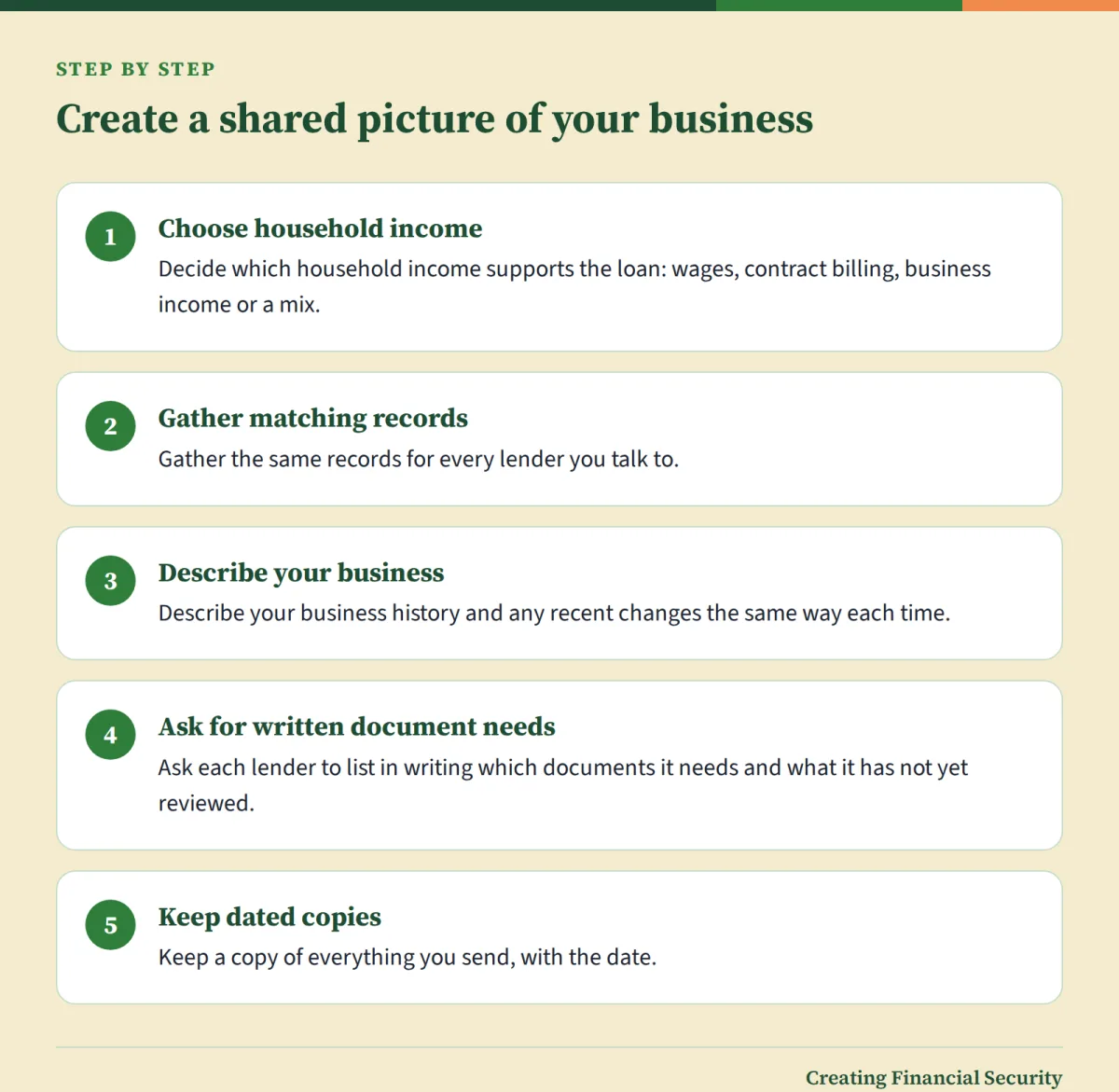
It's hard to compare lenders when each has seen different papers. A shared baseline gives you a steadier starting point:
- Decide which household income supports the loan: wages, contract billing, business income or a mix.
- Gather the same records for every lender you talk to.
- Describe your business history and any recent changes the same way each time.
- Ask each lender to list in writing which documents it needs and what it has not yet reviewed.
- Keep a copy of everything you send, with the date.
This makes the lenders' responses easier to compare, though other differences may remain. It doesn't promise approval from anyone.
Build a document list around your business structure
The records depend on how the business is set up. Here are the kinds that come up in the federal rule and the IRS instructions:
- Tax returns. Federal or state returns already filed are among the permitted verification records.
- Schedules accompanying the return. For a domestic LLC with one owner, Schedule C generally applies unless Schedule E or Schedule F fits the activity, or the business has elected corporate tax treatment.
- Forms 1099. These list payments reported to the IRS that may be business income.
- A business shared with a spouse. Joint ownership and operation of an unincorporated business, with shared profits and losses, generally means partnership treatment. Form 1065 generally applies, but exceptions include eligible joint-venture elections and certain community-property businesses.
- Current financial records and proof of ownership. Ask each lender what it wants here and for which period.
Ask which records the lender needs for the business structure and tax treatment involved.
Flag changes instead of letting the file explain them
If earnings rose or fell, the business is new, there was a loss, or business money may cover cash at closing, say so early and ask how the lender would handle it. The Loan Estimate shows a Cash to Close figure, so it helps to know where those funds will come from before you're asked.
Find out who will review your income—and how
For covered transactions, the federal rule requires a reasonable, good-faith repayment determination by closing. Rather than infer a review process from a lender's label, ask:
- Who reviews business income, and how often do they handle files like mine?
- Which records do you need, and for what period?
- Will you rely on my tax returns, or on other records?
- What conditions would still be open after you issue a written offer?
- Will you tell me in writing if the income you count differs from what I reported?
The Federal Reserve notes that an existing lender might waive or reduce refinancing charges to retain a borrower. It also encourages telling lenders that you are comparing offers.
Ask for the calculation method and the remaining conditions
A preliminary conversation isn't the same as a reviewed file. Ask whether a quote rests on documents the lender has examined or on figures you described over the phone. Then ask what remains unreviewed.
Because the repayment rule generally calls for verification with reliable records, expect questions about records, not just your description. Ask to see how the lender arrived at its income figure, and ask for that in writing.
Separate program rules from a lender's own requirements
The Loan Estimate identifies the loan type, including conventional, FHA and VA. Ask which type the lender proposes and which income-documentation rules apply to it.
Then ask whether any requested document reflects a program rule or an additional lender requirement. Request a written explanation rather than assuming the requirements are identical.
Understand what changes when tax returns are not the main evidence
If a lender proposes relying on records other than tax returns, ask what it would review, how it would calculate income and which rules permit that approach.
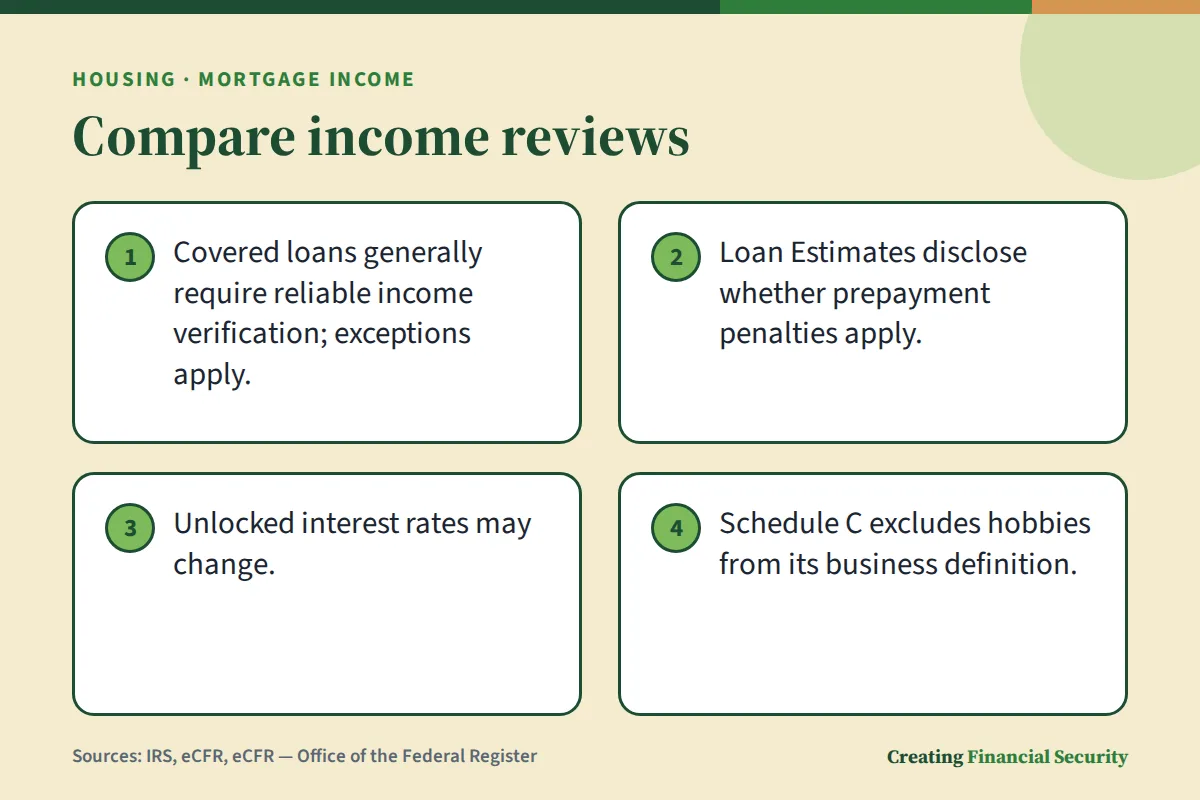
For covered loans, income verification generally requires reliable third-party evidence; exceptions apply. The rule's examples include filed returns, wage forms, pay statements, employer information and government benefit records. Ask which verification provisions apply to the proposed loan.
A fair comparison asks the same four things of either approach: what is reviewed, who verifies it, how it affects cost, and which protections stay in place.
Bank statements do not automatically establish spendable income
If a lender proposes using bank statements, ask what the statements must show and how the lender will turn them into an income figure. A deposit is not profit. Schedule C reports gross receipts and business expenses separately.
For a proposed statement-based review:
- How do you treat money moved between my own accounts?
- How do you account for money that goes out to run the business?
- What happens if the figure from statements differs from what my return shows?
A written answer is easier to compare than a spoken one.
Ask about costs, loan terms and protections together
The Federal Reserve encourages comparing costs alongside interest rates. The Loan Estimate organizes terms, payment projections and closing charges in a standard format. Questions to include:
- Whether the loan carries a prepayment penalty. The Loan Estimate must say whether it does, and the Federal Reserve notes that a penalty lengthens the time to break even.
- Whether the rate is fixed, adjustable or step, as the form labels it.
- How long any rate lock lasts, and when the estimated closing costs expire.
- What a no-cost offer means. The Federal Reserve explains that one arrangement trades lender-paid closing charges for a higher ongoing interest rate. Ask which charges are covered and how the offer changes the loan's terms.
Line two quotes up only after their features match.
Put income assumptions beside the written offer
The Loan Estimate shows price. It doesn't show the income assumptions behind the price. A short worksheet can sit beside it, with one column per lender and the same rows each time:
- Income the lender says it will count
- Period of records it is using
- Documents received, and documents still missing
- Loan program and loan type
- Conditions still open
- Fees and closing costs on the Loan Estimate
- Expected review time
The Federal Reserve provides mortgage comparison worksheets. An income-review checklist can accompany the written pricing information.
Record what is verified, estimated or still missing
Mark an item verified only when the lender confirms that its review is complete; a document's receipt or review alone does not establish final approval. Mark it estimated when the lender is working from your description. Mark it missing when the lender hasn't received the item yet.
Keep unresolved questions in a separate note. A lender can hold every record you sent and still have a question about one of them. Two offers can show the same rate while standing in very different places, and the worksheet makes that visible without ranking anyone.
Check whether the quoted price depends on an unfinished review
The Loan Estimate says the rate, points and lender credits may change unless the rate has been locked. It also gives a date and time when its estimated closing costs expire.
If a quote depends on income the lender hasn't finished reviewing, ask whether the price, or even whether the loan is available, could change once that review ends. The repayment judgment is made at or before closing, so an open income question can matter late in the process. Ask each lender to answer in writing.
Walk through a refinance file before choosing a lender
Here is a made-up example with no dollar figures. Suppose you have an existing mortgage and two written quotes. The first lender gave a quote after a phone call and has received none of your records. The second has received and looked over your tax return and your contract billing records, but hasn't said its income calculation is final.

Neither lender has confirmed an income figure. That is the useful thing the worksheet shows: a quote built on a description, and a quote built on documents that are still under review. Nothing here says either lender is better.
If part of the household income comes from contract billing
Suppose some household income is contract billing reported on Form 1099-NEC. Work through the two lenders in this order:
- Write down what each lender says it will count as income.
- Mark whether each lender has received the Forms 1099 and the return, only been told about them, or neither.
- Ask each lender whether its income calculation is final, and mark the answer.
- List the conditions each lender still has open.
- Note whether each quote depends on income that hasn't been confirmed.
Resolve the uncertainty before treating the offers as comparable
These follow-up questions turn an incomplete quote into one you can weigh:
- What income figure will you use, and how did you reach it?
- Which records are still outstanding?
- Could the quote change after your review ends?
- Does the loan program or your own policy set this requirement?
- How long do you expect the review to take?
Before a fee becomes nonrefundable, the Federal Reserve encourages obtaining written loan details and asking about anything unclear. It directs borrowers seeking local housing counseling to the U.S. Department of Housing and Urban Development.
Protect the application between document review and closing
Business records hold sensitive details such as account numbers and tax identifiers. Handing them over carefully is part of the process:

- Independently confirm the lender's contact details, then ask how to send documents securely.
- Check any later request for documents the same way, using contact details you looked up yourself.
- Keep a log of what you sent and when.
- Ask the lender what it needs if something about your business changes before closing.
Use a verified document channel
The IRS's identity-theft precautions include avoiding suspicious links, attachments and web addresses. It also calls for safeguarding Social Security numbers and account access details. Those are general security precautions, not mortgage-specific submission rules.
For a request to authorize access to tax information, independently confirm the requester before signing.
Ask which changes require another review
Before closing, ask the lender whether any of these would need updated information:
- Updated financial records for the business
- A change in the business itself, such as a new structure or a loss
- A new debt, since lenders consider current debt obligations
- A change in employment status, if wages are part of the income relied on
Ask for written instructions about reporting changes and supplying updated records.
The bottom line
When business income is part of a refinance application, the rate is only one piece. The first piece is what income each lender can verify and count, and how it gets that figure from your records.
A steady sequence runs like this: establish the usable income, find out which conditions are still open, then line up equivalent written terms and costs. A Loan Estimate from each lender, a worksheet of income assumptions and written answers to your questions are the tools.
Questions about a particular income source belong with the lender reviewing it. A qualified tax professional can address an individual return, while a housing counselor can help discuss the mortgage decision.
This is general information, not individualized financial, tax or legal advice.
Questions readers ask
Can I refinance if I recently became self-employed?
Does a credit union approve self-employed borrowers more easily?
Can business deductions reduce the income a lender counts?
What if my spouse has a regular paycheck and I run a business?
Sources
- Federal Reserve Board: Refinancing costs, comparing offers, points, simple break-even calculations, financed cost
- eCFR: 12 CFR 1026.37 -- Content of disclosures for certain mortgage transactions (Loan Estimate)
- IRS: Taxpayer guide to identity theft
- eCFR — Office of the Federal Register: 12 CFR 1026.43 -- Minimum standards for transactions secured by a dwelling
- IRS: Instructions for Schedule C (Form 1040)