

A refinance offer can raise another question: is paying extra at closing for an even lower rate worth the cost? Discount points can be worth it when the monthly savings earn back their cost before the loan is paid off, sold or replaced.
How much a point lowers the rate isn't a fixed number. It comes from each lender's actual quote, so the comparison needs real quotes and a realistic guess about how long you will keep the loan.
That guess carries more weight than any formula. Even a lower rate may not recover the upfront costs before a move, and paying points adds another cost to recover.
It helps to keep two questions apart: whether the points are worth buying, and whether the refinance is worth doing at all. A housing counselor can help review actual offers, while a tax professional can address deduction questions.
Find the charge that actually buys a lower rate
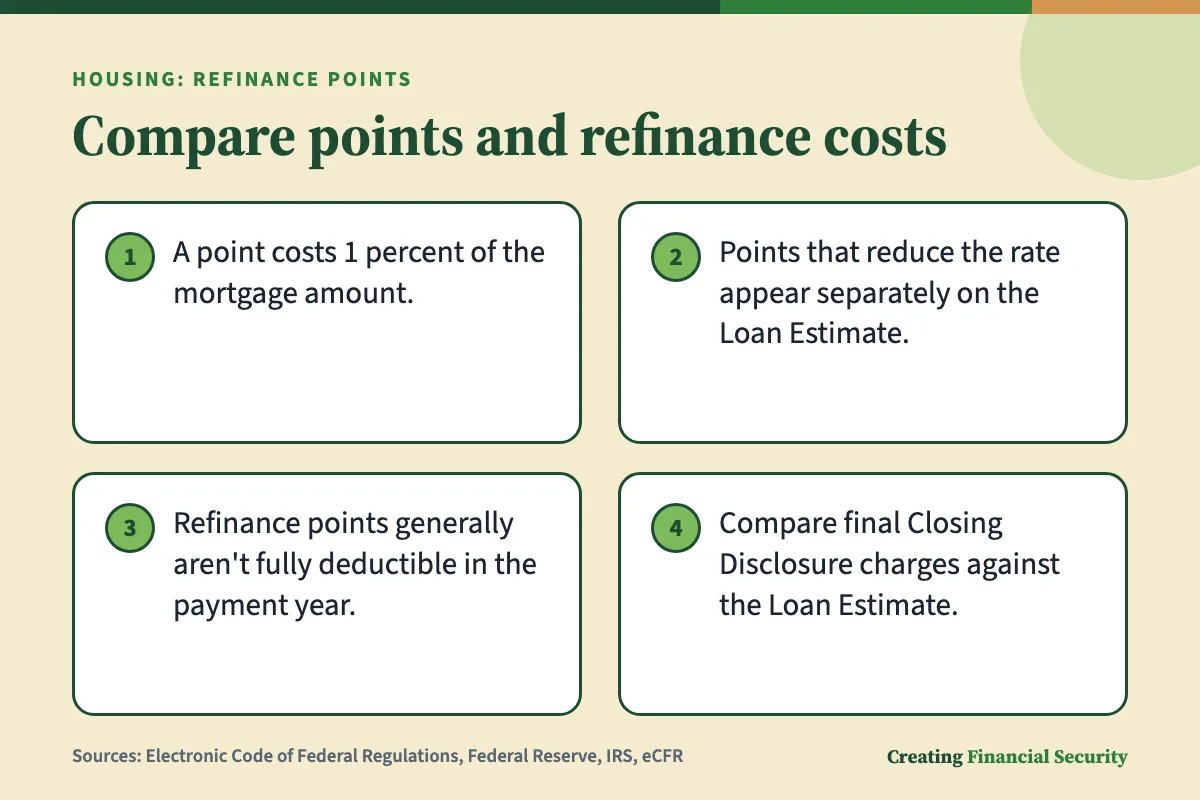
The Federal Reserve describes loan-discount points as a one-time payment made to lower the interest rate on your loan. A point costs 1 percent of the amount borrowed; the quote should also show that charge in dollars.
The wording can mislead. The Federal Reserve says some lenders and brokers also charge points as a way to earn money on the loan, which has nothing to do with your rate. The IRS adds that the term points covers several labels on loan paperwork, including discount points, loan discount and loan origination fees. Two quotes can both list points and mean different things, so it's fair to ask what each charge does. The Federal Reserve also notes that the number of points a lender charges can be negotiated.
Where points show up on your paperwork
Federal Loan Estimate rules say points paid to the lender to reduce the rate get their own line under origination charges. The line shows the charge twice, as a percentage of the loan and as a dollar amount, and it stays blank if you aren't paying points to lower the rate. That line comes first in the origination list.
The Closing Disclosure presents final terms and costs for comparison with the Loan Estimate. Its cost items must use a matching sequence, helping borrowers check for changes.
On a quote, look for these items:
- The points line, in percent and in dollars
- Any separate origination charge, which an older Federal Reserve guide places between 0% and 1.5% of the amount borrowed
- The interest rate and the monthly principal and interest payment in the loan terms table
- Whether the loan has a prepayment penalty
How it works, step by step
- The Federal Reserve suggests recording each lender's answers on a mortgage-shopping worksheet.
- The Federal Reserve says to obtain written loan information before paying a fee that cannot be refunded.
- Find the points line under origination charges on the Loan Estimate and note both the percentage and the dollar amount.
- To test the whole refinance, divide your closing costs by the monthly savings you expect.
- When the final papers arrive, compare the Closing Disclosure against your Loan Estimate.
What determines the price of buying down a refinance rate?
The cost side is straightforward. Because points are percentage-based charges, the same number of points costs more on a larger loan. An older Federal Reserve guide gave a range of 0% to 3% of the principal for points of both kinds. Think of that as a historical reference, not today's price list.
The rate side is where offers differ. The percentage used to price a point is not a promise of an equally sized rate reduction. The Loan Estimate simply shows the interest rate and the points charge for that particular offer, so what a point buys is whatever that lender's quote says.
That is why working out how much to buy down points has two parts to read together: the percentage, which is defined, and the rate it earns, which comes from the quote. Useful questions for each lender are what rate it offers with no points and what rate with points on the same loan amount and term, what the points charge is in dollars, whether the points lower the rate or are paid to the lender for making the loan, and when the quote expires.
Why advertised rates need context
The Federal Reserve points out that mailers and ads are marketing materials, designed to make a mortgage look as appealing as possible. A low rate in an ad doesn't say what was paid up front to get it, and the Federal Reserve says a wide gap between an advertised starting rate and the APR may signal high fees.
Rates and points can change daily, so quotes are easiest to compare when collected close together. The Federal Reserve describes a rate lock as a way to secure the offered interest rate and says the commitment belongs in writing. The Loan Estimate itself must say that the rate, points and lender credits may change until the rate is locked, and when estimated closing costs expire.
Put the no-points and points offers side by side
Whether an offer comes from a bank, a credit union or an online lender, the Federal Reserve suggests taking a worksheet to each one and filling it in as you talk. The VA says terms and fees vary, so contacting several lenders makes sense. The Federal Reserve adds that a current lender may be willing to trim or waive some usual fees, particularly when your existing loan is only a few years old.
The aim is matched quotes: the same loan amount, the same term and the same rate lock period, with one quote that includes points and one that doesn't. When those three line up, the two offers are much easier to read.
That doesn't mean points are the only difference. Other fees, lender credits and loan features can differ between offers, so check those too. Then use two gaps to screen the points: the difference in upfront cost and the difference in monthly principal and interest.
Here is a blank checklist to copy onto paper for each offer:
- Loan amount and term
- Interest rate
- Points, as a percentage and in dollars
- Monthly principal and interest payment
- Other lender and third-party fees, and total closing costs
- Lender credits, if any
- Cash to close
- Prepayment penalty: yes or no
- Rate lock end date and time
The Federal Reserve calls for written loan information before a borrower pays a fee that cannot be refunded. Comparing offers and negotiating charges may reduce borrowing costs; the checklist focuses on terms rather than lender type. When final papers arrive, the Closing Disclosure lets you test them against the Loan Estimate line by line.
When do payment savings recover the points charge?
A break-even check divides what you pay up front by what you save each month. The VA describes that step for refinancing in general: divide your closing costs by the monthly savings you expect. The Federal Reserve adds that it is especially useful when a move may be coming soon.
The first table is a general refinance illustration, not a points-versus-no-points comparison. It shows how the method works when a full set of closing costs is divided by the monthly payment savings.
| Amount | |
|---|---|
| Monthly payment at 6.5% | $1,896.20 |
| Monthly payment at 6% | $1,798.65 |
| Monthly savings | $97.55 |
| Closing costs | $6,000 |
| Months to earn back the closing costs | 62 months |
Fixed rates, principal and interest only; the new loan has the same balance and term; closing costs paid up front. These figures assume fixed rates, principal and interest only, the same balance and term on the new loan, and closing costs paid up front.
In the made-up example above, the payment falls by $97.55 a month, and $6,000 in closing costs takes 62 months to earn back. Keeping the loan for fewer months than that would leave the costs unrecovered by payment savings alone.
For a points-only test, the separate made-up example holds the amount borrowed, repayment term and other charges constant across the quotes. That isolates two figures: the extra cash the points quote asks for at closing, and how much lower its monthly payment is. Dividing the first by the second gives the months needed to recover the points. Real quotes rarely match that neatly, which is why the checklist asks about other fees.
If the points quote doesn't lower the payment, this calculation gives no break-even period, and total cost and remaining balance become the better yardsticks.
What this simple break-even calculation leaves out
Break-even is a screening tool, not a verdict. Several things sit outside it:
- Interest timing. Early payments on a long-term mortgage can contain a larger share of interest. Compare loan balances as well as payments.
- What the cash could have done. Money paid at closing isn't available for other uses. The Federal Reserve notes that some refinance calculators ask what you could earn on investments, since that choice has a price too.
- Balances and terms. The Federal Reserve says a new loan with a longer term than your remaining one sends less of the early payments to principal, slowing equity build-up.
- Total interest. For anyone planning to keep a loan to the end, the Federal Reserve suggests comparing total interest and equity build-up under both loans, not only the monthly payment.
Check the whole refinance against keeping the 7% loan
Points are one piece. The bigger question is whether the refinance itself beats the loan you have, so it's worth testing separately. A refinance can make sense with no points at all, and points can be a poor trade inside an otherwise good refinance.
An older Federal Reserve guide describes refinancing charges equal to 3 percent to 6 percent of the remaining principal as not unusual. It also notes differences among states and lenders. Its older guide also itemizes charges such as application and survey fees. Treat those ranges as dated examples, not current prices; the Loan Estimate shows the actual amounts for an offer.
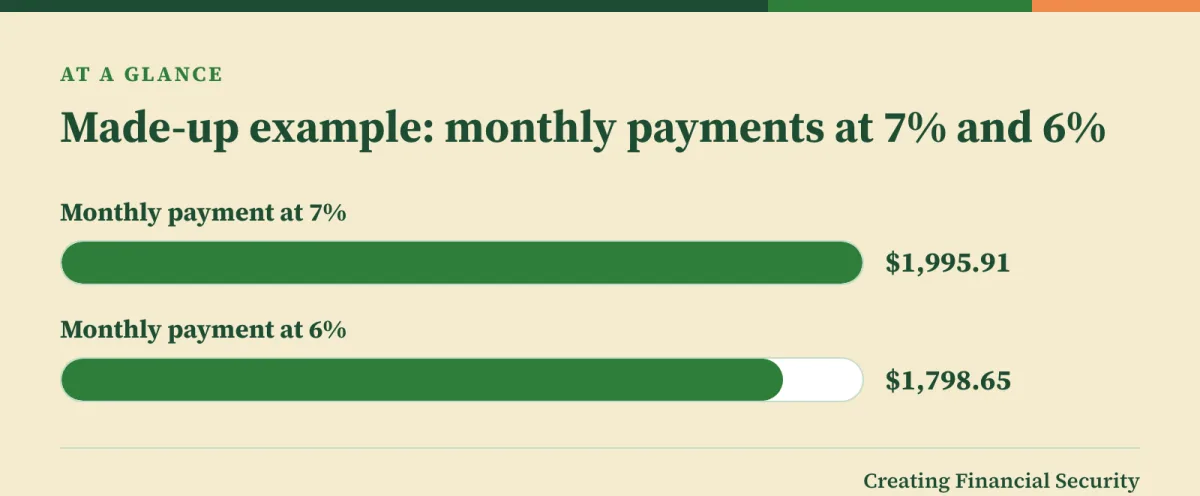
The second made-up example compares a refinance with keeping a current 7% loan, under the same assumptions as the first table.
| Amount | |
|---|---|
| Monthly payment at 7% | $1,995.91 |
| Monthly payment at 6% | $1,798.65 |
| Monthly savings | $197.26 |
| Closing costs | $9,000 |
| Months to earn back the closing costs | 46 months |
Fixed rates, principal and interest only; the new loan has the same balance and term; closing costs paid up front. In the made-up example above, refinancing from 7% to 6% lowers the payment by $197.26 a month, and $9,000 in closing costs takes 46 months to earn back. A real loan has its own balance, rate and costs, so this only shows how to set up the comparison.
Why a restarted term can distort the payment comparison
Both made-up tables hold the balance constant and compare loans with 30 years remaining, which is a simplification. If your current loan has years behind it, restarting the clock changes the picture. The Federal Reserve explains that a growing share of each payment goes to principal over time, and that refinancing late in a loan starts the schedule over, putting most of each early payment toward interest again.
A lower payment can come from a lower rate, a longer term, or both. To understand the trade-offs, compare the rates, remaining terms, payments, balances and total interest side by side.
Prepayment penalties belong in the comparison too. The Federal Reserve says a penalty for paying off the old loan early lengthens the time to break even. The older guide also describes restrictions on these penalties for federal credit unions and loans with federal insurance or backing. The Loan Estimate states whether a loan has one.
Weigh the upfront cash against an uncertain timeline
Break-even assumes you keep the loan long enough to reach it. Moving plans, available cash and the possibility of another refinance can change that comparison.

- Moving. The Federal Reserve says the time you expect to keep the mortgage helps decide whether points are worth paying up front. A shorter stay leaves less time for savings to add up.
- Refinancing again. A later refinance ends the monthly savings tied to the loan you just took, so the break-even you counted on may never be reached.
- Cash on hand. The VA notes that closing costs can add up to thousands of dollars. Money spent there isn't available for repairs or a gap in income, and whether that matters depends on your own cushion.
- Financing the costs. The Loan Estimate has a line for closing costs paid out of the loan amount. Financed costs raise what you borrow, so the comparison has to be run again with the larger balance instead of treating the upfront cost as gone.
- Lender credits and no-cost loans. The Federal Reserve says lenders define no-cost refinancing differently. One arrangement exchanges lender-paid closing costs for a higher rate throughout the repayment term. It suggests asking for a side-by-side of upfront costs, principal, rate and payments with and without that trade, and notes that some no-cost loans carry a prepayment penalty meant to discourage a quick refinance. Lender credits also appear on their own line of the Loan Estimate, which makes them visible when you compare offers.
Which mix fits depends on your timeline and your reserves. The Federal Reserve points to HUD for finding a local housing counseling agency, and a counselor is one place to take your own numbers.
Understand the tax treatment before counting a deduction
A deduction is not automatic simply because a closing statement lists points. IRS Publication 936 sets eligibility rules and limits, and charges for particular loan services are not interest. The debt limits below are for 2025; guidance for the applicable filing year matters.
- Itemizing and qualifying come first. The IRS requires an ownership interest and a qualifying home pledged as security for the debt. Borrowers must also itemize using Form 1040's Schedule A. A qualifying residence may be a main home or second home.
- Refinance points are usually spread out. Refinancing a main-home mortgage does not ordinarily make the entire points payment immediately deductible. The IRS treats eligible points as advance interest, generally allocated in equal portions across the repayment term when its tests are satisfied.
- An improvement exception exists. A substantial improvement to a main home can qualify the related portion of points for an immediate deduction. The IRS requires its applicable tests to be satisfied, including payment from the borrower's own funds. The remaining eligible portion is allocated across the repayment term.
- Same-lender refinancing has its own rule. For points already being deducted gradually, another refinance with that lender does not permit an immediate write-off of the undeducted amount. The IRS requires that amount to be allocated across the replacement loan's repayment term.
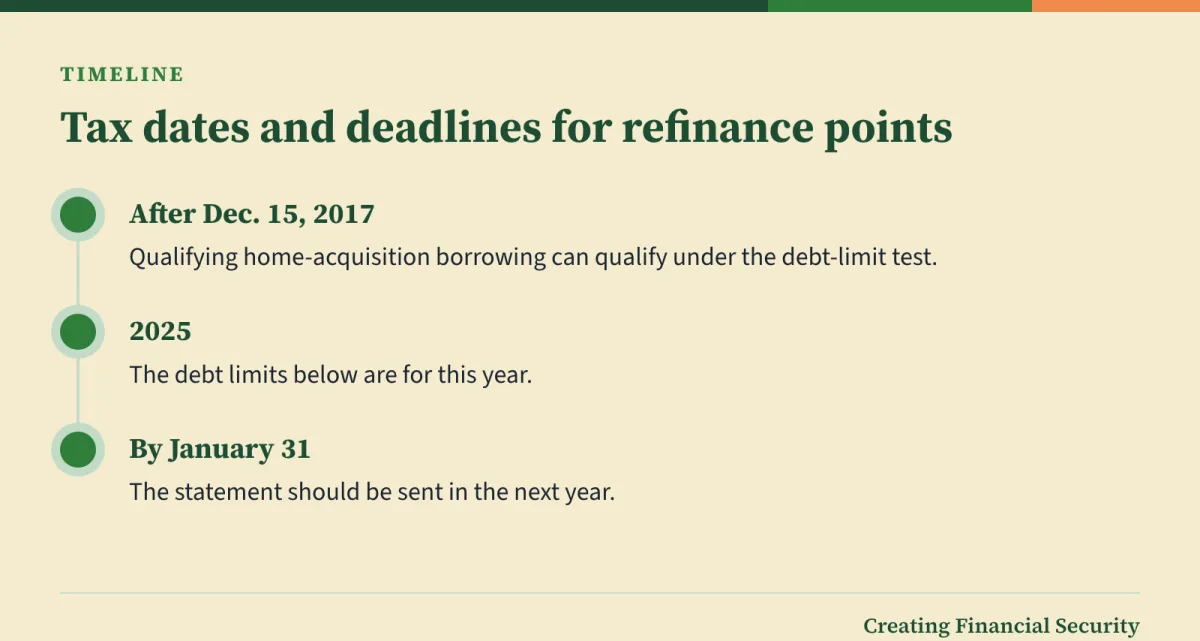
- Debt limits apply. For 2025, qualifying home-acquisition borrowing incurred after December 15, 2017 can qualify for a full interest deduction under this test: its combined balance with grandfathered debt must stay at or below $750,000 for the entire year. The ceiling is $375,000 for a married taxpayer filing separately. Other eligibility requirements still apply. Home-acquisition borrowing means debt used for a home's purchase, construction or substantial improvement; older debt and other situations have different rules.
- Keep your records. The IRS generally calls for Form 1098 or an equivalent statement when annual interest payments on a single mortgage reach $600, including certain points. This applies when the recipient receives that interest as part of its business or trade. The statement should be sent in the next year, by January 31. Settlement records also identify points charges.
Because refinance points are generally spread out and itemizing is required, it's worth confirming how the rules apply to your return before putting a deduction into the break-even math. The IRS publication or a tax professional can answer that.
The bottom line
For the points, matched quotes show what the extra upfront cost buys in monthly payment, and the break-even months show how long that takes to pay back. For the refinance itself, the question is how all the closing costs compare with the monthly savings against the loan you already have, including what a restarted term does to the numbers.
Then comes the part no formula can supply: how long you expect to keep the loan, and how much cash you'd want to hold in reserve instead of spending it at closing. A move or another refinance can end the payment savings before they recover the upfront cost.
For tax questions, the IRS publication or a tax professional can say how refinance points apply to your return, and a housing counselor can go through your own offers with you.
Questions readers ask
How much does one point lower the interest rate?
What happens to the points I paid if I refinance again?
Can discount points be added to the new loan balance?
Does a no-points refinance mean there are no closing costs?
Can I deduct all my refinance points in the year I pay them?
Sources
- Federal Reserve Board: Refinancing costs, comparing offers, points, simple break-even calculations, financed cost
- IRS: Publication 936: Home Mortgage Interest Deduction
- Veterans Affairs: Interest rate reduction refinance loan
- eCFR: 12 CFR 1026.37 Content of disclosures for certain mortgage transactions (Loan Estimate)
- Electronic Code of Federal Regulations: 12 CFR 1026.38 Content of disclosures for certain mortgage transactions (Closing Disclosure)