

A refinance offer can boil down to one tempting number: a rate, a payment, a promise of savings. But a rate in an advertisement isn't a quote built on your finances, and two offers only compare fairly when they describe the same loan.
The steadiest way to weigh a bank, a credit union and an online lender is to set their written offers side by side. Match the loan amount, term, loan type, quote date and rate-lock assumptions first. Then compare costs, how the payment is built and how long it takes to earn back what you pay at closing.
The type of lender doesn't decide the winner. It may say something about how you apply and where you can get help, but the price lives in the paperwork.
Compare matching refinance quotes
The Federal Reserve's consumer guide explains that refinancing means paying off your existing mortgage and creating a new one. So every offer is a proposal for a brand-new loan with its own rate, term and costs, and two proposals line up only when they rest on the same footing.
That's why advertised rates are a starting point at most. The Federal Reserve notes that ads and mailings are marketing, built to make a mortgage look as attractive as possible. An application gets a fuller review: the lender examines earnings, assets, credit history, debt obligations, the home's value and the requested borrowing.
The Federal Reserve also suggests reviewing credit reports for errors before shopping.
Keep the amount, term and loan structure consistent
Start with what the loan is for. Swapping your balance for a new rate, a new length or both is a different product from a cash-out refinance, which borrows more than the existing balance and can provide cash. With cash out, closing costs can affect the amount you actually receive.
The Federal Reserve cautions that taking out equity means owning less of your home, and that rebuilding it takes time. It also points to home equity loans and lines of credit as alternatives worth comparing.
Match the term next. A longer term lowers the monthly payment, but the Federal Reserve says it also stretches the years of payments and raises total interest. Shorter terms generally carry lower rates and higher payments, since more principal is paid each month.
Then match the rate type. An adjustable rate can move your payment up or down, while a fixed rate keeps the interest rate steady, though a payment that includes escrow for taxes and insurance can still shift as those bills change.
Finally, note how each lender handles fees. Some are paid at closing, some can be added to the loan, and some can be covered through a higher rate. Offers that answer this differently aren't interchangeable yet.
Record when the quote was issued and whether the rate is locked
The Federal Reserve says rates and points can change daily, so a quote from last month and one from this morning measure different markets. Write the issue date and any expiration date on every quote.
Then ask about a rate lock, also called a lock-in or rate commitment. The Federal Reserve says to obtain a written rate commitment and understand its charges and responsibilities before signing. How long it lasts, what it costs and what happens if closing runs late are fair questions.
How it works, step by step
- Review credit reports for errors before beginning the comparison.
- Obtain written loan terms before handing over a fee that cannot be refunded.
- Request a written rate commitment and an explanation of its charges and responsibilities.
- Calculate how many months of expected payment savings would cover the upfront closing bill.
What lender type does—and does not—tell you
The institution's category is not a price comparison. For its streamlined refinance program, the VA directs borrowers to private lenders rather than lending the money itself. It identifies banks, credit unions and mortgage companies as possible providers and encourages shopping because their charges and terms can differ. The Federal Reserve likewise notes that refinancing fees differ across lenders and states.
Ask each lender about application requirements and available help. Keep those answers separate from the written rate and charges: a convenient process does not establish which loan costs less.
Separate membership and convenience from loan pricing
Familiarity and convenience are different questions from pricing. Compare the written charges before treating either as a reason to prefer an offer. The Federal Reserve encourages borrowers to tell lenders they are shopping around, allowing lenders to compete for the business.
Read next: mortgage brokers versus direct lenders.
Check the offer before comparing it
The Federal Reserve cautions that mortgage promotions may emphasize a low starting payment without giving equal attention to later increases. For an adjustable-rate offer, compare the introductory rate with APR and check how long the introductory period lasts. The VA also warns its borrowers about pitches promising skipped payments or exceptionally attractive terms.

A few quick checks help before an offer earns a place on your worksheet:
- Is it tied to your loan? A general mailer isn't a quote based on your credit and your home.
- Is it really a refinance? A new loan that pays off your mortgage differs from a home equity loan or line of credit.
- Is it current? Look for an issue date and an expiration date.
- Is it in writing? The Federal Reserve says to get each loan's details on paper before paying any nonrefundable fee.
Identify the lender, broker and eventual servicer
Ask who is offering the loan and which charges come from a lender or broker. The Federal Reserve identifies origination charges and some points as fees these businesses may collect. Its guidance also encourages questions about anything unclear and consultation with a housing counselor or attorney when needed. The Federal Reserve urges borrowers to keep asking about loan features until they receive understandable, complete answers.
| Line | What to look for |
|---|---|
| Rate lock | Obtain a written commitment and clarify its costs and obligations |
| Points | Each point represents 1 percent of the mortgage amount |
| Origination charge | Compensation for the lender's or broker's loan assessment and preparation |
| Prepayment penalty | Check for a charge triggered by early payoff or refinancing |
| Escrow | Changing property bills can alter a payment even with a fixed interest rate |
A side-by-side Loan Estimate checklist
The Federal Reserve's older guide refers to a good faith estimate and HUD-1 paperwork. It directs consumers to the Consumer Financial Protection Bureau for updated mortgage information. Ask the lender to explain the current disclosures rather than relying on those older form names.
Whatever the form is called, the idea holds: get a written estimate of closing costs from each lender and compare it line by line with the final papers. Copy the same lines from each estimate onto one sheet:
- Lender name and the date of the quote
- Loan type, loan amount and term
- Interest rate, and whether it's locked and until when
- Annual percentage rate (APR)
- Points, and any lender credits
- Charges the lender or broker sets, such as application and origination fees
- Other closing costs, such as title work and a survey
- Escrow amounts for taxes and insurance
- Any prepayment penalty
- Cash needed at closing, or costs added to the loan balance
- Monthly payment, first for principal and interest alone, then with escrow
A blank line is useful, because it shows what a lender hasn't told you yet. The Federal Reserve says to keep asking about loan features until the answers are clear and complete.
Compare pricing separately from prepaid expenses and escrow
A single closing total can obscure the difference between loan charges and money collected toward property bills. Keep escrow for taxes and insurance separate from the fees already listed on the worksheet.
Listing these separately shows why cash at closing differs between offers. The Federal Reserve notes that an escrowed payment can change as taxes, insurance or community association fees change, so principal and interest alone is the cleaner comparison.
Read points, lender credits and APR together
The Federal Reserve defines a point as a charge equal to 1 percent of the mortgage balance being borrowed. Loan-discount points are a one-time charge to lower the rate, and whether they're worthwhile depends partly on how long you expect to keep the mortgage. Other points are charged to earn money on the loan, and the number can be negotiated.
A credit can trade lower upfront charges for a higher interest rate that continues throughout repayment. For a higher-rate option, ask the lender to show the up-front charges, loan balance and monthly payment alongside an alternative without the credit.
APR is a useful flag, since a wide gap from the quoted rate can point to high fees. But it's one figure. Read it alongside the rate, points, credits and cash due at closing, and against how long you expect to keep the loan.
When closing costs earn their way back
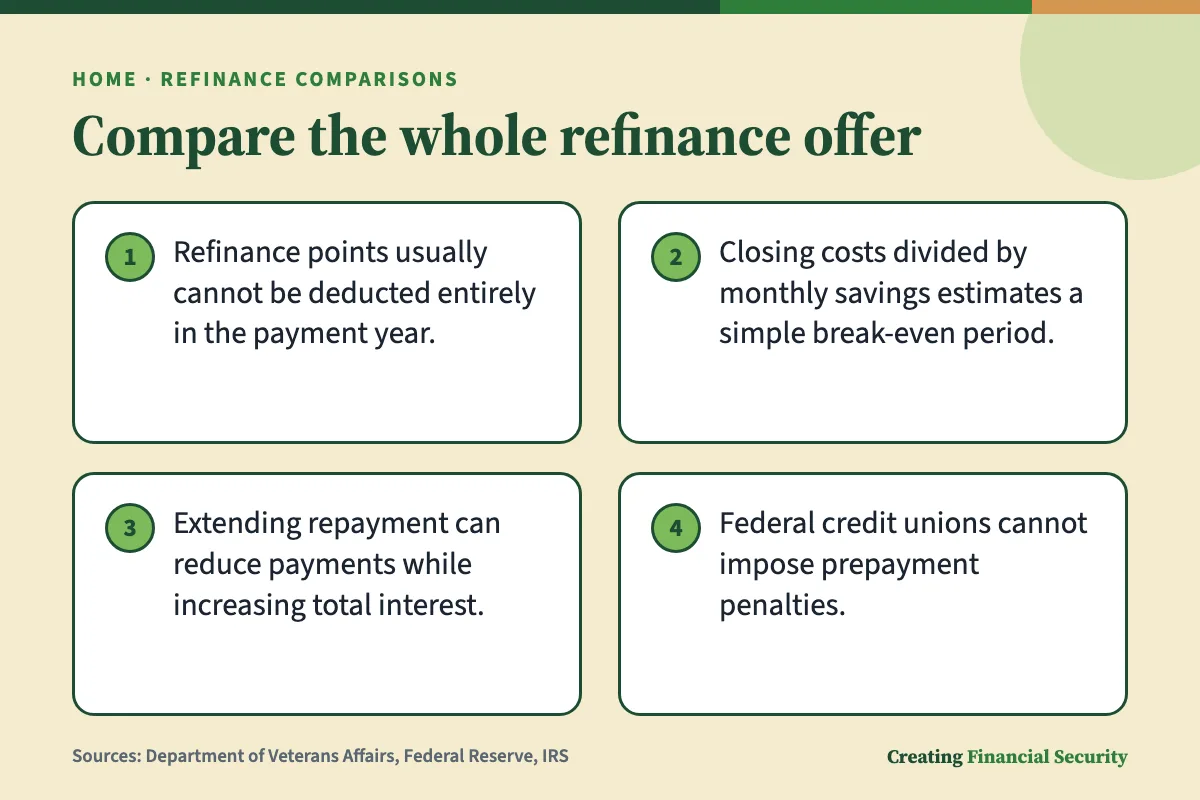
Under every offer sits one question: will the monthly savings outrun what you pay to get them? The VA suggests dividing your closing costs by your expected monthly savings, and the Federal Reserve calls a break-even check especially useful if you might move soon.

A made-up refinance, step by step
The table below is a made-up example, not a quote from any lender. Its balance, rates and costs are invented to show the method: find the old and new payment on the same balance and term, subtract to get the monthly savings, then divide the closing costs by that saving.
| Amount | |
|---|---|
| Monthly payment at 7% | $1,995.91 |
| Monthly payment at 6% | $1,798.65 |
| Monthly savings | $197.26 |
| Closing costs | $6,000 |
| Months to earn back the closing costs | 31 months |
Fixed rates, principal and interest only; the new loan has the same balance and term; closing costs paid up front. The table assumes fixed rates, principal and interest only, a new loan with the same balance and term, and closing costs paid up front. The last row counts the months of savings it takes to match the closing costs. Real quotes will give different numbers, so the method matters more than the result. The Federal Reserve suggests testing the benefit over one, two or three years against your plans for staying in the home.
What the simple break-even result leaves out
A simple division skips several things, and each can change the answer:
- No monthly saving. Without a payment reduction, this simple payment-savings calculation cannot produce a break-even date.
- Financed costs. Costs added to the loan become part of the balance, which can affect payments and interest over time.
- Credits paid for through the rate. A credit can cover some closing costs, while a higher rate can increase the cost over the life of the loan.
- Prepayment penalties. The Federal Reserve says paying one lengthens the time to break even.
- A changed term. A lower payment may reflect more years of payments rather than only a lower rate.
- Mortgage insurance. Whether it applies depends on the loan program; the VA, for one, says its program doesn't require monthly mortgage insurance.
- Timing. Selling or refinancing again before break-even means the savings may not recover the costs.
Look beyond the monthly payment

A lower payment is the headline, but it's one column among several. The Federal Reserve ties it to term length, total interest, whether you qualify at all and how much equity you build. The table below, another made-up example, isolates what the rate alone does on a fresh loan.
| Interest rate | Monthly payment | Total interest |
|---|---|---|
| 6% | $1,798.65 | $347,514.57 |
| 7% | $1,995.91 | $418,526.69 |
Fixed rate, equal monthly payments of principal and interest; taxes, insurance and fees are not included. It assumes a fixed rate and equal monthly payments of principal and interest, with taxes, insurance and fees left out. Total interest is everything paid beyond the amount borrowed over the full term, so a lower rate moves both columns.
A fresh loan term can hide extra years of payments
The table compares two brand-new loans, but a homeowner several years into a mortgage isn't starting from zero. The Federal Reserve explains that the share of each payment going to principal generally grows as a fixed-payment loan is repaid, and that refinancing late in a mortgage restarts that process with a new repayment schedule.
If the new term is longer than what remains on the current loan, the Federal Reserve says less of the early payments go to principal, which slows equity build-up. So the fair comparison is the new loan against your existing payoff schedule. Ask each lender for the new term, and check how many years remain on yours.
Ask what could change before closing
An estimate isn't an approval. Questions worth putting to each lender:
- Underwriting. The Federal Reserve describes a review of earnings, assets, credit, debt obligations, home value and requested borrowing. A decline in credit score since the current mortgage was issued may mean a higher rate.
- Appraisal. Lenders compare the loan amount with the home's appraised value. If the ratio falls outside their guidelines, they may decline or offer weaker terms than you have now.
- Documentation. Which papers are needed, and by when?
- Lock expiration. What happens to the rate if closing slips past the lock date?
- Estimate versus final. How do the closing figures compare with the estimate?
What refinancing changes at tax time
Refinancing does not automatically reduce taxes. The IRS's Publication 936 explains mortgage-interest deductions and their limits. Consult the edition for the tax year being filed rather than assuming every rule remains unchanged.
A few ideas cover most of it:
- The IRS says the deduction requires itemizing on Schedule A.
- An eligible main or second home must secure the debt, and the borrower must have an ownership interest.
- The date and size of the debt can limit how much interest counts.
- How the loan proceeds were used matters, especially with cash out.
For home equity borrowing, the IRS generally ties an interest deduction to spending on the purchase, construction or substantial improvement of the property securing that debt. Other requirements also apply, and Publication 936 addresses older mortgages separately. A qualified tax professional can explain the rules for a particular return.
Interest, points and the records that support a deduction
Refinance points usually do not qualify for an immediate deduction of their entire cost, even on a primary residence. The IRS generally treats eligible points as advance interest deducted gradually during repayment. Publication 936 sets out the tests and exceptions.
An exception may allow an immediate deduction for the portion of points attributable to substantial improvements to a primary residence. The IRS requires the relevant tests to be met and payment from the borrower's own funds. When refinancing through the original lender, previously unclaimed points being deducted gradually must continue to be spread across the replacement mortgage's term.
Not every closing charge counts as interest, either. The IRS says amounts a lender charges for specific loan services aren't interest.
For a single mortgage, annual interest payments of at least $600 generally trigger a Form 1098 or equivalent statement; certain points count toward that threshold. The IRS applies this reporting requirement when the recipient receives the interest through its business or trade. It says the statement should be sent by the following January 31. Retain the closing statement too, because it identifies charges recorded as points.
The bottom line
Comparing refinance offers starts with matching them. Put the same loan amount, term, loan type, quote date and lock status on both, then line up rate, APR, points, credits, closing costs and cash needed. Lender type may hint at how you apply and get help, but it doesn't tell you the price, so a bank, a credit union and an online lender each earn their place on the page the same way.
A lower payment is only part of the answer. Dividing closing costs by monthly savings shows how long they take to earn back, and a longer term, financed costs or a prepayment penalty can change that result. The made-up numbers here show the method, not what anyone would be offered.
For your own loan, the written estimates, a housing counselor and a qualified tax professional can fill in what no general guide can.
Questions readers ask
What refinance pitch warning signs does the VA flag?
Does meeting a minimum credit score guarantee refinance approval?
Is a no-closing-cost refinance really free?
Are refinance closing costs deductible on my taxes?
Sources