

Say a refinance offer lands in your mailbox, and another arrives from your credit union. Each one leads with a rate, and the rate looks like the whole story. It isn't.
An advertised mortgage rate may depend on paying discount points up front, so the rate alone can't show what the offer costs. The points, the APR, the assumptions behind the loan and the lock terms have to be read together, then checked against a written Loan Estimate.
Treat an ad as an incomplete price tag, not a promise or a reason to rush.
This guide is part of our larger one on comparing refinance points with payment savings.
Start with the rate, APR and the fine print
Begin with the biggest number on the page and ask what kind of number it is. An ad can show a simple yearly interest rate, an annual percentage rate (APR), or both, and the two measure different things.
Regulation Z, the federal rule behind mortgage advertising, says an ad that states a rate of finance charge has to call it an “annual percentage rate.” For credit secured by a home, a simple yearly rate may appear next to it, but not more prominently than the APR.
What APR includes, and what it leaves out
The APR expresses the cost of credit as a yearly rate. It relates the amount and timing of what you receive to the amount and timing of what you pay. It builds on the finance charge, and points, loan fees and similar charges are on the rule's list of finance charges.
Some real-estate charges can stay out of the finance charge when they're genuine and reasonable in amount, such as fees for title examination or a property survey. That's why APR is a handy yardstick but not a full bill. It's a rate, not your monthly payment and not the cash you'll bring to closing. Those answers sit on the Loan Estimate.
What the fine print has to show
Advertising rules decide some of what an ad can leave out, though they don't reach every format:
- An ad that states specific credit terms may state only terms the creditor actually offers or will arrange.
- When a covered ad for credit secured by a dwelling gives a simple annual rate and more than one rate will apply over the loan, it has to show each rate, how long each lasts and the APR, close to the advertised rate. The rates and their time periods get equal prominence; the APR may be shown more prominently.
- Those rate and payment provisions don't apply to the envelope a mailing arrives in, or to banner and pop-up ads linked to an electronically provided application. They also leave out television and radio ads, which have their own alternative disclosure options.
The Federal Reserve adds a practical clue. If the APR sits well above the starting rate, payments may climb after an introductory period, and a big gap can also point to high fees. Its guide also reminds readers that ads and mailings are marketing, built to make a loan look attractive.
How it works, step by step
- Request written loan details before paying any fee that cannot be refunded.
- Ask about a rate lock, and have any lock promise put in writing with its costs explained.
- If an offer trades a higher rate for fewer upfront costs, ask for a comparison with and without that trade.
Find the upfront price attached to the advertised rate
Here's what a headline rate can leave out. A lower rate is sometimes available only when you pay something at closing to get it, and that something is often points.
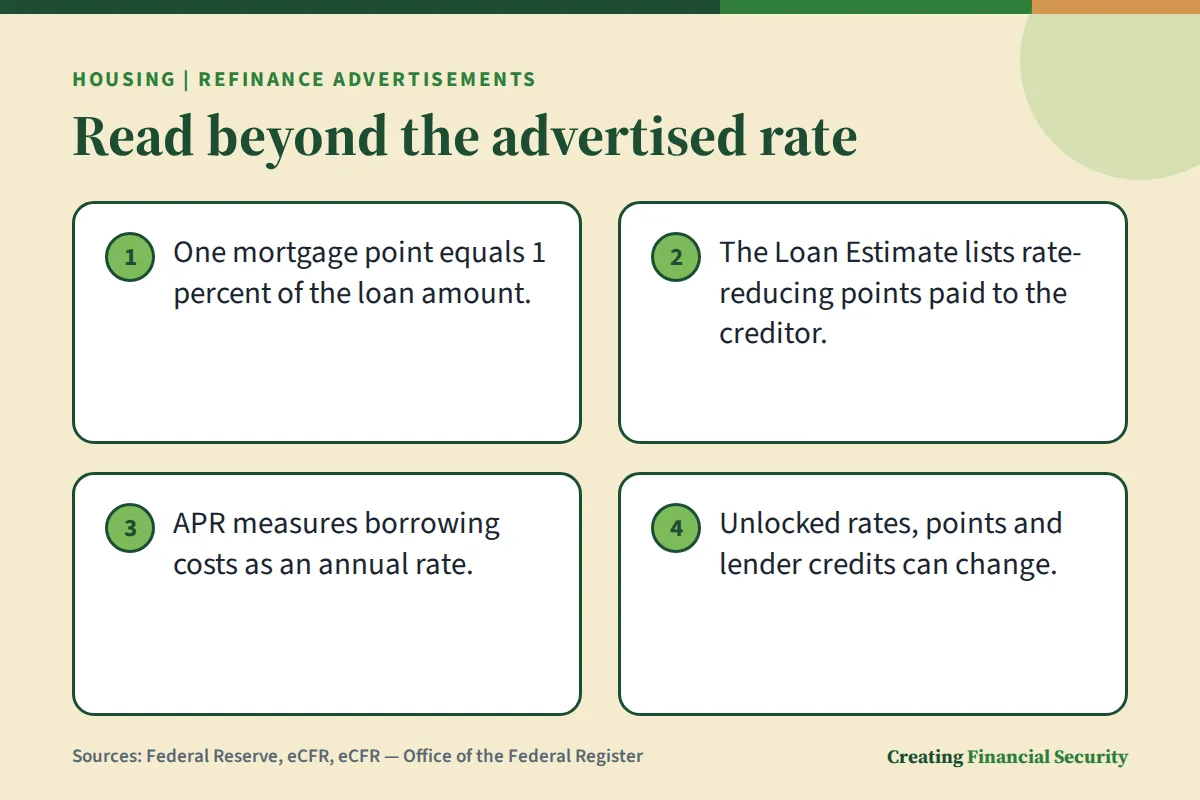
The Federal Reserve describes a point as 1 percent of the mortgage amount. Discount points purchase a lower interest rate through a single upfront payment. Other points compensate a lender or broker for making the loan. Its guide lists a typical points range of 0% to 3%, measured against the principal, and says borrowers can negotiate the number charged.
Refinancing can also involve application, origination and survey charges. The Federal Reserve's guide gives 3 percent to 6 percent as a not-unusual fee range, measured against the remaining principal. Any penalty or other expense for retiring the existing mortgage is additional. This older guide's range is not a current personalized quote; location and lender affect the charges.
The IRS notes that points can go by several names, including loan origination fees, loan discount and discount points. So the label on a mailer may not match the label on the paperwork.
How the Loan Estimate shows points
Regulation Z has the Loan Estimate itemize points paid to the creditor to reduce the rate, as both a percentage of the loan and a dollar amount. If no such points are paid, that line is left blank. Lender credits are shown separately, as a negative number in the closing cost totals.
What ads promising no points or no closing costs can mean
The Federal Reserve warns that “no-cost” does not have a uniform meaning. One version exchanges lender-paid closing expenses for a higher interest rate throughout the mortgage. It suggests requesting both versions in writing, comparing the initial expenses, borrowed amount, rate and payments.
It also says a no-cost loan may include a prepayment penalty meant to discourage refinancing again within the first few years. So the cost may not vanish. It can move into the rate, or come back as a penalty for paying off early.
When the ad does not state the points clearly
Missing information alone does not establish a disclosure violation; the applicable rules depend on the ad's terms and format. Questions to put in writing include:
- Does this rate require points? If so, how many?
- Are any points meant to lower the rate, and are any charged to pay the lender for the loan itself?
- What do the origination charges add up to?
- Does this rate depend on a lender credit, and what would the rate be without it?
- Does the loan carry a prepayment penalty?
- Can all of this be sent to me in writing?
If a question can't be answered yet, write it down rather than guessing at the answer.
| Detail | Where on the Loan Estimate | Offer 1 | Offer 2 |
|---|---|---|---|
| Interest rate | Interest Rate under Loan Terms | ____ | ____ |
| Rate lock | Rate Lock, which says whether the rate is locked | ____ | ____ |
| Rate-reducing points paid to the creditor | Separate points entry under Origination Charges, in dollars and as a percentage | ____ | ____ |
| Lender credits | Lender Credits, shown as a negative number in total closing costs | ____ | ____ |
| Prepayment penalty | Prepayment Penalty under Loan Terms | ____ | ____ |
| Cash to close | A dollar amount labeled Cash to Close | ____ | ____ |
Check whether the offer describes your kind of refinance
A rate in an ad is priced for a certain borrower and a certain loan. Yours may differ, and the ad may not say how.
The Federal Reserve describes an eligibility review covering earnings, assets, existing debts and credit score, together with the requested borrowing and property valuation. A changed credit score can affect the available rate. Lenders also assess borrowing relative to the appraised home value; a ratio outside their guidelines may mean rejection or less favorable terms.
So read the ad for the assumptions behind its rate:
- Credit profile: Does it say what score or range the rate assumes?
- Equity: Does it assume only a certain share of the home's value is borrowed?
- Occupancy: Is the rate for a main home, a second home or a rental?
- Loan amount: Is there a minimum or a maximum?
- Term: The Federal Reserve says shorter terms generally carry lower rates but higher monthly payments, while longer terms lower the payment but add to total interest.
- Cash-out status: The Federal Reserve describes a cash-out refinance as borrowing more than you owe and taking the difference as cash. It adds that taking out equity means you own less of your home.
- Loan type: The Loan Estimate labels a loan as conventional, FHA, VA or other.
On the Loan Estimate, the purpose reads Refinance when the loan replaces an existing obligation, and the form also states the term, the product and the loan type. Those are the lines to hold up against the ad's assumptions.
Ask whether the low rate lasts for the whole loan
A low interest rate and a low starting payment are not necessarily the same thing.
A lower rate bought with points. Discount points purchase a rate reduction, but do not by themselves establish that the loan has a fixed rate. The Loan Estimate's Product entry identifies whether the rate is fixed, adjustable or stepped.
An adjustable rate with an introductory period. The Federal Reserve says an ad for an adjustable-rate mortgage that shows an introductory rate should also show how long that rate is in effect, along with the APR. The Loan Estimate labels a loan Adjustable Rate when the rate may increase after closing and the future rates or their periods aren't known at that point.
An offer described as a temporary buydown. Ask the lender to explain that term in writing rather than assuming it means discount points or an adjustable rate. Questions include:
- Does the rate on the loan itself change, or only the payment during the early period?
- Who pays for the reduction, and does it appear in closing costs or as a lender credit?
- How long does the lower payment last, and what is the required payment afterward?
- What would the payment be without the reduction?
For covered dwelling-secured ads stating a payment amount, Regulation Z requires the payment amounts, including any balloon payment, and their applicable periods. Variable-rate figures use a reasonably current index and margin. A covered first-lien ad must also explain, when applicable, that taxes and insurance are excluded and the actual obligation will be larger.
Regulation Z also restricts the word “fixed” in ads for variable-rate loans and certain other loans whose payments will increase, and it requires specified wording, such as how long the rate or payment is fixed. On the Loan Estimate, the question to find is “Can this amount increase after closing?” It's asked about the loan amount, the interest rate and the principal-and-interest payment.
Read two fictional ads without guessing the missing costs
The two ads below are made up. No real lender, rate or date is behind them, and neither is an offer.
Fictional Ad A shows a rate of 6% and says to ask about points. It gives no number of points, no APR and no quote date.
Fictional Ad B shows a rate of 6.5% and says nothing about points. It gives no APR either.
That's everything either ad tells you, and it leaves a lot unknown:
- How many points Ad A requires, and whether Ad B's rate depends on a lender credit.
- The APR for each, and the date each rate was quoted.
- Whether either loan is fixed for its whole term.
- Whether either rate is locked, and for how long.
- Other origination charges and any prepayment penalty.
Ad B's silence about points does not establish that it has none. Neither fictional summary supplies enough information to compare total costs.
What the advertised rates change in principal and interest
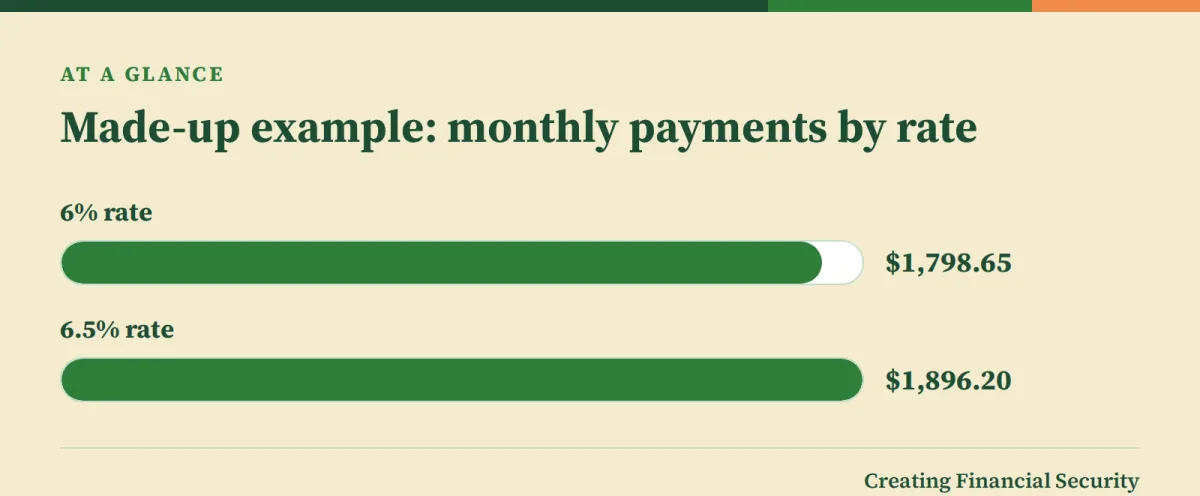
The table isolates the one thing two different rates change: the principal-and-interest payment on the same loan. In this made-up example it uses Ad A's 6% and Ad B's 6.5% on a made-up $300,000 loan over 30 years.
| Interest rate | Monthly payment | Total interest |
|---|---|---|
| 6% | $1,798.65 | $347,514.57 |
| 6.5% | $1,896.20 | $382,633.47 |
Fixed rate, equal monthly payments of principal and interest; taxes, insurance and fees are not included. These figures assume a fixed rate and equal monthly payments of principal and interest; taxes, insurance and fees are not included.
In this made-up example, the lower rate produces a smaller payment and less total interest. But the table excludes fees, so it cannot establish which offer costs less overall or whether points are worthwhile.
Match the advertised terms to a Loan Estimate
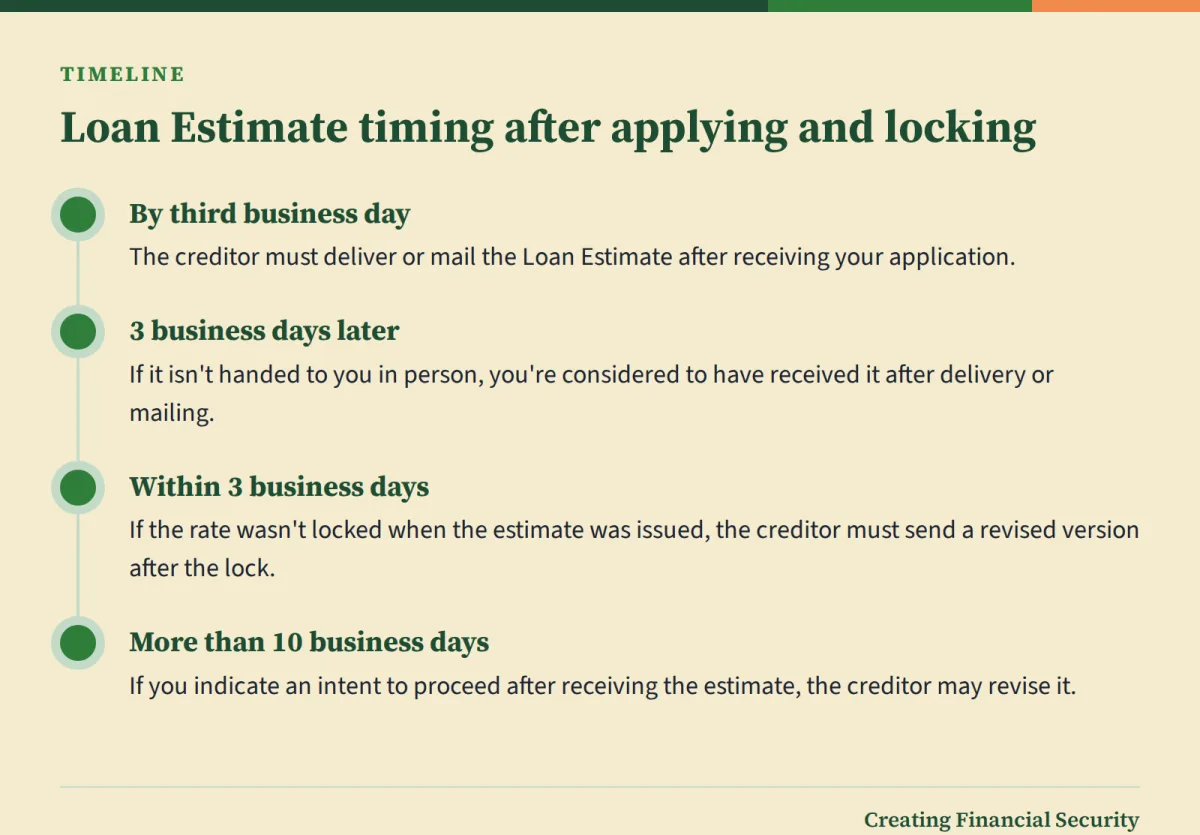
An ad is marketing. A Loan Estimate is the formal disclosure for your application. For a covered mortgage, the creditor must deliver or mail it by the third business day after receiving your application. If it isn't handed to you in person, you're considered to have received it three business days after it is delivered or mailed. The form itself says: “Save this Loan Estimate to compare with your Closing Disclosure.”
Before you've received it and indicated an intent to proceed, an application-related fee generally can't be imposed, though a bona fide, reasonable fee for a credit report is an exception. And a written estimate made specifically for you before the Loan Estimate has to carry this warning: “Your actual rate, payment, and costs could be higher. Get an official Loan Estimate before choosing a loan.”
The comparison table pairs each detail with the place it appears on the form, and leaves two columns blank for you to fill in as offers arrive. Then look for differences:
- Rate: Is the interest rate the same as the ad's? If not, ask what changed.
- Points and credits: The rate, points and lender credits may change unless the rate has been locked. If the rate wasn't locked when the estimate was issued, the creditor has to send a revised version within three business days after the lock, showing the revised rate, points and credits.
- Expiration: The form states when the estimated closing costs expire. If you indicate an intent to proceed more than 10 business days after receiving the estimate, or after any longer period the creditor specified, the creditor may revise it.
- Cash to close: Compare it with what you expected after reading the ad. Closing costs, loan costs and other costs each appear in their own place on the form.
Use this checklist when comparing two offers
The comparison table gives you a blank side-by-side to copy onto paper: one column for each offer, with the Loan Estimate line to check beside each detail. Use the same loan amount, term and loan type in both offers where you can.

A few details don't have a line in that table, so add them beneath it:
- The lender's name, the type of lender and the date the rate was quoted.
- The APR, if the ad shows one.
- Whether the loan is fixed, adjustable or something else, and how long any starting rate lasts.
- Whether the loan refinances your balance only or is a cash-out refinance.
- The credit score, equity and loan amount the rate assumes.
- The lock end date and the date the estimate expires.
- Whether a Loan Estimate has arrived, and its date.
- Questions still unanswered, who is to answer them and by when.
The Federal Reserve suggests recording each lender's answers on a worksheet and making clear that competing offers are being considered.
Lender type alone doesn't set the total cost, so comparing the same lines across a bank, a credit union and an online lender is what matters. For tax questions, IRS Publication 936 and a tax professional are the places to check.
The bottom line
An advertised refinance rate is one line from a longer price tag. The rate, the points, the APR, the assumptions about your credit and loan, and the lock terms belong together, and a mailer rarely shows all of them. Discount points are a one-time charge paid to reduce the rate, “no-cost” can mean the cost moved into the rate, and a low starting payment needs its end date and its later payment spelled out.
An ad is not a substitute for the estimates prepared for your application. A written Loan Estimate provides those figures, but it is not a final bill; rate-dependent terms can change before a lock. Putting two side by side, on the same loan amount, term and loan type, turns a pile of mail into something you can compare.
Whether points are worth paying is a separate question, and the site's guide on mortgage points takes it up. For your own numbers, a housing counselor, a tax professional for the deduction rules or a licensed mortgage professional can go through them with you.
Questions readers ask
Does receiving a refinance advertisement mean I qualify for its rate?
Does a lower APR always mean a better refinance offer?
Are credit-union advertisements different from bank or online-lender advertisements?
Can advertised refinance points be deducted on my taxes?
What if a lender will not provide the advertised terms in writing?
Sources
- Federal Reserve Board: Refinancing costs, comparing offers, points, simple break-even calculations, financed cost
- IRS: Publication 936: Home Mortgage Interest Deduction
- eCFR: 12 CFR 1026.19 -- Certain mortgage and variable-rate transactions
- eCFR: 12 CFR 1026.37 -- Content of disclosures for certain mortgage transactions (Loan Estimate)
- eCFR — Office of the Federal Register: 12 CFR 1026.24 -- Advertising
- eCFR — Office of the Federal Register: 12 CFR 1026.4 -- Finance charge
- eCFR — Office of the Federal Register: 12 CFR 1026.22 -- Determination of annual percentage rate