

A refinance advertisement may emphasize a low starting payment without making later increases equally clear. Before comparing that payment with an existing mortgage, there is a plain question to ask: what exactly is being reduced?
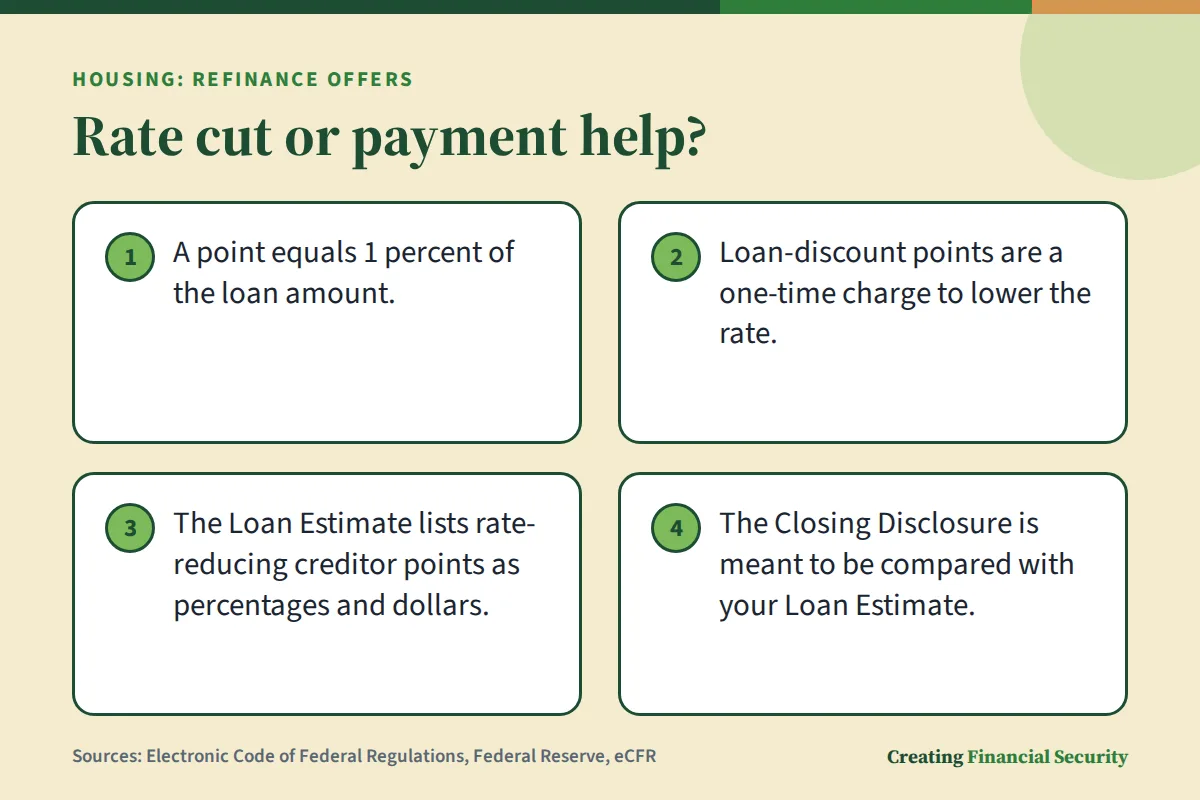
Discount points are a one-time charge paid to lower the interest rate in the loan contract. A payment that is lower only for an early stretch is a different promise from a rate that is lower for the whole loan, and the payment alone can't tell you which one you're looking at.
The Loan Estimate provides a starting point: its rate, points and projected-payment disclosures help identify the loan terms. Ask the lender for a written explanation of any advertised payment that those disclosures do not explain.
This guide is part of our larger one on refinance points costs and savings.
Start with what changes: the loan rate or the early payment
A mortgage offer has two things that are easy to blur together. One is the interest rate written into the loan contract. The other is the amount that leaves your account in a given month. The Federal Reserve Board notes that lower rates usually mean lower payments, which is why the two often get treated as one. But a lower payment can have other causes, so it isn't proof that the rate came down.
A point represents 1 percent of the mortgage amount. But the charge's purpose matters: the Federal Reserve Board distinguishes rate-reducing discount points from points that compensate a lender or broker. It also says the number charged is negotiable. Ask what a charge buys rather than relying on its label.
If an advertisement uses “temporary buydown,” ask the lender to explain the term in writing. Does the offer reduce the contractual rate, provide help with early payments, or involve something else? Who pays, how long does it last, and which document establishes those terms?
Ads deserve a little extra care. The Federal Reserve Board warns that they may play up low starting rates and payments without stressing that these could rise later. An advertised payment alone does not explain the loan's full terms.
What permanent does—and does not—mean
Permanent, in this setting, means the contract rate is lower than the rate the same offer would carry without points. It describes the rate, not your whole monthly bill.
Two things can still move. If your payment includes escrow amounts for taxes and insurance, the Federal Reserve Board says it can change over time as property taxes, insurance or community association fees change. And an adjustable-rate loan's payment moves with its rate, so a low starting rate on an adjustable loan is a different promise from a lower fixed one.
The Loan Estimate also recognizes a third kind of product, the step-rate loan, where the rate changes after closing on a schedule already known at closing. So when a mailer says “permanent,” two follow-up questions help: permanent compared with what, and on a fixed, adjustable or step-rate loan?
How it works, step by step
- Read the Interest Rate line in the Loan Terms table; it shows the rate applicable at closing.
- Find the Principal & Interest payment and note whether the form says it can increase after closing.
- Read the Projected Payments table year by year, looking for more than one payment or range of payments.
- Check for an introductory-period duration where the Product disclosure requires one.
- Locate the Total Monthly Payment rather than relying only on the principal-and-interest figure.
- Before signing, compare the Closing Disclosure with your Loan Estimate to see what changed.
Follow the payment beyond the introductory period

A low first payment describes the first payment. What you live with is the payment that comes next, so the job is to find that figure and the date it starts.
The federal Loan Estimate rule gives you a map. For certain adjustable-rate, step-rate and payment-feature disclosures, the Product line includes the duration of an applicable introductory period. The form can also name features that change the payment. A “Step Payment” label is used when scheduled payments vary for reasons other than a change in the interest rate. A “Step Rate” label is used when the rate will change and the new rates and their periods are known at closing.
That difference is worth holding onto: a payment that changes on a schedule is not the same as a rate that adjusts. Ask the lender how the advertised discount relates to these required disclosures; do not infer an assistance arrangement from a product label.
Principal and interest versus the whole payment
The Loan Estimate splits a payment into pieces. Its Projected Payments table lists each payment or range of payments, along with an estimate of taxes, insurance and assessments. “Principal & Interest” is only one line. The Total Monthly Payment adds principal and interest, mortgage insurance and escrow, as they apply, so it's worth checking which costs sit inside escrow and which don't.
A walk through the form, in order:
- Read the Interest Rate line in the Loan Terms table. That's the rate that applies at closing.
- Find the Principal & Interest payment beside it, and note whether the form says that amount can increase after closing.
- Read the Projected Payments table year by year, looking for more than one payment or range of payments.
- Check the Product line for the rate type and any payment feature, including an introductory period where applicable.
- Set principal and interest beside the Total Monthly Payment, then check which taxes, insurance and assessments are in escrow.
If the table shows a payment rising while the rate line stays the same, that's a question for the lender, not a conclusion to draw alone.
Trace the promise through the loan documents
An offer is a promise spread across several documents, and each answers a different part of the question.
- The Loan Estimate. The federal rule makes its Interest Rate line the rate that applies at closing, and its Projected Payments table lists each payment period.
- The points line. Points paid to the lender to reduce the interest rate are itemized separately, as a percentage of the loan and a dollar amount. A points line alone doesn't cover other origination charges, so ask about those too.
- Lender credits. These appear in the closing cost totals as a negative number, on their own line apart from points.
- The rate lock statement. The form says whether the rate is locked, and that the rate, points and lender credits may change unless it is.
- The Closing Disclosure. It sums up the final terms and costs of the loan and is meant to be set beside your Loan Estimate.
- The legal obligation and any related agreement. Ask the lender to identify the documents establishing the rate and payment terms, and to show where any advertised help is explained.
When the advertisement and paperwork seem to disagree
If the mailer and Loan Estimate seem inconsistent, these questions can help clarify the offer:
- Which line on the Loan Estimate shows the rate in the note?
- Is anyone else covering part of my early payments, and where is that written down?
- How many months does it last, and what is the full payment afterward?
- Does the Principal & Interest figure already include any early help?
- Are points being charged, and are they shown as a percentage and a dollar amount?
The Federal Reserve Board says to ask for information in writing about each loan before paying a nonrefundable fee. If the answers still feel tangled, a housing counselor or another trusted adviser can read the documents with you.
Use a sample loan to separate rate changes from payment assistance
The table below is a made-up example of what a contract rate does to a loan payment. Your own balance, rate and remaining years will differ, so treat it as a picture of the idea.
| Interest rate | Monthly payment | Total interest |
|---|---|---|
| 6% | $1,798.65 | $347,514.57 |
| 7% | $1,995.91 | $418,526.69 |
Fixed rate, equal monthly payments of principal and interest; taxes, insurance and fees are not included. These figures assume a fixed rate with equal monthly payments of principal and interest; taxes, insurance and fees are not included.
In this made-up example, the lower-rate row has a smaller principal-and-interest payment and less total interest. The balance and term are unchanged; the rate is the difference. These are not all-in borrowing costs, because fees and other housing expenses are excluded.
The calculation cannot establish what an advertised buydown means. If an advertised payment differs from the payment disclosed for the contractual rate, ask the lender to reconcile the figures in writing. Is assistance involved? If so, where are its amount, duration, funding and later payment documented?
A useful habit is to treat any number you can't tie to a named document as unconfirmed. A lower rate also often comes with a charge at closing, which the table leaves out. Weighing that charge against the payment difference is math a lender's written estimate or a housing counselor can walk through with your own figures.
Ask who funds the assistance and what happens to unused money
For an offer promising payment assistance, ask who would supply the money and whether accepting it changes the rate, fees or other terms.
Would any contribution be required from the borrower at closing? If so, where would it appear in the cost disclosures? If another party contributes, what conditions would apply?
The Federal Reserve Board describes a related trade-off in what some lenders call “no-cost” refinancing. In one version, the lender pays the closing costs but sets a higher interest rate, and you carry that higher rate for the life of the loan. The Board suggests asking for the up-front costs, balance, rate and payments with and without the trade-off. The same kind of question fits any offer that sounds like help.
If the offer involves money reserved for assistance, ask for written answers about any amount left over:
- If I sell or refinance during the assistance period, what happens to any money left?
- Is any of it refunded, applied to the loan balance, or kept?
- Does the help change or end if I pay the loan off early?
Then look at payoff terms. A prepayment penalty is a fee some lenders charge if you pay a mortgage off early, including when you refinance. The Federal Reserve Board says a loan backed by the federal government generally can't carry one, and that some lenders, including federal credit unions, can't charge it either. The VA rule permits full early repayment without an extra charge and also protects qualifying partial prepayments. For other mortgages, check the Loan Estimate's Prepayment Penalty disclosure and ask about the applicable terms.
Check whether the offer actually applies to your refinance
Does the promotion apply to a refinance, or only to a purchase? Ask the lender to confirm eligibility for the proposed transaction in writing, including any program restrictions. The Loan Estimate's Purpose field distinguishes a purchase from a refinance; check that it describes the transaction being discussed.
Then comes qualifying. The Federal Reserve Board says the lender will look at what you earn and own, your credit score, your other debts, what the home is worth and how much you want to borrow. An advertised rate or payment is a starting point. The Loan Estimate prepared for your application is the one priced for you.
If both points and temporary help are mentioned, ask whether both are included in this quote and request an explanation of each charge and promise. The points disclosure identifies payments to the creditor for reducing the rate; it does not answer every question about an advertised payment.
For taxes, the IRS generally requires refinance points to be deducted over the mortgage term rather than immediately, subject to its eligibility rules and exceptions. Using the principal residence as collateral does not by itself allow an immediate deduction. A qualified tax professional can review the charges and any assistance in an individual case.
Put two offers through the same written checklist
Offers are easier to compare when each one answers the same questions on paper. Rates, points and credits may change until a rate is locked, so note the date on each figure. One column per offer:
- Note rate and product: the Interest Rate line, and whether the loan is fixed-rate, adjustable-rate or step-rate.
- Points: the percentage and dollar amount on the points line, or a blank line if none are disclosed there.
- Lender credits: any amount shown as a negative number in the closing costs.
- Payment help: whether any early payments are covered, by whom, for how many months, and where it is written.
- Later payment: the principal and interest payment after any help ends, and the date it starts.
- Total monthly payment: read the form's total with mortgage insurance and escrow, and check which taxes, insurance and assessments are already included in escrow and which must be paid separately.
- Payoff terms: whether there is a prepayment penalty, and what happens to unused assistance.
- Rate lock: whether the rate is locked, and when the lock and the estimate expire.
If an answer isn't on a form, ask for it in writing, and keep the Loan Estimate to compare with the Closing Disclosure later. If two offers still look alike, a housing counselor or another trusted adviser can go through your own numbers.
The bottom line
An advertised payment is not enough to identify a refinance offer's terms. Start with the contractual rate and the disclosed payment obligation, then ask the lender to reconcile any difference between those figures and the advertisement. If the offer mentions temporary assistance, request written answers about its duration, funding, conditions and payment afterward rather than assuming what the label means.
Keep the Loan Estimate for comparison with the final Closing Disclosure. Alongside the rate, check the product type, closing charges, credits, escrow and payoff provisions. A lower principal-and-interest payment does not account for every housing expense or every cost of replacing a mortgage.
For unresolved questions about an actual offer, a housing counselor can help review the documents. A qualified tax professional can address individual deduction questions. Neither an advertised payment nor the sample calculation establishes whether refinancing is worthwhile for a particular household.
Questions readers ask
Can an offer include both discount points and a temporary buydown?
Does a temporary buydown make the mortgage an adjustable-rate loan?
Are lender credits the same thing as a temporary buydown?
Will the payment stay unchanged if I pay permanent points?
Are points and temporary buydown payments deducted the same way on taxes?
Sources
- Federal Reserve Board: Refinancing costs, comparing offers, points, simple break-even calculations, financed cost
- IRS: Publication 936: Home Mortgage Interest Deduction
- eCFR: 12 CFR 1026.37 -- Content of disclosures for certain mortgage transactions (Loan Estimate)
- Electronic Code of Federal Regulations: 12 CFR 1026.38 -- Content of disclosures for certain mortgage transactions (Closing Disclosure)
- Office of the Federal Register / Department of Veterans Affairs: 38 CFR 36.4311 -- Prepayment