



If a hospital bill and a car repair landed in the same month, a call from a card company can feel like one more thing arriving at once. Before you talk with anyone about a payment, a bare-bones budget can show what might realistically be available. It's a temporary plan: it protects the essentials first, sets aside spending that can wait, and counts only money you can count on.
This isn't a test of discipline, and you don't need a perfect spending history. A first draft from pay stubs and statements is enough to start, and you can correct it as bills arrive. If the numbers show there's no room, that's useful information.
Extension educators encourage assessing basic expenses, outstanding debts and payment capacity before contacting creditors. The worksheet below offers an illustrative way to organize that information; its categories and calendar are not agency requirements.
This guide is part of our larger one on preparing to negotiate card payments.
Gather the bills that show what life costs now
Start with paper or a notes app and whatever already exists. You're collecting enough to see this month and the next one clearly, not rebuilding years of history.
Here's what tends to be useful:
- Recent pay stubs and a note of how and when your pay is deposited
- Credit card statements showing the balance, due date and minimum payment
- The hospital bill, any letters from the hospital or a collector, and the insurance explanation of benefits
- The repair invoice, plus any loan, payment plan or card charge that covered it
- Rent or mortgage, utility, phone, insurance and loan statements
- Today's balance in each bank account
If a bill isn't in hand, log in or call and ask for the current balance and due date. Where you truly don't know a number, write a question mark and keep going. You'll come back to it.
Keep the hospital bill and repair bill separate
Give each emergency its own line and note three things: the balance, who is asking for payment and by when, and whether any of it was already charged to a card.
That last point matters. If the repair went on a credit card, it's already inside that card's balance. The repair can remain listed for reference. Note it on the card line, but subtract only the payment due for the budget period—not the full repair balance as well.
A hospital bill that's still being sorted out with the hospital or insurer is also different from a payment you've agreed to make. Mark which one you're looking at, so nothing is treated as settled when it isn't.
How it works, step by step
- Assess the household's basic monthly costs before contacting creditors.
- Count the creditors and record the combined outstanding debt.
- Identify a realistic payment amount and date for each creditor.
- Explain the financial difficulty to creditors, including payment capacity and timing.
Base the plan on income that is dependable
A card payment comes out of money that has actually arrived, so in this method the budget starts with take-home pay: what lands in your account after taxes and deductions. Gross pay overstates what you can spend.
One way to set it up:
- Pull recent pay stubs and find the take-home amount for each paycheck.
- Write down how often you're paid and the actual dates the money arrives.
- Count pay you can reasonably rely on, such as regular hours at your usual rate.
- Put overtime, side work, a possible refund or a gift in a separate column labeled uncertain.
- Keep retirement accounts off the income list. They get their own discussion below.
Leaving uncertain income out makes the plan less dependent on it, though other costs or income can still change. In this worksheet, a refund or other one-time receipt stays separate from recurring pay.
Also note what's in your bank account on the day you start. That opening balance is real cash, and it belongs in the plan next to pay. Just be careful: if a paycheck has already landed in that balance, don't count it a second time as income.
Mark when money arrives, not just the monthly amount
Paydays and due dates don't always line up, and a monthly total can hide that. A simple calendar can reveal a timing gap, though it can't promise that a proposed payment will work.
List the dates of the month down a page. Put each paycheck on the day it arrives and each bill on the day it's due, then track your bank balance as you move down the list.
If the balance dips below zero before a payday, you've found a timing gap. That's different from an ongoing shortage of income, and the two lead to different conversations. A timing gap raises a question about due dates. A lasting shortage raises a question about what can be paid at all. The calendar helps you tell which one you're looking at.
Set a realistic floor for essential spending
The floor is the least you can spend while keeping home and work steady. It's a short-term line, drawn so the basics are protected first.

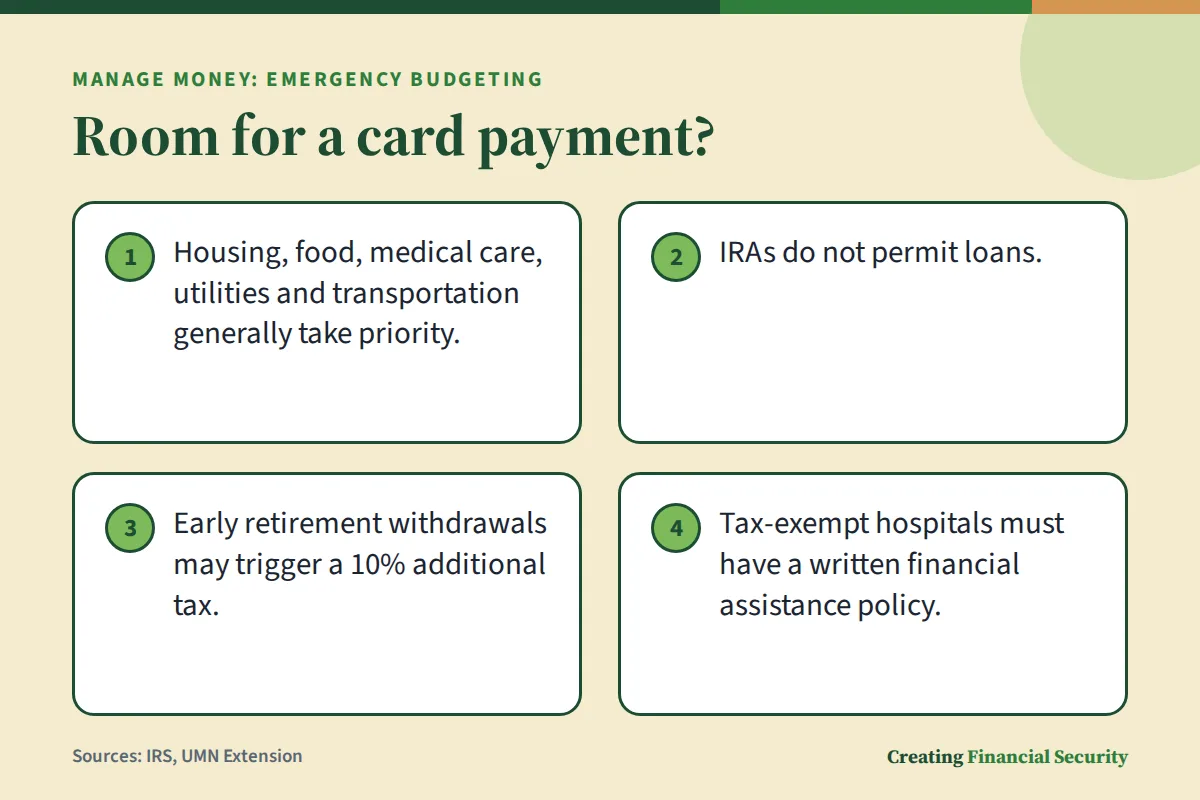
Extension educators generally put housing, food, medical care, utilities and transportation ahead of other bills. Beyond that, which costs count as essential depends on the household. A starting list might include:
- Rent or mortgage
- Groceries and basic household supplies
- Electricity, heat, water and phone service
- Gas, bus fare or whatever gets you to work
- Insurance you're required to carry or that protects your health
- Prescriptions and ongoing medical care
- Tools, uniforms or certifications your job requires
Extension also treats a vehicle payment as a possible priority when employment depends on the vehicle. A lender may repossess a vehicle securing its loan after missed payments.
Use current bills as the starting point. A spending floor needs to reflect actual costs, not just a hoped-for total.
Separate temporary cuts from costs that cannot safely wait
Some spending can pause: streaming services, takeout, nonessential shopping, a membership you rarely use. Pausing isn't banning. These wait until the pressure eases.
Other costs deserve a second look before they go. Extension warns that dropping health coverage can expose a household to substantial medical bills if someone gets sick.
A simple question can sort a line: could cutting this threaten health, housing, insurance or my job? If the answer might be yes, think harder before it goes. If not, it can join the pause list. Write that list down so you remember what's waiting.
Give each debt its own place in the plan
Living costs keep you going; debts are obligations with their own due dates and consequences. Giving each one its own line keeps the picture clear. In the worksheet below, rent or mortgage and any vehicle payment you need for work sit with the essentials, so every other debt goes here, and no payment is subtracted twice.
For each debt, record:
- Who it's owed to and what it was for
- The full balance, for reference
- The payment due during the budget period
- The due date
- Its status: current, past due, on a payment plan, or under review
- What the statement or contract says can happen if it isn't paid
The full balance and the payment due are different numbers. The balance is for reference; only the payment due in the period goes into the cash math later.
Consequences differ by obligation. Extension warns that missed or late bills can hurt credit access and make borrowing more expensive. It describes card minimums as the payments needed to maintain current account status.
Separate a disputed bill from an agreed payment
A medical bill can be billed, under review, or covered by an agreed plan. Your worksheet should say which. A charge you're questioning, or a help application you've sent, is not a settled amount, and it isn't a discount yet.
The IRS requires tax-exempt hospital organizations to maintain written policies covering financial assistance and emergency care at each facility. The assistance policy must explain eligibility, available free or discounted care, and the application process.
The IRS also points out that some discounts a hospital offers fall outside that policy and aren't financial assistance under it. Until a decision or payment arrangement is confirmed in writing, keep the bill in the debt list at its billed amount, with a note about what you've asked for.
Fill in a worksheet that shows room—or a shortfall
Here's a blank worksheet to copy onto paper. Use one copy for the budget period you're checking, such as payday to payday, and fill in only what you know.

Budget period: from __ to __
Part one, money available
- Cash in the bank on the first day: __ (this already includes any pay that has arrived, so don't list that pay again below)
- Later paychecks in this period, one line per payday: take-home amount __, date it arrives __
- Uncertain income, such as overtime or a refund: __ (kept out of the math)
Part two, essential costs (one line each: amount __, due date __, estimate? yes or no)
- Rent or mortgage
- Food and household supplies
- Utilities and phone
- Transportation to work, including a vehicle payment if you have one
- Insurance premiums
- Prescriptions and medical care
- Tools or certifications for work
- Other: __
Part three, debts (one line per debt, not including rent, mortgage or vehicle payments already in part two)
- Creditor and what it was for: __
- Balance, for reference only: __
- Payment due this period: __
- Due date and status: __
Part four, the remainder
- Money available (opening cash plus later take-home pay): __
- Minus essential costs from part two: __
- Minus payments due in part three on debts other than the card being discussed: __
- Equals the remainder before any payment on this card: __
- Current minimum on the card: __
Each cash outflow gets subtracted in exactly one place. Estimate unavoidable costs even when the exact amount is unknown, mark those estimates for review, and keep uncertain income separate.
Now compare the remainder with the card's current minimum. If the remainder is less than the current minimum, record the difference. If it is negative, the budget is already short before a payment on this card.
A remainder at or above the minimum gives you a figure to think about, not a promise. A remainder of zero means everything is already spoken for. Whatever the result, write it down as it is.
Follow the emergency bills through the worksheet
Here's how the hospital bill and the car repair move through it, using labels rather than amounts.
- Put the hospital bill in part three as a debt. Write its status beside it, and mark any assistance application as pending, not approved.
- Put the car repair in one place only. If a card paid for it, note the repair on the card line, but subtract only the payment due for the budget period. If a shop financed it, it gets its own line in part three.
- Keep the vehicle's running costs in part two as a work expense: fuel, required insurance and anything the job needs.
- Enter each other debt's payment due this period, with its date, so the calendar shows whether it lands before or after payday.
- Work through part four and write the result. If the remainder is below the card's minimum, record the difference. If it's negative, record the shortfall.
The balances of the hospital bill and repair stay in the reference column. Only payments actually due in the period enter the math, so nothing is counted twice and nothing is treated as approved.
Check whether the payment survives a difficult month
Run through these checks:
- Irregular essentials. Think of costs that don't come monthly: vehicle registration, insurance premiums, a replacement tool. Put each on the calendar in the month it's due, as an estimate if needed.
- Timing. Check that a payment date falls after the money has arrived.
- New borrowing. If the payment only works by charging more to a card or borrowing from someone, it fails the test. Extension warns that additional borrowing usually worsens financial strain without a quick improvement in circumstances.
- Lower income. Imagine a pay period with fewer hours than usual and see how the remainder changes.
- Cushion. If every dollar is spoken for, one surprise could break the plan.
If the plan fails, you haven't. You've learned that an amount can't safely be promised. A smaller figure, a different date, or an honest statement that there's no payment room right now is more useful than a promise that gets broken.
Extension also says a non-profit consumer credit counseling service may be worth contacting if card debt is hard to pay. A counselor can look at your actual numbers, which no article can.
Do not make retirement savings the balancing entry
When a worksheet comes up short, a 401(k) or an old IRA can look like the way to fill the gap. It's worth treating that as a separate decision, because the rules can add costs.
The IRS explains that withdrawals generally count as taxable income. Taking money out before age 59½ can also trigger a 10% additional tax, with exceptions depending on the circumstances. An exception to that additional tax does not by itself establish that the withdrawal is free of income tax.
IRA borrowing is prohibited. The IRS says an owner who borrows from an IRA causes the account to lose IRA status, with the whole account value included in income. Workplace plans can choose whether to allow loans. Their usual repayment limit is 5 years, although exceptions exist. Default generally makes the remaining loan balance taxable as a distribution.
A tax professional or the plan administrator can explain the rules for a particular account. For this budget, the simplest labeling is to keep those dollars apart from dependable pay.
Keep the temporary plan usable until income and bills settle
In this illustrative method, a payday or changed bill is a useful prompt to update the worksheet.
A quick review might include:
- Updating your bank balance and marking what has cleared
- Replacing question marks and estimates with real numbers as bills arrive
- Moving received overtime into available cash without also counting it as future income
- Writing down any call or letter from the hospital, the repair shop or a card company, with the date
- Moving an item off the pause list only when the numbers allow
This keeps the budget temporary. When income steadies and the emergency bills are settled or on a firm schedule, paused items can come back one at a time, at a pace the numbers support.
Carry a short budget summary into the conversation
When it's time to talk with a card company, a hospital billing office or a nonprofit credit counselor, one page is easier to use than a stack of papers. It could hold:
- Dependable take-home pay and the dates it arrives
- Essential costs, by category, with estimates marked
- Each debt, with its payment due, due date and status
- What's left, even if the answer is nothing, and any difference from the card's minimum
- Timing limits, such as dates a payment can't safely fall on
- What's still uncertain, such as a hospital bill under review or an assistance application awaiting a decision
Extension encourages explaining payment capacity and timing to creditors. The summary can support that discussion without turning an estimate into a promise.
The bottom line
A bare-bones budget isn't a verdict on how you handle money. It's a short-term way to protect what keeps your household and your job steady while a hospital bill and a car repair get sorted out. It's built from dependable take-home pay, real bills with their due dates, and the essentials that usually come first.

Keep each debt on its own line, keep unresolved medical charges visible without treating them as settled, and subtract every payment in just one place. Estimate unavoidable costs you can't pin down, and keep uncertain income apart. Treat retirement accounts as a separate question, since income tax, a possible additional tax and plan rules can apply.
The worksheet can show what may be possible; it can't promise it. If it shows room, you have a figure to think about. If it shows a shortfall, you have an honest number, which is more useful than a promise that breaks. A nonprofit credit counselor can walk through your own numbers, and a tax professional or your plan administrator can explain any retirement question.
Related guides
Questions readers ask
Do I need a complete spending history before making this budget?
Does a bare-bones budget mean cutting every nonessential expense?
What if my budget cannot cover the current card minimum?
Where does a medical bill go if I am asking the hospital for help?
Can I borrow from my old IRA to make the budget work?
Sources