



A hospital bill and a car repair can land in the same month, and the next question is usually how much of it the credit card can take. The answer starts with a subtraction, not a guess.
Here is one way to lay it out. Pick a starting moment, such as this morning's bank balance, and an end date, such as the day before the pay after next arrives. Add the pay that will reliably arrive in between. Subtract essential bills, other required payments, a set-aside for costs that don't come monthly and a small cash cushion. What remains is a starting limit for your card payment.
That limit describes your household. It doesn't change the payment your account requires. If it falls below the required amount, explain the gap to the issuer and ask what arrangements are available; don't assume a smaller payment changes the terms.
University of Minnesota Extension encourages households to assess their resources and essential expenses before discussing payments with creditors. The worksheet below is an illustrative way to organize that assessment, not an official formula. It excludes retirement savings from recurring payment capacity.
This guide is part of our larger one on negotiating affordable credit card payments.
Start with the pay that reliably reaches your bank account
A payment has to hold up in an ordinary month, so the first line is dependable take-home pay: what lands in your account after taxes and payroll deductions, not an hourly rate multiplied by a hopeful number of hours.
These don't belong on that line:
- Overtime that doesn't arrive in every pay period
- Money you could borrow, including new card charges
- Retirement balances, such as a 401(k) or an old IRA
Extension educators caution that additional borrowing can deepen a shortfall unless household finances improve quickly. Their guidance emphasizes reducing spending while working through the income loss.
A retirement balance is savings rather than recurring wages. Accessing it involves separate rules.
Pay records provide a starting point for this estimate, even when hours or earnings vary.
Handle changing hours without budgeting your busiest month
If your hours move around, your pay records show what has actually arrived. Look across a run of pay periods and find the level your pay reaches in most of them.
One illustrative choice is to build the worksheet on that steadier level. A busy month then becomes a pleasant surprise you decide about when it arrives, instead of money the payment already leans on.
That's a worksheet assumption, not an official rule, and another household could reasonably choose differently. How many pay periods to look back across is up to you. Use as many as it takes to see a pattern you trust.
| Row | What goes in it |
|---|---|
| Illustrative input: starting cash | Account balance at the selected starting moment |
| Illustrative input: incoming take-home pay | Dependable receipts after the starting moment through the end date |
| Illustrative deduction: essential costs | Unpaid housing, utilities, food, transportation, insurance and medical costs within the period |
| Illustrative deduction: other obligations | Payments within the period, excluding all card payments being tested against this remainder |
| Illustrative deduction: irregular-cost reserve | Money to remain unspent for later costs, excluding expenses already entered |
| Illustrative deduction: cash cushion | A separate amount retained in the account, counted once |
| Illustrative result: card-payment capacity | Add starting cash and incoming pay; subtract the expense, required-payment, irregular-cost and cushion rows |
Keep essential bills visible before assigning money to the card
Extension educators say food, housing, utilities, transportation and medical care usually take priority when money is short. Write each one at its real cost before the card gets a dollar.
A list that fits many households:
- Rent or mortgage
- Utilities
- Food
- Transportation, including fuel, insurance and any loan or lease payment
- Health insurance premiums and ongoing medical costs
- Other required payments you already have
Extension adds that if you need a vehicle to keep or find a job, the car payment may be a priority, since missed payments can lead to repossession when the vehicle secures the loan. It also cautions against letting medical insurance slide, because uninsured medical bills could be devastating.
Write each cost once. A premium that comes out of your paycheck before it reaches the bank is already missing from take-home pay, so subtracting it again would shrink your limit twice.
Separate this month's hospital and repair bills from ongoing costs
In a month like this one, a few kinds of items can blur together:
- Already paid. A repair you paid for last week is spent. It lowered your starting cash, so it doesn't go on the list again.
- Unpaid and not yet arranged. This bill still needs a plan. It belongs in the worksheet once you know what is due and when.
- An agreed installment. Once a provider agrees to a payment schedule, each installment is a recurring obligation and goes in with your other required payments.
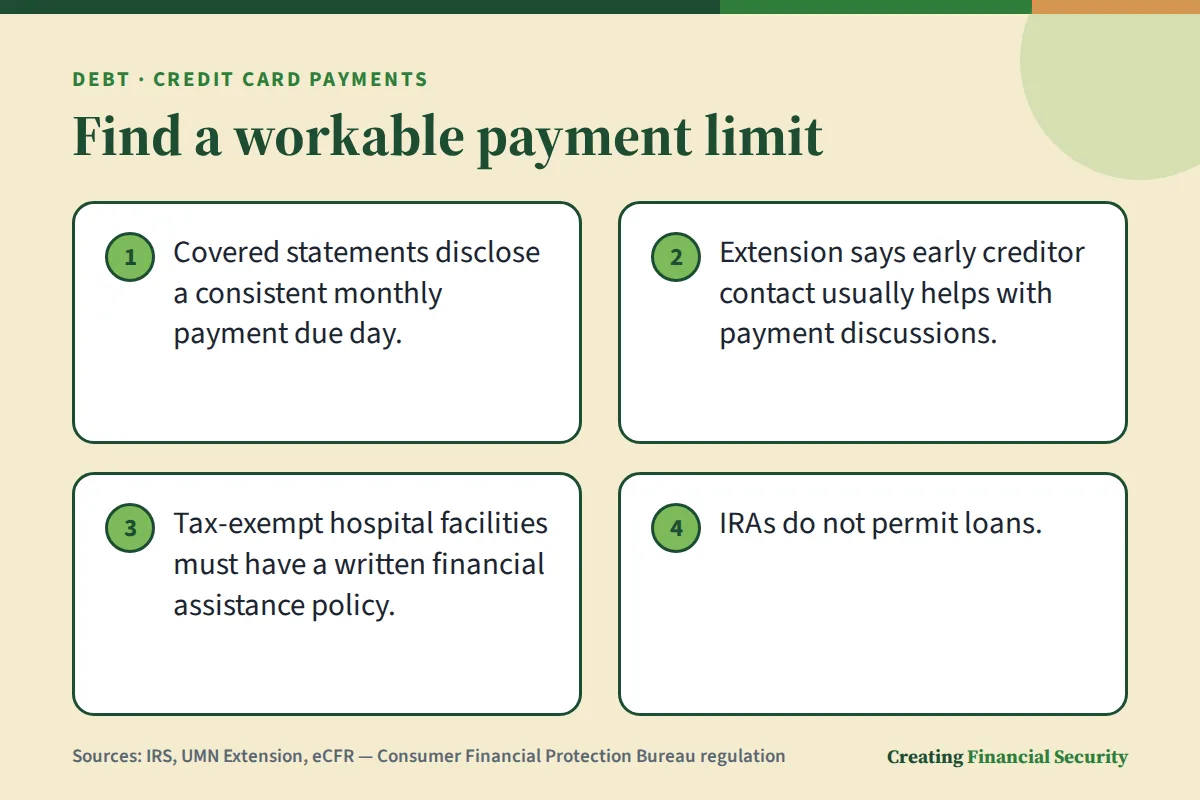
Before a card takes on a hospital bill, one piece of IRS guidance is worth knowing. The IRS says a tax-exempt hospital organization must establish a written financial assistance policy for each hospital facility it operates. The policy must explain that eligible patients cannot be charged above the amounts generally billed for emergency or medically necessary care.
The IRS also says billing statements must carry a conspicuous notice about that assistance, with a phone number to call. Reading the policy before the bill is settled is a calm, low-cost step, and the hospital's billing office is the place to ask how it applies to your bill.
Make room for costs that do not arrive every month
For illustration, costs outside a monthly bill list might include an insurance premium, replacement tires or a brake job. Leave them out of the worksheet and they come back later as surprises.

List the ones you can name, then set aside part of each month toward them, based on what they have really cost you and when they tend to come due. For this illustrative worksheet, past bills and known upcoming costs can inform the amount entered.
Some help exists for evening things out. Extension notes that certain businesses, such as utility companies, have counselors who can help set up a budget plan that evens out payments during the year.
Add a small cash cushion, too. How large it should be depends on your household, and a licensed professional or nonprofit credit counseling service can talk through your own case. Even a modest cushion may keep an ordinary surprise from turning into a new balance.
Both rows are illustrative choices, not official requirements. They can feel like a luxury with a balance looming, but the expenses happen whether or not they were planned for.
Do not make the next repair depend on another card charge
It can be tempting to send every spare dollar to the card. But if that leaves nothing for the next repair, and the repair lands on a card, the balance you just paid down starts climbing again.
In this illustration, preserving money for known upcoming costs is part of testing the payment—not a reason to disregard the amount the issuer requires.
Extension's caution about borrowing applies here: more debt tends to make things worse unless income recovers quickly. If a lower payment would fall below the minimum, the step is to talk to the issuer about the shortfall. Paying less on your own doesn't change what's required.
Put your payment limit on a simple worksheet
Here is the formula in one line. Start with the cash in your account at a stated moment, add the dependable take-home pay still to arrive through your end date, then subtract essential expenses, other required payments, the irregular-cost set-aside and the cash cushion for that same period. The remainder is what's left for card payments. The worksheet table lays these out as rows, and the amounts are yours to fill in.

Two details keep it consistent. First, name the starting moment and the end date, and include everything that happens after that moment through the end date, even if it happens later the same day. Anything that already happened is part of the starting balance and isn't listed again.
Second, keep the card payment you're testing out of the other-payments row. Then test it: after the payment comes out, check every day's running balance through the end date against both the cushion and any irregular-cost money that must remain unspent.
There's also a full-month view, which lists a typical month's whole income and every bill, with no starting-cash row. It asks a different question: whether an ordinary month balances. Choose one view for the month you're testing rather than blending the two.
Three results are possible:
- Positive. You have a starting limit, which still has to be compared with the statement and your paydays.
- Zero. Nothing is left for the card after essentials. That's a signal to talk with the issuer, not a personal failing.
- Negative. Required costs are higher than dependable pay plus cash. Something has to change, whether costs, terms or income. It doesn't mean more borrowing.
Check that each expense appears only once
Double-counting can make a workable payment look impossible, or an impossible one look fine. With your bank and card statements in hand:
- If you start from take-home pay, leave out payroll deductions such as insurance premiums. They're already gone.
- Track cash leaving the bank account, card payments included. A new card charge isn't a second bank withdrawal, but it can raise a later statement balance and required payment, so a payment isn't tied to any particular purchase.
- Count a medical installment once, as a required payment, rather than also listing the full bill.
- Include an upcoming repair you'll pay in cash once, as an expense. Reserve only the part of its earmarked set-aside that will stay unspent.
- Leave out anything already reflected in your starting balance.
- Count the cushion once, and don't treat it as spare money for the card.
Compare your payment limit with what the statement requires
This is where two numbers meet. For credit card accounts covered by the federal rule, the statement must show a due date that falls on the same day of the month each billing cycle. It must also show the late fee and any higher rate that could follow a late payment. Exceptions include certain charge-card statements and statements for charged-off accounts whose entire balance is immediately due.
Each figure on the statement has its own job:
- Minimum payment due. The amount the issuer requires for the cycle.
- Past-due amount. Money that was already due and wasn't paid. Check how your statement shows it.
- Balance. What you owe as of the statement.
- Your payment limit. What the worksheet says your household can pay.
Compare your limit with the amount currently required, including any past-due amount, and check the timing. A displayed minimum alone doesn't show whether every past-due obligation is covered, and the issuer can confirm the amount needed.
Sending less doesn't by itself revise the account's payment requirements. Extension warns that late or missed bills can appear in credit records and make future borrowing harder or more expensive. Its guidance describes minimum payments as a way to maintain current card accounts, but confirm with the issuer what is needed when an account has overdue obligations.
Many statements also carry a warning that paying only the minimum means more interest and a longer payoff. How long yours would take depends on your balance, your rate and what you pay, so the statement's own estimate is the place to look.
When several cards share the same remaining money
With more than one card, ask each issuer for the amount currently required, including any past-due amount, and add those up. Compare that total with your overall limit.
Only if the limit is larger is there money left over for anything extra. If it isn't, the shortfall belongs to the whole set of cards, and each issuer needs to hear from you.
Extension notes that dividing your money evenly among creditors may seem fair but doesn't always work, because each creditor would have to agree to accept less and stretch out the timeline.
Check the payment against your actual paydays
A monthly surplus can hide a shortage in the middle of the month. A bill may fall due before the next paycheck, and a payment that works on paper can still fail in practice.
To test it, follow the money day by day:
- List each payday and each bill's due date between your starting moment and your end date, in order.
- Begin with the starting balance, then add pay and subtract each bill on its day.
- Place the proposed card payment on its payment date, checking that it meets the account's deadline. Confirm the deadline with the issuer if it isn't clear; a charged-off account with its entire balance immediately due is an exception to the regular statement due-date disclosure rule.
- After the payment and through the end date, check that each day's balance still covers the cushion and any irregular-cost reserves that must remain unspent.
- If it dips, ask the issuer about moving the due date, or set money aside as soon as you're paid.
A due date just before payday may explain part of the shortfall, even when the period's total income covers its expenses. Whether an issuer changes a date is up to the issuer, so it's a question to ask, not something to assume.
Look for the need to borrow again before payday
If your calendar shows you reaching for a card, an overdraft or a loan to cover groceries, fuel or a utility before payday, take that as a warning that the payment may be too high.
That isn't a failure of discipline. It means the plan on paper doesn't match the timing of the money, and a payment that needs new borrowing to survive isn't really affordable.
If the fix would take the payment below the minimum, the next step is a conversation with the issuer about the gap, not a quiet cut.
Use a shortfall as a signal to seek different terms
If your limit comes out below what's required, treat it as evidence, not blame. Extension says creditors are usually willing to work with people who contact them before they get behind. The issuer may not agree to a change, but a conversation before a missed payment starts from a better place.
Extension suggests deciding how much you can pay each creditor, and when, before you reach out.
Federal rules point toward counseling as well. When a statement carries the minimum-payment warning, it lists a toll-free number, and through it the issuer must provide contact details for at least three approved credit counseling organizations, to the extent that information is available. Extension also says a nonprofit credit counseling service may help if card debt is hard to manage.
Hospital financial assistance has its own eligibility and application process, separate from any arrangement with the card issuer.
Bring the worksheet, not an unsupported payment promise
A finished worksheet shows what you can pay and why. A number backed by your own records is a firmer starting point than a figure you hope to manage.
Retirement money stays on a separate track. The IRS says IRAs do not permit loans. An employer plan may offer loans but isn't required to, and the IRS says a loan not repaid under its terms is treated as a taxable distribution. The IRS also explains that tax calculations for a deemed distribution can include an early distribution tax.
Whether any tax applies, and how much, depends on a person's situation, and a tax professional can explain it. Withdrawals and loans carry their own rules and possible costs. They aren't a way to make a monthly payment look affordable.
The bottom line
A payment you can afford starts with pay you can count on, plus the cash you have at a stated starting moment. Then it subtracts essential bills, other required payments, a set-aside for irregular costs and a cushion, all through a stated end date. What remains is a ceiling for your household, and it doesn't replace the minimum on your statement.
If the ceiling is above the amount currently required, you have a choice about what to do with the difference. If it's below, treat that as a message to talk with your issuer and look into nonprofit credit counseling, worksheet in hand. The issuer may not agree to a change, and Extension's caution is that new borrowing tends to put people further behind.
Check the result against your paydays, and revisit it when your pay, bills or card terms change. A licensed professional or credit counselor can help with your own numbers.
Questions readers ask
Is there a percentage of income that makes a card payment affordable?
Does paying less than the minimum count if that is all I can afford?
What if my worksheet leaves nothing for the card?
Can I count overtime toward the payment?
Should retirement savings count as money available for monthly payments?
How often does the payment worksheet need updating?
Sources