

If your mother has asked about a burial-insurance ad she saw on TV, a manageable place to start is with the company behind the offer, before requesting a quote. Research starts with the insurer's exact legal name, then its state licensing record, complaint history and financial-strength information.
Those checks help you judge the company. They don't tell you whether its burial policy suits your mother's needs, budget or health. That depends on the written policy, which comes later.
Think of this as fact-checking, not a hunt for a perfect insurer. Each record answers one narrow question and leaves others open. Knowing which is which keeps the job calm.
The Texas Department of Insurance publishes detailed consumer guidance, so its tools appear below as examples. Your mother's own state insurance department is the office to ask about her state's records.
This guide is part of our larger one on comparing insurance for family protection.
Find the state record that matches the offer
An ad gives you a brand, a phone number and maybe a policy name. Regulators work with legal entities, so the first job is to turn what you saw into a name a state record can match. Ask which company would be responsible for paying the benefit, and record its name beside the advertised brand.
In Texas, the department's website has a lookup named “Look up a company or agent”; its Consumer Help Line number is 800-252-3439. Those are Texas tools. Your family's relevant office is the insurance department where your mother lives.
Ask first what type of policy the ad is selling. Ask whether the offer is prepaid funeral insurance or another form of life insurance. The Texas guide discusses prepaid funeral insurance separately and gives specific cautions about it.
A simple order of work:
- Write down exactly what the ad says, including the phone number and any policy name.
- Find the legal insurer's name in the fine print, in written materials or on the company's own site.
- Ask your mother's state insurance department how to check that exact name, and use any lookup it offers.
- Record what the answer shows and which questions it leaves open.
If the legal name can't be found anywhere, that is itself a finding worth noting.
Build a research file from the ad
One page or a shared note keeps the details from blurring together. Useful entries:
- The advertised policy name, exactly as written
- The policy type, if the ad or seller names it
- The legal insurer named in the fine print
- The seller: an agency, a call center or an individual agent
- The state where your mother lives
- Any insurer identifier a document or state record shows
- The date and channel where she saw the ad
Before sharing anything personal, ask the state insurance department what information its company and seller checks require.
Follow an unnamed burial-policy ad through the lookup
Here is the sequence for a hypothetical ad, with no real company and no findings. Suppose a TV spot promotes a burial plan under a friendly brand name and a toll-free number.
The first request, to the seller, is for the insurer's exact legal name, the policy name and the seller's own name, in writing. Next, ask the state insurance department how to check whether the insurer and the seller are each authorized; in Texas, the company-or-agent lookup or help line serves that purpose.
Record the names obtained and any unanswered questions; this hypothetical example does not require a quote or medical details. If the brand belongs to a different legal entity than the one in the fine print, note the mismatch and ask which record matches the offer.
How it works, step by step
- Record the company and agent names from the offer, then ask the state department how to verify them.
- Check the insurer and the seller separately with your mother's state insurance department.
- Ask for the complaint count and financial rating for the same legal entity, and note the date of each answer.
- Ask which orders the department publishes, and read any naming the insurer or seller, noting each date and subject.
A license check establishes permission, not quality
A license check can help establish whether an insurer or seller is authorized. Ask the state department what the record permits. It doesn't show whether a company treats customers well, pays promptly or offers fair value, so think of it as a gate passed early, not a verdict.
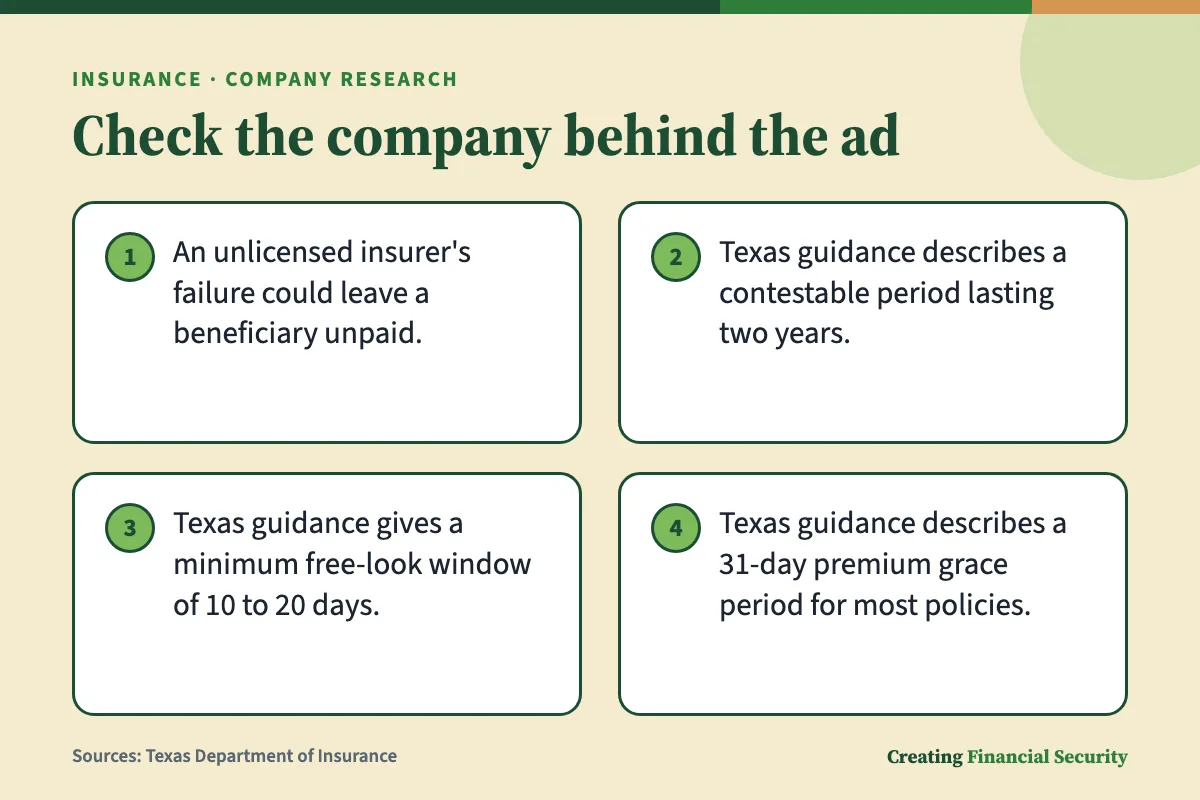
The Texas department explains why it matters: a beneficiary of a policy from an unlicensed company might go unpaid if that company collapses. It also advises confirming that both the agent and the company are licensed.
The department describes several sales routes: buying directly from an insurer, through an agent or through a broker. A broker can represent several insurers. Ask which role the person on the phone has. The insurer and the seller are separate questions, and each gets its own check.
Read the license status and permitted insurance line
When a record or help-line answer comes back, note whether the status is current and which kinds of insurance it covers. Then ask the department whether the insurer and the seller are authorized for the coverage being offered. A matching name alone doesn't settle that.
If an answer is unclear or the name doesn't quite match the ad, the department's consumer line is the place to ask what a record means.
Verify the seller through an independent contact route
A name in an advertisement doesn't by itself show that the caller is connected to the insurer. One approach is to ask the insurer and the state insurance department how to verify the seller, then use contact details you found yourself rather than ones the seller supplied.
The Texas department also says agents may not use gifts, or price breaks on an investment or loan, to entice a buyer. If an offer seems improper, it invites people to call its Consumer Help Line. That is a reporting route, not a conclusion about any seller.
| Record | What it can show | Where to find it |
|---|---|---|
| License record | Licensing status for the insurer or agent | Texas company-and-agent lookup or Consumer Help Line |
| Complaint count | Recorded complaints against the insurer | Texas company-and-agent lookup or Consumer Help Line |
| Financial rating | A company's financial rating | Same Texas lookup feature or help line |
| Commissioner orders | Listed orders, identified by number, issue date and subject | Texas orders page |
Read complaint records without letting one number decide
The Texas department says its lookup feature or help line can give you the number of complaints against a company. That is a starting point, but a count isn't a ranking.
Alongside the total, ask what the complaints concerned, whether outcomes are available and what context the department provides for interpreting the number. Ask what the record covers and whether more detail is available. If the answer includes an unfamiliar measure, ask the department to explain it rather than trying to turn it into a company score.
Match the entity, coverage category and reporting period
Before comparing anything, confirm you are looking at like with like:
- The entity. Ask whether the result matches the insurer named in your file.
- The coverage. Ask which kind of insurance the complaint information concerns.
- The state. Ask which state's records are included in the answer.
- The period. Ask which dates the record covers and note them beside the result.
If you can't match all four, say so in your notes instead of filling the gap with a guess.
Look for patterns and understand the data limits
Rather than building a score of your own, ask what detail accompanies the count. Does the department identify complaint subjects, dates or outcomes? Can it explain whether similar concerns appear more than once? Record the answers it actually provides, and mark the rest as unknown.
If the total is small, ask how the department interprets it and what conclusions it considers appropriate. Keep the complaint information beside the license and financial-rating checks, rather than treating one answer as a substitute for the others.
What financial-strength evidence can and cannot tell you
Burial coverage is a long-term promise, so the company's financial condition belongs on the list. The Texas department says you can learn a company's financial rating through its lookup feature or its help line.

Ask what any rating provided actually assesses. Does its explanation address financial condition only, or anything about service? Keep separate questions about the policy's price and benefits; the Texas guide calls for comparing coverage and costs as well as checking the company.
If no rating turns up, record that as an unanswered question. Ask the department what financial information it can share, and ask the insurer to identify the organization behind any rating it advertises.
Check the rated entity, rating date and scale
Three plain questions help with any rating you come across:
- Who was rated? Ask for the exact company name attached to the rating and compare it with the insurer in your file.
- When? Ask when the rating was issued and whether the department can help confirm it.
- On what scale? Ask the organization behind the rating to explain its terms and scale.
If the ad leaves out a date or company name, put those details on the unanswered-questions list rather than supplying them yourself.
Keep each source in its own lane
Each kind of evidence answers a different question:
- A license record speaks to whether the insurer or seller is authorized.
- A complaint count shows how many complaints were recorded, with limits on what it explains.
- A financial rating belongs with the explanation supplied by the organization that issued it.
- Official orders can be read for their dates, named parties and subjects.
- Informal reviews can go on a separate list of questions to investigate, not in the column for state-confirmed findings.
Keep these answers in separate columns. Alongside the company checks, retain the Texas guide's separate questions about coverage, policy features and cost.
Look for enforcement history and separate it from reviews
The Texas department publishes a list of Commissioner orders. Each entry gives an order number, a version, the date issued and a short reference line. The page says copies of other orders can be requested through an open records request. Other states may publish orders differently, so ask your mother's state insurance department what it makes available and how to search.
Two habits help. Search the legal insurer's name and the seller's name separately. Keep online reviews in a different part of the file from official records; for an order, record its identifying number and date. Reviews can suggest topics to ask about, but they are a different kind of evidence.
Read the date, scope and outcome of an official action
Not every entry on an orders list signals misconduct. On the Texas list, many entries concern rate filings, assessments and plan amendments, while a few carry titles such as emergency cease and desist. So read the reference line, the date and, where possible, the order itself.
Useful questions: Who is named? What is the subject? When was it issued? What was the outcome? Ask whether the action has been resolved and whether any later order changes it. If your search returns nothing, record where and when you searched, without turning that result into a safety endorsement.
Know the limits of insolvency protection
The Texas department says licensed insurers participate in a guaranty association that pays claims following an insurer's failure. Ask the state insurance department about eligibility, limits and other conditions; don't assume every claim is paid in full.
It also isn't the same protection people know from banking. FDIC deposit insurance protects insured deposits at FDIC-insured banks if a bank fails. A life insurance policy isn't a bank deposit, so ask the state department which protections apply to a life policy.
Use the sample contract to test the company's answers
Company research tells you who is behind the offer. The written policy tells you what is promised. Ask whether the insurer can provide the policy form or a sample contract before a sales conversation begins.

The Texas guide describes prepaid funeral insurance as coverage that pays funeral expenses and fixes the cost at today's prices. It cautions that this type can be expensive next to other life insurance, that premiums paid might exceed what it pays out, and that many such policies won't cover the whole funeral if death comes before a required amount has been paid. Those cautions concern prepaid funeral insurance specifically, so the policy type matters.
The guide adds that ordinary life coverage or savings could cover funeral costs instead. Weighing that for your mother's circumstances is something a licensed insurance professional can help with.
Ask for documents that explain the early benefit
Before a sales conversation, ask in writing for the policy form or sample contract, any benefit disclosure and the list of exclusions. Then read for these:
- Whether anything limits the benefit in the early years, and what the policy says if death comes then
- The full list of exclusions
- What the policy says about its contestable period
The Texas guide says the contestable period lasts two years. If the insured person dies within it, the insurer may review the application, and wrong or missing information can lead to denied payment even if it was a mistake. In that case the premiums go back to the beneficiary.
Check service, claims and cancellation procedures
A few practical questions belong in the file too:
- What proof does the company need for a claim, and who sends it?
- How quickly is payment made? Texas guidance requires payment within two months once the insurer has received proof of death and confirmed the beneficiary; a death during the contestable period can mean a longer wait.
- What happens if a premium is late? Texas guidance describes a grace period lasting 31 days for most policies, measured from the premium deadline. Check the policy and your state's rules.
- How can the policy be cancelled? Texas guidance puts the minimum free-look window at 10 to 20 days and says cancellation within it qualifies for a full refund. Ask what applies in your mother's state.
- Which state office takes complaints if something goes wrong?
Turn the evidence into a short pre-quote checklist
By now you may have scattered notes. A one-page checklist turns them into something the family can read in a few minutes, without ranking anyone or deciding anything. It can hold:

- The legal insurer's name, confirmed
- License answers for the insurer and for the seller
- The complaint count and what it covers
- Any financial rating, with its date and the entity rated
- Official orders found, with dates and subjects
- Under each, a line for what is still unknown
Record the source and date beside every finding
Write where each fact came from and the day you looked. A claim copied from an ad belongs in a different column from something a state office confirmed. Later, you can show what is verified and what is only advertised. The same sheet works for any other company the family considers, which keeps comparisons fair without turning into a score.
Carry unresolved questions into the next conversation
Some questions have clear homes. The state insurance department can clarify what a record means, whether a company is authorized and how to file a complaint. A licensed insurance professional can explain how a specific policy works and how it fits your mother's situation, and an attorney or financial adviser can address wider money questions. Going into a call with a short list of open questions keeps the talk on facts you can check.
The bottom line
Researching a life insurer before a quote comes down to a few modest steps. Turn the ad into the legal insurer's exact name, then ask your mother's state insurance department which checks and records it offers on licensing, complaints, financial information and orders, for both the insurer and the seller. Texas's tools are one example, not a rule for every state. Each check answers one narrow question, and none says whether a burial policy is right for your mother.
The written policy holds the benefit terms, exclusions and cancellation rights, so ask for it before a sales conversation, and ask what type of policy is being offered. Keep a sheet noting the source and date of every finding and what is still unknown. The state insurance department can clarify records, and a licensed insurance professional can speak to your mother's own situation.
Questions readers ask
Do I need to share my mother's health information to research an insurer?
What if I cannot find a financial-strength rating?
Does an old complaint mean a company is unsafe?
Can a company be licensed but not offer the advertised policy in my mother's state?
What if the seller will not identify the legal insurer?
Does a strong company record mean the burial policy is a good fit?
Sources