



If you're wondering whether an evening of paid surveys after a shift is worth it, the plain answer is that an advertised balance is not cash in your hand. Whether the time pays off depends on what actually reaches your bank account, how many hours it took, what it cost you, and what personal information you handed over.
This general guide cannot verify a particular company's current payment record or predict your earnings.
Start with what the reward actually promises
Start by asking what participation would involve and what, if anything, the service promises in return. Look for written answers rather than assuming that an advertised reward is available to everyone.
Useful questions to start with:
- How is the reward described: as cash, points, credit toward purchases, or something else?
- Can the terms be read before you spend time on tasks, or only after you sign up?
- What do the terms say about being turned away from a survey? Time spent without a reward is still time spent.
Each form of reward has a different value in a household budget. Money that arrives in your own account can pay a bill. A credit that works in only one place, if the terms say so, helps only with what you would have bought there anyway.
Also ask what remains unknown: how often tasks might appear, whether you would qualify, and when any reward would become available. An unanswered question is not proof of wrongdoing, but it leaves less to rely on when planning your time.
A reward balance is not a paycheck
Keep these labels apart when you read any account page:
- Advertised incentive: what the service says you could earn.
- Pending credit: something recorded but not yet confirmed, if the service uses that kind of status.
- Money received: what has actually arrived somewhere you control.
The FBI warns that fraudulent task jobs can display fictitious earnings that victims cannot withdraw. That warning concerns a specific scam, not survey services generally. A displayed balance and a completed payment are different kinds of evidence.
A screenshot of a balance, yours or someone else's, belongs in the same category. It shows what an app displayed at one moment, not what could be withdrawn, when, or at what cost.
How it works, step by step
- The FBI asks task-scam victims to submit an Internet Crime Complaint Center report with details of related transactions.
- Check statements from banks and card issuers for transactions that appear unauthorized or suspicious, and report them.
- USA.gov advises protecting birth dates, Social Security numbers and banking details.
Check whether the balance can become usable money
Before spending hours building a balance, read how it could turn into something you can use. Those rules should be readable before you start, not only after you've finished tasks. If they're hard to find, or seem to differ depending on where you look, note that in your records.
A balance is only as useful as the answers to a few plain questions. Can it be withdrawn as money you control? How much has to build up first? How long does it take to arrive? Can it disappear? Write the answers where you can find them again, even in a phone note, and mark anything the terms don't answer as unknown rather than assuming the best. A saved copy of the terms as they stood the day you joined helps if the wording changes later.
What to look for in the withdrawal rules
Several features decide whether a balance is practical for someone with a demanding schedule:
- Eligibility. Who may request payment? Are there location, age or identity requirements, and what information would they require?
- Thresholds. Is there a minimum balance? What evidence would help estimate whether reaching it is realistic?
- Payment methods. Can you use the offered payment method, and is there a fee?
- Processing time. What timing is promised, and how can a missed payment be queried?
- Expiration. Can a balance expire, including during inactivity?
- Account restrictions. What rules govern account closure, canceled rewards and disputes?
A balance that stays under a threshold or runs into a restriction may simply stay out of reach. That's why the terms deserve a read before the tasks, not after.
Count the whole session, not just the completed survey
For a complete time log, record whatever you actually do, including any login, qualifying questions, loading time or support requests. Count minutes that produce no reward as well as minutes spent completing a task.
For someone working long shifts and sometimes overtime, spare hours are the scarce thing. The useful comparison isn't survey pay against nothing. It's survey pay against whatever else that hour could hold, whether that's rest, family, errands or another way of earning.
If you decide to try it, here is one way to measure it:
- Choose a session length that fits the time available.
- Start a timer when you open the app and stop it when you close it, not when a single survey ends.
- After each session, note what was recorded and whether it is pending, confirmed, noncash or paid.
- When money reaches an account you control, note the date and amount.
- Review the log after a stretch you choose and see whether the pattern is worth continuing.
Keep a simple time-and-payment log
A notebook page with a few columns works, and every cell can stay blank until you have something to put in it:
- The date.
- Minutes spent on qualifying questions, if any.
- Minutes spent on the task itself.
- Minutes spent on administration, such as logging in, verifying details or contacting support.
- The reward recorded and its status.
- Cash actually received, and the date it arrived.
- Any purchase, fee or subscription charge connected to the session.
- Notes on anything odd, such as a task that never credited.
Compare received cash with the time it took
For a cash-flow comparison, take the cash you actually received, subtract any money you spent connected to the activity, and divide by the total hours in your log. The result is a rough picture of what an hour of this has returned to you.
Pending balances and noncash rewards stay out of that figure and get their own columns. An unwithdrawn balance may or may not become money later, and the terms decide that, not the number on the screen.
The measure has limits. A short log may not look like a longer stretch of time, and it ignores how tired you are after a shift. It can compare your own receipts, costs and hours. It can't show what other people typically get.
Read next: answering survey screening questions honestly.
Look for costs and data requests hidden behind the reward
Check whether participation requires a purchase, trial, subscription or software permission. If spending is involved, compare that cost with money actually received. Assess data permissions separately; a cash total cannot measure what sharing information is worth to you.

Patterns worth watching for:
- A trial that asks for payment details and may renew if you forget to cancel.
- A purchase required before a reward is credited.
- A request to install software or to allow broad access to your phone, contacts or browsing.
- A form that asks for more personal detail than the task would seem to need.
In the FBI's warning, criminals obtain cryptocurrency from victims by claiming it is needed for additional earnings or access to tasks. That does not establish that every participation cost is fraudulent. For the cash-flow comparison, record any spending connected to the activity.
Personal information deserves its own check. USA.gov warns that quizzes and surveys online can be used to solicit identifying details. Its precautions include protecting birth dates, Social Security numbers and banking details. Ask what information is requested and how the terms allow answers to be used or shared.
A paid offer is different from a free survey
Does the offer request only answers, or does it also require buying something, subscribing or registering elsewhere? Evaluate any required action and its cost separately from the advertised reward.
If a reward you're looking at is tied to an action like that, one charge, or a monthly bill that keeps running until you cancel, can erase it. The question is the same each time: after everything I would pay, what am I left with, and what happens if I miss a cancellation date? Write any such charge in the cost column of your log so it isn't forgotten when you add up the results.
Separate ordinary frustrations from warning signs
If a survey ends early, no tasks appear or a reward remains pending, record what happened and ask what the terms say. Without more evidence, avoid treating the event as either reassurance or a finding of fraud.
The FBI identifies a particular combination: an unexpected job approach, simple online tasks, confusing pay arrangements and demands for cryptocurrency to access tasks or increase earnings. The supposed earnings appear on a fraudulent display but are unavailable for withdrawal.
A rough way to sort what you see:
- Worth investigating, not proof either way: surveys unavailable, early endings, pending rewards, terms that are hard to find, support you can't reach, a reward form you can't use.
- Matches the FBI's task-scam pattern: an unexpected job offer involving cryptocurrency demands and fictitious, inaccessible earnings.
- A separate FBI caution: requests for identifying or financial details from an unsolicited job contact.
For unexpected job messages, the FBI cautions against interacting with attached files or links. It also warns against paying anyone who promises recovery of cryptocurrency losses.
What payment screenshots and reviews cannot prove
People often try to settle the question with evidence: an image of a payout, a video, or a post announcing a payment. These can be sincere and still tell you little. A single image doesn't show how long the payment took, how much time came first, or what happened to other people who tried.
Someone else's payment doesn't establish typical earnings, and it can't verify a company's current payment record. If the person posting also benefits when you sign up, it's fair to ask whether that gives them a reason to sound positive. That doesn't make the post false. It means it shouldn't be the only thing you rely on.
Use a short checklist before giving up an evening
Before starting or continuing, check the following:

- Find the terms and read the parts on rewards and withdrawals before completing tasks.
- Note the form of the reward and whether cash is one of the options.
- Look for anything that would require spending, including trials and subscriptions.
- See what personal information is requested and whether the task needs it.
- If you take part, log time, receipts and costs, with every minute counted.
- Watch for the FBI's warning pattern: cryptocurrency demands tied to task access or increased earnings.
Questions to settle before starting or continuing
Additional questions to record:
- Can I read the terms without finishing tasks first?
- Am I comfortable with how my data could be used, including whether it could be shared?
- Does earning anything require me to spend money?
- Can I reach support if a reward doesn't credit or a withdrawal stalls?
- Is the time cost, counted honestly, one I'm willing to accept for what I've actually received?
If any answer is no or unknown, that's useful information. It doesn't prove a service is dishonest. It means it may not fit the time and risk you have to give.
Keep records of money received and problems encountered
Records do two jobs. They show you whether the activity is worth it, and they back you up at tax time or if something goes wrong.
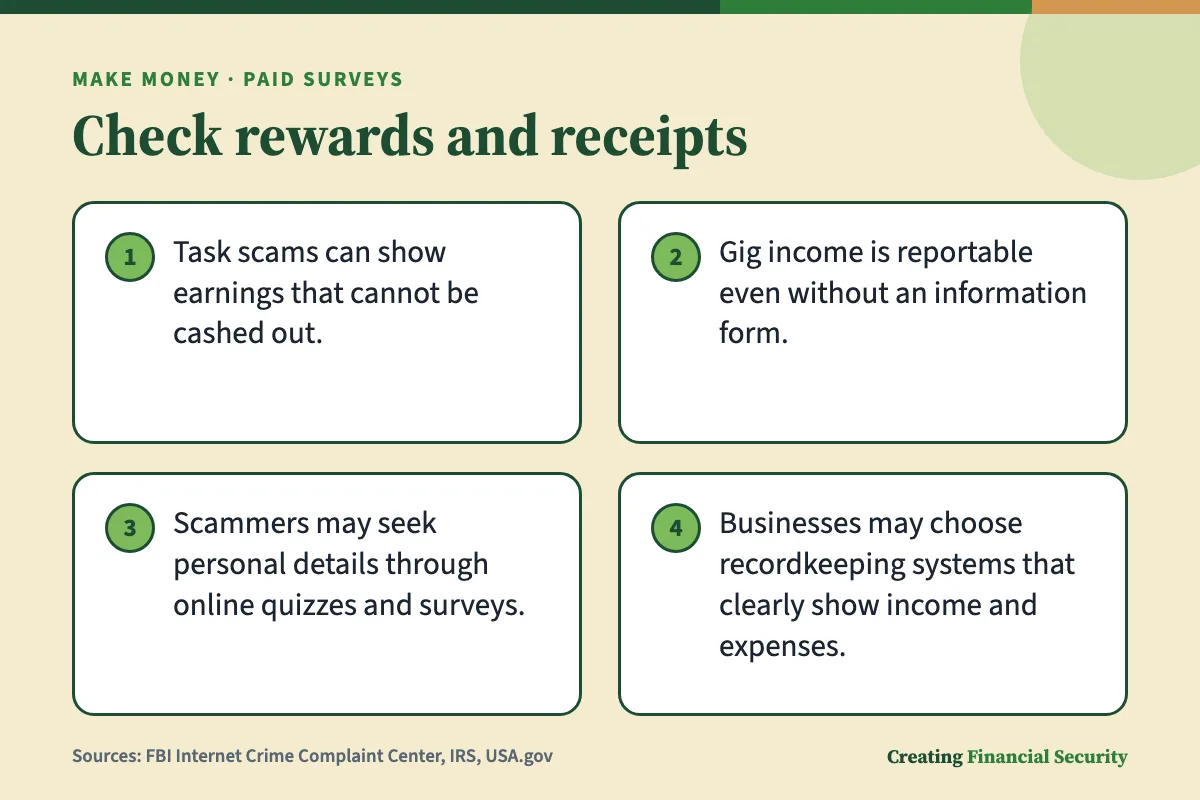
On taxes, the IRS describes gig work as income-earning activities that can be arranged through digital platforms. It says income from the gig economy must be reported on a tax return even when it isn't shown on an information return such as a Form 1099-K or W-2. Whether a particular survey activity counts, and how a given reward is treated, depends on the facts. IRS guidance or a licensed tax professional can help with your own case, and not receiving a form isn't a reason to assume there's nothing to report.
For businesses, the IRS permits a choice of recordkeeping methods, provided receipts and expenses are clear. It explains that records help trace income and substantiate tax-return entries, and must be retained for the period needed to establish reported income or deductions. That business guidance does not determine whether a particular survey activity is a business.
Records worth keeping:
- Money received: dates, amounts and how it was paid.
- Noncash rewards: what they were and when you received them.
- Costs: receipts or statements for anything you paid in connection with the activity.
- Terms: a saved copy of the rules on rewards and withdrawals as they stood when you joined.
- Correspondence: messages with support, with dates and what was said.
- Cancellations: confirmation that a trial or subscription ended.
The FBI asks task-scam victims to submit reports through its Internet Crime Complaint Center, including details of related transactions. For identity theft, USA.gov directs people to the Federal Trade Commission's identity-theft reporting tool or 1-877-438-4338. It also advises checking statements from banks and card issuers and reporting transactions that appear unauthorized or suspicious. Reporting is not a guarantee of repayment.
Read next: documenting offer completion.
The bottom line
An advertised reward is a promise, not a payment. What matters is what reaches an account you control, how many hours it took from first login to last message, what it cost along the way, and what personal information went out the door. Your own log helps document receipts, time and costs; it does not verify a company's current payment record or establish typical earnings.
The FBI's task-scam warning concerns fake jobs that demand cryptocurrency for task access or increased earnings while displaying money victims cannot withdraw. It separately cautions against giving identifying or financial details to unsolicited job contacts. Neither warning establishes the status of a particular survey service. Investigate unexplained delays or inaccessible rewards rather than assuming they are harmless or fraudulent. If the hours, costs and receipts do not justify continuing, choosing another use for the evening is a reasonable result.
Questions readers ask
How can records help track receipts and costs?
Does a displayed balance prove money is available?
Are survey payments taxable if no tax form arrives?
How can victims report a suspected task scam?
What personal details does identity-theft guidance say to protect?
Sources
- FBI Internet Crime Complaint Center: Task-scam warning signs, including fake earnings interfaces and cryptocurrency payments (report at www.ic3.gov)
- USA.gov: Identity theft | USAGov (FTC reports: IdentityTheft.gov or 1-877-438-4338)
- Internal Revenue Service: Gig economy tax center: tax treatment of side income
- Internal Revenue Service: Recordkeeping for small businesses and the self-employed