



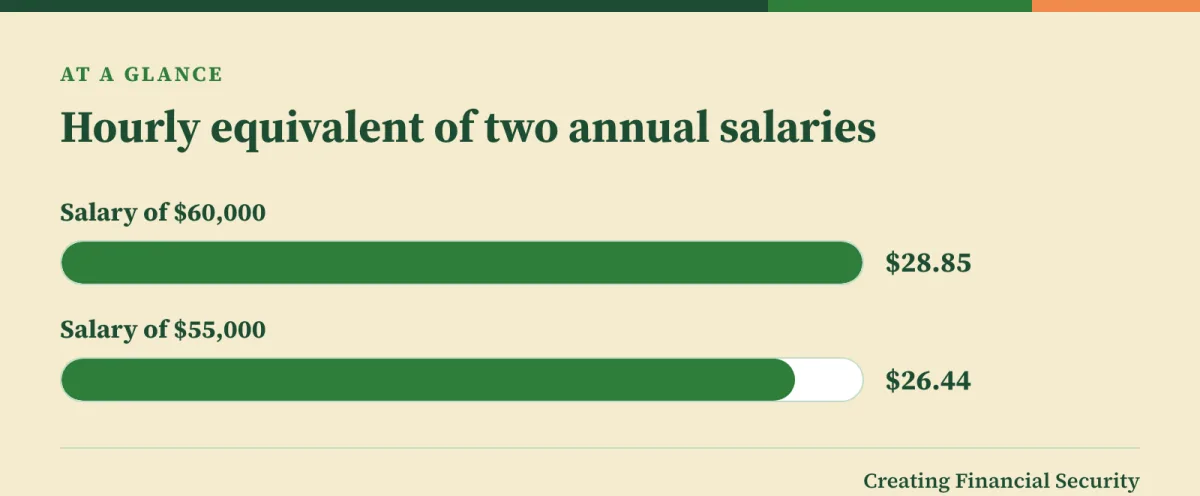
If you're asking how much hourly pay it takes to make 60k a year, the answer on a full-time schedule is $28.85 an hour, before taxes. A hypothetical $55,000 offer works out to $26.44 an hour on the same schedule, which is higher on paper than the $25 hourly reference wage used here.
That's a starting line, not a finish. The conversion assumes a standard week. It can't see the overtime you may be earning now, the hours a supervisor job really asks for, or what comes out of each check.
From there, the question is what sits behind the number: hours, overtime rules, taxes, local pay and benefits. Your pay stubs and offer letter hold the real figures, and the $55,000 and $25 used here are reference points.
This guide is part of our larger one on salary versus hourly offer comparisons.
Put $60,000 and $55,000 on the same pay scale
A salary and an hourly wage are quoted on different clocks, which is why they're hard to compare by feel. A conversion puts one yearly figure onto each clock: monthly, twice a month, every two weeks, weekly, daily and hourly.
| Yearly salary | Monthly | Twice a month | Every two weeks | Weekly | Daily (8 hours) | Hourly |
|---|---|---|---|---|---|---|
| $55,000 | $4,583.33 | $2,291.67 | $2,115.38 | $1,057.69 | $211.54 | $26.44 |
| $60,000 | $5,000.00 | $2,500.00 | $2,307.69 | $1,153.85 | $230.77 | $28.85 |
A full-time year is 2,080 work hours: 40 hours a week for 52 weeks, with paid time off counted as paid hours. Paychecks: 26 every two weeks, 24 twice a month, 52 weekly; a work day is 8 hours and a work year has 260 work days. Amounts are before taxes and other deductions (gross pay). The $55,000 and $60,000 rows provide two salary reference points. The hourly column is the quick answer: $26.44 for $55,000 and $28.85 for $60,000. The weekly column helps if you think in weeks, since $1,057.69 and $1,153.85 are the gross amounts for a standard 40-hour week.
Compare the $25 hourly reference wage with those figures. Any gap you see is all the table can tell you. It doesn't know the hours you work now, and it doesn't know what the new job will ask of you.
The schedule assumed in the table
The table assumes a full-time year of 2,080 work hours: 40 hours a week for 52 weeks, with paid time off counted as paid hours. It counts 26 paychecks for pay every two weeks, 24 for pay twice a month and 52 for weekly pay, and it treats a work day as 8 hours.
Those are averages, not deposits. An actual check can differ with the employer's payroll calendar and with other pay. Every amount is gross, meaning before taxes and other deductions.
The Labor Department describes 40 hours as the general weekly threshold beyond which covered, nonexempt employees must receive overtime pay. That is an overtime threshold, not a limit on how long a workweek may be.
Check how much time the salary actually covers
The conversion quietly assumes a 40-hour week, but a salary doesn't buy 40 hours by itself. It covers whatever hours the job is understood to include. For an employee paid a weekly salary, the Labor Department says the regular hourly rate comes from dividing the salary by the number of hours that salary is meant to pay for. Change the hours and the same yearly figure becomes a different hourly rate.

A few things can move the number in everyday terms:
- A longer regular week. The same pay spread over more hours means less earned for each hour worked. If the role also carries extra pay for extra hours, that changes the math, which is why it helps to know whether it does.
- Unpaid time off. The table counts paid time off as paid hours. Days an employer doesn't pay for are different, and the offer letter or handbook should say which kind a given day is.
- Work that isn't on the schedule. Early meetings, calls after a shift or covering for a no-show add hours the table can't see.
- Commute and shift timing. A start time that adds travel or childcare cost changes what the hours are worth to a household, even when the pay is the same.
None of this is a reason to distrust a salary. It's the reason the hours matter as much as the amount.
Paid hours and hours on the job are not interchangeable
The standard conversion is a pay-system calculation: yearly pay spread over the 2,080 hours that count as a paid year. A personal effective hourly figure is a separate calculation, built from your own yearly pay and the hours you actually spend working, including the ones nobody scheduled.
Keeping the two apart avoids a common mix-up. The table describes the standard schedule. If your weeks run longer or shorter, your own number will come out differently, and counting real hours is the only way to know. One option is to ask people already in the role what a typical week looks like.
Account for overtime before calling the salary a raise
For an hourly worker, overtime can be a big slice of the year. Under the general federal rule described by the Labor Department and IRS, covered, nonexempt employees must receive overtime pay once weekly hours exceed 40. The required rate is generally at least 1.5 times the regular rate.
The law also looks at one week at a time. The Department's interpretation says hours can't be averaged across two or more weeks. For a covered, nonexempt employee under that general rule, a 30-hour week followed by a 50-hour week still requires overtime pay in the second week; averaging them to 40 does not erase it.
That's why a fair comparison isn't one hourly figure against another. It's actual yearly hourly earnings, overtime included, against a salary that may or may not include additional compensation for extra hours.
A made-up overtime week at $25 an hour
The table below is a made-up example, not a forecast of anyone's schedule. It assumes 5 overtime hours a week, paid at 1.5 times the hourly rate for hours over 40, every week of the year, before taxes.
| Per week | Per year (52 weeks) | |
|---|---|---|
| Regular pay (40 hours) | $1,000 | $52,000 |
| Overtime (5 hours at $37.50) | $187.50 | $9,750.00 |
| Total | $1,187.50 | $61,750.00 |
Overtime is paid at 1.5 times the hourly rate for hours over 40 a week, every week of the year. Amounts are before taxes and other deductions (gross pay). Change the number of overtime hours and the totals change with them. Your own pay stubs can show how many overtime hours you really worked in a recent year, which is the number that matters.
A supervisor title does not decide overtime eligibility
Moving into a supervisor role doesn't automatically end overtime pay, and it doesn't automatically keep it. The Labor Department's regulations say a title alone is not enough to make someone exempt; the employee's salary and duties have to meet the tests.
For the general executive exemption, the regulation looks at several things together. The general salary requirement is at least $684 weekly, paid on a salary basis and excluding board, lodging or other facilities. Management of the business or a recognized department must be the main duty. The employee must also routinely supervise at least two full-time employees or an equivalent workforce. Finally, the employee must either have hiring or firing authority or make recommendations about employment-status changes that carry particular weight. The regulation specifies different salary thresholds for certain territories.
The regulations also address mixed jobs. An assistant manager who also serves customers or stocks shelves can still be exempt if management is the primary duty and the other executive-exemption requirements are met. A working supervisor whose primary duty is production-line work doesn't become exempt just because they sometimes direct others.
State and local laws can set wage and overtime rules that differ from the federal ones. For a specific job, the Labor Department's Wage and Hour Division is the office that answers questions about how the rules apply.
Separate the salary figure from the paycheck
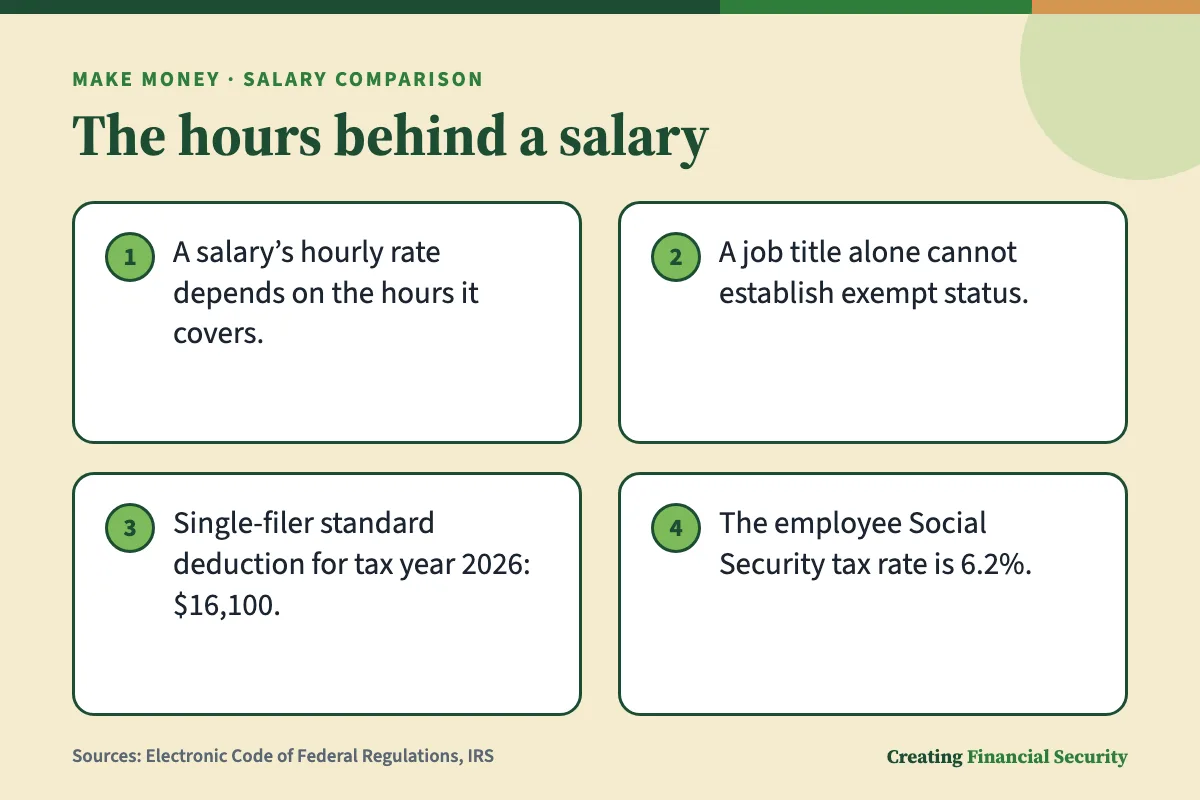
A salary is a gross number. What reaches a bank account depends on taxes, benefits and withholding choices, and no table can know your situation. The two tables below are a bounded federal illustration for $60,000, not an estimate of anyone's deposit.
| Yearly salary | Standard deduction | Taxable income | Federal income tax | Social Security (6.2%) | Medicare (1.45%) | Left after these taxes | Per month |
|---|---|---|---|---|---|---|---|
| $60,000 | $16,100 | $43,900 | $5,020 | $3,720 | $870 | $50,390 | $4,199.17 |
Tax year 2026 federal figures from the IRS; single filer; the standard deduction; no other income, pre-tax deductions or credits. State and local income taxes are not included; they depend on where you live. Payroll taxes are the employee share. Real paychecks also depend on your W-4 and benefits. For tax year 2026, the IRS sets the standard deduction for single filers at $16,100. Subtracting it leaves the taxable income in the table. The table then adds the employee share of Social Security and Medicare taxes to show what is left after these taxes: $50,390 a year, or $4,199.17 a month.
Income tax is built in layers. The IRS applies the 10% rate to a single filer's taxable income of $12,400 or less, and the 12% rate to taxable income above $12,400 through $50,400. The next table shows how the two layers that apply here add up.
| Tax rate | Part of taxable income | Amount taxed | Tax |
|---|---|---|---|
| 10% | $0 to $12,400 | $12,400 | $1,240.00 |
| 12% | $12,400 to $43,900 | $31,500 | $3,780.00 |
| Total | $43,900 | $5,020.00 |
Taxable income $43,900 = $60,000 minus the $16,100 standard deduction.
What the federal illustration does and does not include
The figures use tax year 2026, which the IRS says generally applies to returns filed in 2027. They assume a single filer taking the standard deduction, with no other income, pre-tax deductions or credits. Payroll taxes are the employee share: 6.2% for Social Security and 1.45% for Medicare.
Left out are state and local income taxes, health premiums, retirement contributions and anything else on a pay stub. The table also shows tax liability, not withholding. Employers withhold federal income tax using the employee's Form W-4 and IRS withholding tables, so deposits can differ from what's finally owed when the return is filed.
A temporary federal deduction can also affect the comparison. For an eligible individual, the IRS describes a deduction capped at $12,500 for qualifying overtime pay. It concerns the premium above regular pay required by federal overtime law—not all earnings during overtime hours. Social Security and Medicare taxes generally still apply to overtime compensation. Other eligibility conditions apply; the IRS or a tax professional can help determine how the provision affects a particular return.
Check the local wage benchmark, not a national label
An offer's value depends on the work, the place and the household it has to cover. A salary can feel generous in one area and thin in another, because rent, transportation and childcare cost different amounts. That part is personal arithmetic, and only you have the numbers for it.
Published wage data can supply the other half: what employers in your area pay for comparable work. A few steps keep the comparison grounded:
- Write the duties the offer describes in your own words: how many people you'd direct, what you'd decide and how much hands-on work remains.
- Look for an official wage-data source that lists pay by occupation and by area, and pick the occupation whose description matches those duties rather than the job title.
- Choose the area where the job is located, not the whole country, and note the year the data covers.
- Read the range the source gives rather than one figure, and treat it as a reference point, not a rule about what an offer should be.
- Set your household's regular monthly costs beside it, including the commute to the new site.
Match the work before comparing the wage
Titles are slippery. A shift lead, a team lead and a supervisor can describe quite different jobs, and companies use the same word for different roles. The Labor Department makes a similar point about overtime: what the job involves matters more than its label.
So the comparison should follow the work. A role directing a crew and making staffing decisions isn't the same as a lead who mostly works alongside the team, and data for one may not describe the other. If no listed occupation fits well, that's worth knowing too, and the employer can say how the role is classified.
Compare what comes with the pay
Two jobs with the same hourly equivalent can leave a household in different places once benefits, schedules and travel are counted. None of those values appear in the conversion table, so they're left as blanks to be filled from written terms rather than guessed.

Use the written terms rather than assumed benefits
For each line, write what the current job gives and what the offer states. Where the offer is silent, write "unknown" instead of assuming.
- Pay basis and schedule: hourly or salary, scheduled hours a week, shift times and weekend coverage.
- Overtime: whether it's paid, and under what conditions.
- Health coverage: who pays what share of the premium, and when coverage starts.
- Retirement plan: whether there's an employer contribution and any waiting period.
- Paid time off: how much, how it builds up, and whether unused time is paid out.
- Commute and costs: distance, start times and anything that affects childcare or transport.
An offer letter or benefits summary is where these answers should live. If a term was only mentioned in conversation, asking for it in writing is a common step. An "unknown" is still useful, because it marks a question to bring back.
Get the missing terms answered before deciding
Open questions about hours, overtime and deductions are easier to settle when they're specific. These are the ones the earlier sections point to:
- How many hours a week does the salary cover?
- Is the role treated as exempt from overtime, and on what basis?
- Is there any pay or time off in return for extra hours?
- Which benefits start on day one, and which have a waiting period?
- Which deductions come out of each paycheck, and which are optional?
- When are pay reviews held, and how are raises decided?
Ask about ordinary weeks and busy weeks
For both ordinary and busy weeks, ask what hours the role involves, how much notice there is for extra shifts, whether you'd be expected to be reachable off shift, and how coverage works when a team member is out.
Then ask how exemption status was decided. The Labor Department's regulations tie it to pay and duties, not title, so a clear answer should describe what the role does: who you'd direct, whether you'd have a say in hiring and firing, and how much hands-on work remains.
Writing the answers beside the figures from the first table and your recent pay stubs makes the comparison concrete. If doubt remains, a wage-and-hour office, an employment attorney or a tax professional can look at your actual paperwork.
Quick answers about salary conversions
The same table math runs in reverse. An hourly rate becomes a yearly figure when it's multiplied across a full-time schedule, and an unusually high rate shows why the schedule assumption matters.
| Hourly | Daily (8 hours) | Weekly (40 hours) | Every two weeks | Monthly | Yearly |
|---|---|---|---|---|---|
| $200.00 | $1,600 | $8,000 | $16,000 | $34,666.67 | $416,000 |
A full-time year is 2,080 work hours: 40 hours a week for 52 weeks, with paid time off counted as paid hours. Paychecks: 26 every two weeks, 24 twice a month, 52 weekly; a work day is 8 hours and a work year has 260 work days. Amounts are before taxes and other deductions (gross pay). The table assumes every one of those hours is paid, week after week. A rate quoted for a one-off contract or a side job doesn't establish a full year of paid hours.
The bottom line
A yearly salary converts to an hourly figure on a standard full-time schedule: $28.85 for $60,000 and $26.44 for $55,000, before taxes. That's a useful starting point, but it isn't proof that an offer pays more than $25 an hour with overtime.
What the number can't see is the part that decides the comparison: the hours the salary really covers, the overtime that may stop if the role is exempt, and the deductions between gross pay and what reaches an account. The made-up overtime week showed how much a few regular extra hours can add, and your own pay stubs show your real figure.
Before deciding, it helps to get the hours, overtime status and benefits in writing, and to check the pay against official wage data for the same kind of work in the same area. For a question about a specific job's overtime status, the Labor Department's Wage and Hour Division is where those go, and a tax professional can look at your own withholding.
Questions readers ask
What annual salary does $200 an hour represent?
Are biweekly pay and twice-monthly pay the same?
Does paid vacation reduce a fixed annual salary?
Can a salaried supervisor still receive overtime?
Will the federal estimate match my direct deposit?
Sources
- Electronic Code of Federal Regulations: 29 CFR Part 778 -- Overtime Compensation
- Electronic Code of Federal Regulations: 29 CFR Part 541 -- Defining and Delimiting the Exemptions for Executive, Administrative, Professional, Computer and Outside Sales Employees
- Internal Revenue Service: Publication 15 (2026), Employer's Tax Guide
- IRS: IRS releases tax inflation adjustments for tax year 2026
- IRS: Topic no. 751, Social Security and Medicare withholding rates
