

Reviewing Schedule A means lining up every deduction with a record, confirming the amounts against that year's limits, and making sure the total carries to Form 1040 correctly. It's a records check more than a tax puzzle, and you can do it calmly, one line at a time.
One idea is worth holding from the start. The mortgage interest you paid is not automatically the amount you can deduct, and neither figure is the same as the tax you'd save.
You don't have to finish in one sitting. Work one category at a time, write down questions as they come up, and take the open ones to your preparer or to the IRS's own materials.
This guide is part of our larger one on deducting mortgage interest on your return.
Start with the return year and a small stack of records
Begin with the year printed on the return, because deduction rules and limits can change. The IRS's 2025 instructions apply to that tax year. For a different year's return, use that year's instructions rather than carrying these figures forward.
The IRS says Schedule A is where itemized deductions are figured, and that in most cases tax is lower with the larger of itemized or standard deductions. It also says that if you itemize, you can't take the standard deduction. Owning a home doesn't settle which one a return uses.
A small stack of papers makes the review easier:
- The draft return, including Schedule A and the first page of Form 1040
- Your filing status as it appears on the draft, since some limits differ for married filing separately
- The Form 1098 or similar mortgage interest statement for each mortgage
- Your real estate tax bill and a record of what was paid to the taxing authority
- Year-end records for medical costs, gifts, and state and local taxes
- The closing statement, if you bought or refinanced during the year
- The IRS instructions for Schedule A for the year you're filing
For a mortgage with annual interest payments of at least $600, including certain points, the IRS generally requires the mortgage holder to provide Form 1098 or an equivalent statement when those payments arise in its business. A missing statement is a question for the mortgage holder, not a reason to guess an amount.
How it works, step by step
- For line 1, exclude the portion of eligible medical bills paid by insurance or other sources.
- Request the property-tax bill when it has not been supplied by the lender or taxing authority.
- Check other parts of the return for expenses already deducted before including them on Schedule A.
- Compare the itemized total with the standard deduction for your filing status and year.
Match each deduction to evidence
Think of each Schedule A line as a small claim. It needs a record behind it, a rule that allows it, and a reason it belongs on this form instead of somewhere else. Category by category:
- Mortgage interest. Check it against the lender's statement and loan papers. Warning signs: a figure that differs from the statement, or loan proceeds that went somewhere other than the home.
- Real estate taxes. Check them against the tax bill and the record of what was paid to the taxing authority. A warning sign is a figure that looks like your escrow deposits.
- Points. Check the closing statement. A warning sign is a full amount claimed in one year on a refinance.
- Medical and dental costs. Check receipts, insurance statements, and reimbursements. A warning sign is an amount never reduced by what insurance paid.
- State and local taxes. Check year-end forms, tax bills, and sales tax receipts. A warning sign is both income and general sales taxes claimed.
- Charitable gifts. Check receipts and written acknowledgments. A warning sign is a payment that also bought you something, such as a dinner ticket.
One caution covers every category: an expense already deducted on another part of the return cannot also become a Schedule A deduction. Review the main return and any separate business, rental or other schedules for overlapping entries.
Give home-related entries an extra look
Three entries deserve a slow read: mortgage interest, real estate taxes, and points.
Mortgage interest. Form 1098 supplies the reported interest and points for the line 8a review. Under the IRS instructions, applicable restrictions can make the allowable entry smaller than the reported figure. The statement supplies information; it does not resolve every eligibility question.
For a 2025 return, the IRS ties this deduction to borrowing used for the purchase, construction or substantial improvement of the property pledged as security. A grandfathering exception covers loans originating October 13, 1987, or earlier. Check the line 8 box when a home mortgage had an outstanding balance during 2025 and some proceeds went to purposes other than purchasing, constructing or substantially improving the home. Publication 936 explains the balance restrictions and remaining conditions.
An interest payment exceeding the statement's figure needs an explanation when the larger eligible amount is entered on line 8a. Shared borrowing needs another check: when another liable borrower also paid interest, the deduction is restricted to the filer's portion. A spouse filing jointly is excluded from that shared-borrower rule.
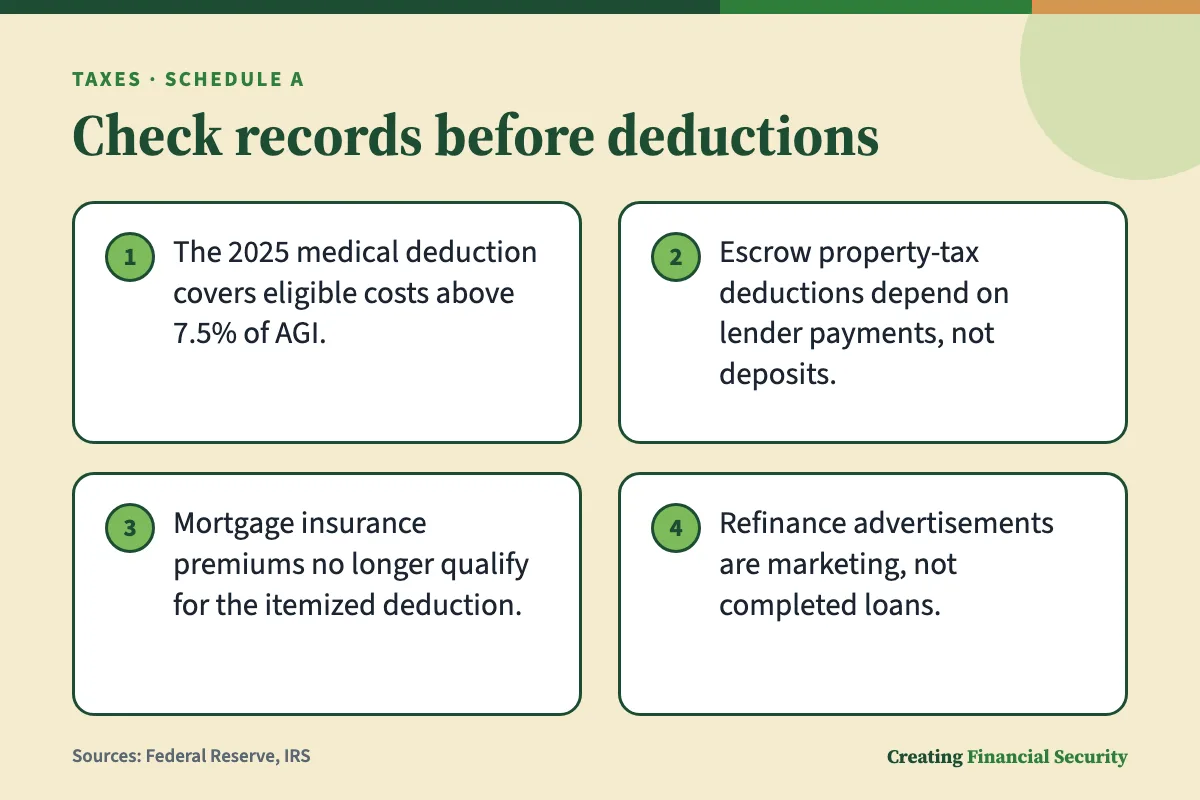
Real estate taxes. Putting money into escrow is different from paying a property tax. The IRS bases the escrow-related deduction on the lender's disbursement to the government, not on deposits awaiting payment. Other eligibility rules and limits still apply. Use the tax bill to verify the payment and identify service charges that do not qualify. Request the bill from the lender or taxing authority if it is missing.
Points. These charges can represent interest paid ahead of time. The IRS generally spreads the deduction across the mortgage term, although qualifying payments can receive different treatment after specific tests are met. Refinancing does not generally permit an immediate deduction of all points.
The closing statement also helps divide property taxes between buyer and seller. For federal tax purposes, the buyer's portion starts on the sale date; the seller's portion ends immediately before it. Closing records generally show this allocation. That split concerns the purchase-year return, while allowable points deductions may continue across later years.
Check the categories beyond your mortgage
A full review covers the rest of the form too, without assuming that every expense qualifies.
Medical and dental costs. The 2025 instructions set a floor of 7.5% of adjusted gross income, using the AGI figure from line 11b of Form 1040. Only eligible costs above that floor become a deduction. The initial expense entry on line 1 is different: first remove insurance payments and other reimbursements from qualifying bills. Health premiums funded through pretax payroll reductions are excluded because the corresponding compensation was not included in taxable income.
State and local taxes. For the income-tax-versus-sales-tax choice, the IRS permits one category, not both. Property taxes also fall within the overall SALT limit. The applicable ceiling depends on filing status and can shrink as modified adjusted gross income rises, so check the return-year worksheet. A sales-tax claim based on actual spending requires receipts documenting those payments rather than an unsupported estimate.
Charitable gifts. The IRS generally requires itemizing for a charitable deduction, and the recipient must qualify. Its online organization-search tool can help verify that status. When a payment also purchases a benefit, only the eligible excess over that benefit's value is deductible. A combined donation-and-purchase payment exceeding $75 generally triggers a written disclosure from the organization; exceptions apply. Buying raffle tickets or playing bingo is not a charitable deduction.
Look for limits, reimbursements, and duplicate claims
Once each line has a record, look at what could shrink it or remove it. A short pass helps:
- Reimbursements. A provider's bill may include an insurer's payment as well as your own. The IRS excludes the insurer-funded portion from the medical expense entry. Reimbursements received in 2025 reduce medical costs paid that year, but repayments relating to earlier years follow separate rules rather than reducing the current expense total. A property-tax refund relating to that same year's payment also reduces the tax deduction.
- Repeated entries. The same payment can show up on a lender statement, an escrow summary, and a year-end printout. Make sure it lands on the return once.
- Personal costs. The IRS excludes personal interest, while allowing specified qualifying interest categories. Association assessments also cannot be treated as property taxes: they are imposed by the homeowners' association rather than a government.
- Mixed-use loans. If loan proceeds served more than one purpose, the IRS says to allocate the interest by tracing where the proceeds went.
- Prepaid interest. For mortgage interest covering later tax periods, generally allocate the deduction to the applicable years instead of claiming everything immediately. Points can qualify for an exception.
- Shared expenses. Married people filing separate returns need to establish their respective portions of jointly paid expenses. The IRS directs filers to Publication 504 for that allocation.
Closing papers can mix items that behave differently: prepaid interest, points, service fees, and taxes. Sort them before any of them goes on a form.
Use the rules for the year being filed
Use the final instructions matching the return's year to verify thresholds, ceilings, exceptions and any carryover treatment. The Schedule A update page also identifies later developments, including legislative changes that may not appear in the original instructions.
Several distinctions matter here. For 2025, IRS guidance says mortgage insurance premiums no longer qualify for an itemized deduction; their appearance on a statement does not make them deductible. Home-equity borrowing also needs a purpose check: interest attributable to spending other than purchasing, constructing or substantially improving the securing home does not qualify as home mortgage interest, regardless of the borrowing date. Separately, deductions introduced in 2025 for qualifying tips, overtime and vehicle-loan interest, along with the enhanced senior deduction, belong on Schedule 1-A. Eligible itemizers use that separate schedule too.
Check what flows from Schedule A to Form 1040
After reviewing individual entries, follow the itemized total through to the main return. Use the matching Form 1040 instructions to locate the deduction entry rather than relying on a line number from another year. The IRS says electronic-filing software generally selects the necessary schedules. That automated selection is separate from checking the amounts and eligibility behind the entries.
- Confirm the filing status on the draft Form 1040 is the one you used for Schedule A's limits.
- Read each Schedule A line against its record, not just the total.
- Check that the medical line used the adjusted gross income shown on Form 1040, line 11b, in the 2025 instructions.
- Follow the Form 1040 instructions to the line that takes the itemized amount, and confirm it matches the final Schedule A total.
- Compare itemizing with the standard deduction applicable to the year and filing status. For married people filing separately, a spouse's decision to itemize rules out the standard deduction on the other spouse's return.
- Recheck other deduction entries, including separate business and rental schedules, for expenses already included on Schedule A.
Savings are a separate question. The IRS says tax is usually lower with the larger of the two deductions, but how much lower depends on the figures on your own return, and a tax professional can confirm that for your case.
Walk through a homeowner's draft return
Here's a made-up walk-through with no figures. A hypothetical homeowner receives refinance offers and has a draft return to review.

She starts with the year and her filing status, then opens the mortgage interest statement. The interest on it is where line 8a begins, not where the review ends. She asks how the loan proceeds were used and whether another loan is secured by the house. She doesn't treat one answer as the end of the question; she notes the other conditions and limits the IRS describes and marks anything unclear for her preparer.
Next come property taxes. Her monthly payment includes an escrow amount, so she looks for the real estate tax bill and the record of what was paid to the taxing authority. She sets the escrow deposits aside as a separate figure, compares the paid amount with the draft, and reads the bill for service charges.
Then she matches medical costs, gifts, and state and local taxes to receipts. One charity entry came from a dinner ticket, so she asks her preparer how the dinner's value affects it.
Last, she checks that the return uses her final Schedule A total and compares it with the standard deduction. Anything that doesn't line up goes on a list of questions, not into a guess.
Separate an actual loan change from a refinance advertisement
The mailers on her counter don't change her return. The Federal Reserve's refinancing guide notes that ads and mailings are designed to make a mortgage look as attractive as possible. An offer is marketing, and by itself it creates nothing to deduct.
A completed refinance is different, and its records belong in the review. The IRS includes refinanced borrowing within its home-mortgage rules. She compares the closing documents with statements covering the old and replacement loans, checking the covered periods for omissions and overlap rather than assuming one statement replaces another. Previously deferred points need attention too. When refinancing stays with the same lender, the IRS requires the remaining eligible points to be allocated across the replacement loan's term instead of deducted all at once.
Whether refinancing is worth its costs is a different question. The Federal Reserve describes a break-even calculation for that, which weighs costs against monthly savings. It doesn't say what belongs on a tax form.
Turn discrepancies into questions before filing
A review is only useful if it ends with clear next steps. Sort what you found into two piles. Some items are correctable entry problems, such as a transposed digit or a figure entered twice. Others are real questions about whether something is deductible, how a loan was used, or whether a claim has support. The second pile is worth asking about, not guessing.

- Mismatched statements. The lender's interest figure doesn't match the draft. Ask the mortgage holder which loan and period each statement covers.
- Missing support. A deduction has no receipt or acknowledgment. Ask the organization or provider for it, or ask your preparer whether the item should stay.
- Uncertain loan use. You aren't sure how proceeds were spent. The IRS points to Publication 936 for those cases, and a tax professional can look at the loan history.
- Unclear property taxes. The bill and the lender's payment record disagree. Ask the lender or taxing authority for the missing record.
- A preparer's entry. A line confuses you. Ask the preparer to show the line and the record behind it.
For unresolved questions, the IRS offers its Interactive Tax Assistant online. Its topic search can help locate explanations when a publication does not answer the question.
Make one final pass through the filing copy
Review the version you'll actually submit, not the draft you marked up.
- Open the final Schedule A and Form 1040 and confirm each resolved item shows the corrected figure.
- Read the itemized total and the standard-deduction comparison once more on that copy.
- Compare names and Social Security numbers with the corresponding cards. The IRS warns that missing or incorrect numbers can mean more tax, a smaller refund or slower refund processing.
- Save the return with the records behind each Schedule A line, somewhere secure.
Keep the documents that explain an entry's treatment, not just its amount. A closing statement can explain the buyer-seller property-tax allocation, while a charity's disclosure can explain the benefit received in exchange for a payment. Those records support different questions and belong with the relevant return.
Questions that come up during a Schedule A review

Property-tax assessments can raise a separate question: what did the charge pay for? The IRS distinguishes improvements that add property value from maintenance, repairs, and related interest. An assessment for a new sidewalk generally becomes part of the property's basis rather than a property-tax deduction. A charge for repairing an existing sidewalk may qualify. For a mixed assessment, the deductible portion needs support; the entire charge does not automatically qualify.
The bottom line
A Schedule A review usually ends with a few questions that only the records, the IRS instructions, or a professional can settle: whether a loan's proceeds qualify, how much of a house payment was really property tax paid, and whether a gift bought something in return.
The IRS points to Publication 936 for mortgage interest, Publication 530 for homeowner expenses, and Publication 526 for charitable gifts, and it offers the Interactive Tax Assistant for questions the publications leave open. A licensed tax professional can look at your own loan history and return.
Until then, a mortgage statement is a starting point, escrow deposits aren't automatically a deduction, and a refinance mailer is only an offer. If something stays open, asking before you file is a calm, ordinary step.
Questions readers ask
Do I need to file Schedule A just because I own a home?
Does Form 1098 prove that all my mortgage interest is deductible?
Can I use the amount added to my escrow account as my property-tax deduction?
What if I receive mortgage statements from more than one servicer?
Does e-filing help determine which schedules are needed?
What if I discover a mistake after I file?
Sources
- IRS: Instructions for Schedule A (Form 1040)
- IRS: Publication 936, Home Mortgage Interest Deduction
- Federal Reserve Board: A Consumer's Guide to Mortgage Refinancings
- IRS: Instructions for Form 1040
- IRS: Publication 530, Tax Information for Homeowners
- IRS: Publication 17, Your Federal Income Tax
- IRS: Publication 526, Charitable Contributions