

If you sold your home this year, the mortgage interest you paid for the days before the sale may be deductible on Schedule A, as long as you itemize and stay within the loan limits. The payoff as a whole is not a deduction. Eligible interest and certain qualifying charges may count; principal and escrow do not count as mortgage interest.
Start by comparing the lender's year-end Form 1098 with the payoff statement and closing paperwork. Agreement between the documents helps establish what was paid, but eligibility rules still determine what is deductible.
Your paperwork holds three separate things at once: interest, the loan balance and any profit on the house. Each follows its own rules, so it helps to keep them in three piles. Whether itemizing makes sense on your return is a question for tax software or a licensed tax professional.
This guide is part of our larger one on where mortgage interest belongs on returns.
Start with what the mortgage payoff actually includes
A mortgage payoff can contain several different charges. Their labels matter because repaying borrowed money is different from paying interest.
- Interest. The IRS describes home mortgage interest as interest on a loan secured by your main home or a second home. When you sell, interest paid for the days before the sale date can count, within the limits.
- Principal. This is borrowed money going back to the lender. It isn't a cost of borrowing, so it never becomes an interest deduction.
- Escrow. Money held for property taxes and insurance isn't interest either. Whatever comes back unused is your own money returning.
- Points. These are prepaid interest with their own timing rules, covered further down.
- Early-payoff penalties and late charges. The IRS says a penalty for paying a mortgage off early can be treated as mortgage interest when it isn't for a specific service or cost connected with the loan. Late charges get a similar test.
- Service fees. Charges the lender makes for specific services connected with the loan aren't interest.
Interest through payoff is different from paying off the loan
Retiring a loan ends a debt; it isn't the cost of borrowing. What can count is the interest that built up through your regular payments and through the last stretch before the sale.
The date that matters is the sale date, which may not be the day you remember as closing day. The IRS says it's in box 1 of Form 1099-S if you received one. Without that form, it's whichever came first: the date title transferred or the date the buyer took on the benefits and burdens of owning the home.
In an IRS example, a May 7 sale follows $1,220 of interest payments through April 30. Another $50 appears on the settlement sheet for May's 6 pre-sale days. The IRS gives a $1,270 mortgage-interest deduction for that example. Applicable limits still need to be considered.
How it works, step by step
- Without Form 1099-S, use whichever happened first: title transfer or transfer of ownership's economic benefits and burdens.
- Check what the Form 1098 interest figure includes: prepayment penalties and late charges, but not late charges for a specific mortgage service.
- Document any deductible interest missing from the recipient's statement, then use the 2025 line 8a instructions to report and explain it.
- If your records and the lender's disagree, contact the mortgage company first, then the CFPB if it can't be resolved.
- If a filed return needs changing, use Form 1040-X, filing one form for each tax year you are amending.
Match the lender's tax statement to your closing records
Each record answers a different question, so it helps to know what each one is for.
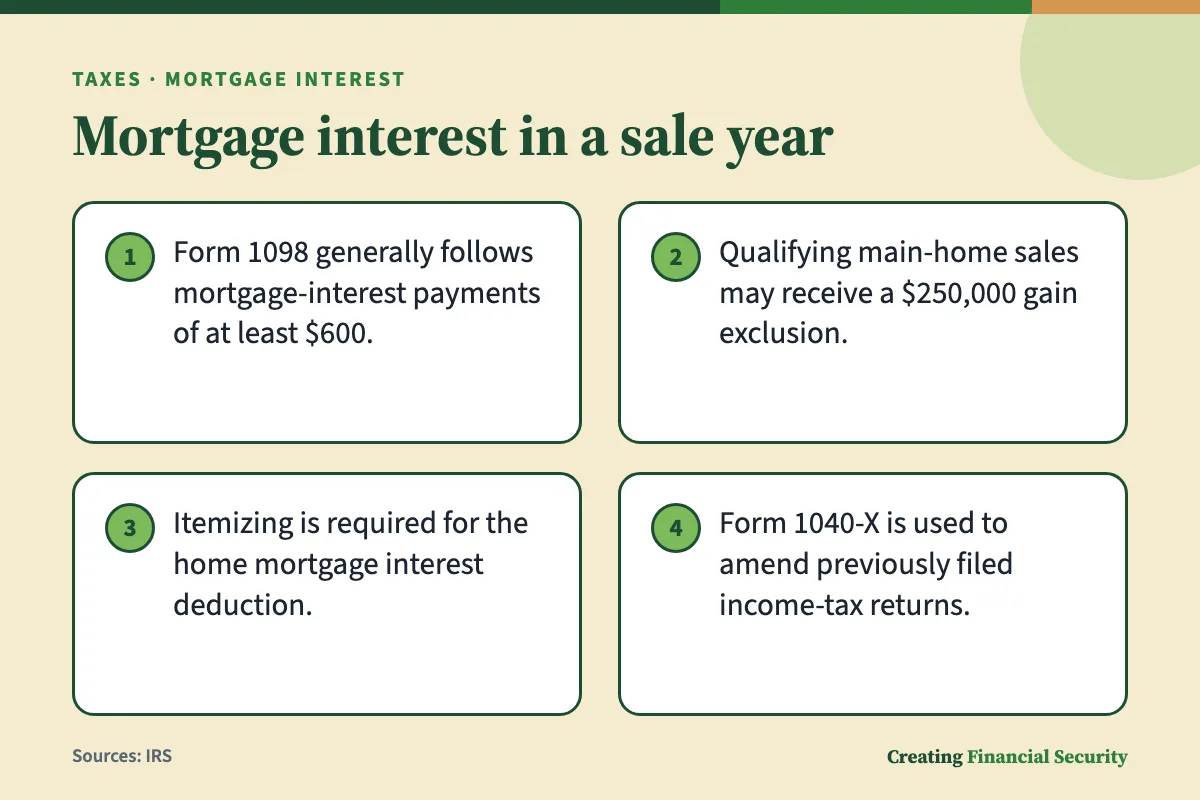
Form 1098 is the lender's tax statement. The IRS says you'll generally get one when you paid $600 or more of mortgage interest, counting certain points, on any one mortgage during the year. The threshold applies to each mortgage separately, and the statement for each year should reach you by January 31 of the following year.
Its interest figure includes prepayment penalties and late charges, except late charges for a specific mortgage service. A separate box, box 4, shows refunds or credits of interest overpaid in earlier years. The form also reports principal, but only the balance on January 1, or at origination or acquisition for a loan that began or changed hands that year. That is a record of the balance, not a deduction.
The payoff statement shows what the lender says it needed to close the loan: principal, interest through a stated date, and any fees.
The closing disclosure or other settlement statement records the closing transaction, including any interest and property taxes charged there.
A simple order for comparing them:
- List the interest part of each payment you made in the sale year, from monthly statements or the online payment history.
- Compare your list with the interest figure on Form 1098 once it arrives.
- Find the interest line on the payoff statement and the closing paperwork, and note the date each runs through.
- Mark principal and escrow as not interest, and look closely at each fee or penalty before deciding what it is.
- Put a short note beside every difference, so it's easy to explain later.
Check for omitted interest without counting it twice
Only your own records can show whether the interest in your payoff is already inside the Form 1098 interest figure, so that is the question to settle.
If the same payoff interest appears on both the form and the closing paperwork, those are the same dollars, and they count once. If the closing paperwork shows interest the form leaves out, the form may have omitted it.
Under the 2025 Schedule A instructions, line 8a can include additional deductible interest actually paid to that recipient but omitted from the statement. An explanation must accompany the discrepancy.
When you can't tell which situation you're in, contacting the mortgage company is the first step. If it can't be resolved, a complaint can go to the Consumer Financial Protection Bureau (CFPB). A tax professional can also read the documents side by side.
| Payoff item | What it is | Interest deduction? |
|---|---|---|
| Interest before the sale date | Cost of borrowing for the days before the sale | Potentially deductible if you itemize and limits allow |
| Loan principal | Borrowed money you repay | Not interest |
| Escrow balance | Money held for taxes and insurance | Not interest |
| Prepayment penalty | Early-payoff charge | May qualify as interest, but not when charged for a specific loan-related service or cost |
| Points | Interest paid ahead of time | Undeducted qualifying points generally become deductible at loan termination; same-lender refinancing is an exception |
| Lender service fees | Charges for specific loan services | Not interest |
| Seller-paid loan placement fees | Fees to arrange the buyer's financing | Selling expense, not interest |
Put the qualifying amount on the sale-year return
Schedule A (Form 1040) is where itemized deductions are figured. The IRS says your federal income tax is usually lower with whichever is larger, your itemized total or your standard deduction. Mortgage interest only helps if the itemized total is the one you use.
The line numbers below come from the 2025 Schedule A instructions. For a sale in another year, use the edition for that year, because lines and amounts can change.
- Line 8a generally receives the deductible portion of interest and points shown on your lender's Form 1098. Publication 936 explains how to calculate that portion when a limit applies.
- Line 8b handles eligible interest absent from a Form 1098 issued to you, including your paid share shown on another borrower's statement.
- The line 8 checkbox applies when a mortgage had an outstanding balance during 2025 and some proceeds served purposes other than purchasing, constructing or substantially improving the home. Interest attributable to those other uses cannot be entered as home mortgage interest on either line.
For borrowers who were liable for the mortgage and paid its interest, each person's deduction is limited to their own share, except for spouses filing jointly. If the statement came to you, report your portion on line 8a and tell the other borrowers their portions.
When itemizing and loan limits affect the deduction
Selling does not remove the itemizing requirement or the restrictions on qualifying debt.
For most mortgages, proceeds must finance purchasing, constructing or substantially improving the property securing the debt. Publication 936 calls mortgages dating from October 13, 1987, or earlier grandfathered debt; special rules apply to them.
For 2025, qualifying debt incurred later than December 15, 2017, generally has a $750,000 interest-deduction debt ceiling. Married taxpayers filing separately have a $375,000 ceiling. Earlier qualifying debt generally has a $1,000,000 ceiling, or $500,000 for separate married returns, with an exception for grandfathered debt. Holding both older and newer qualifying debt reduces the newer debt's $750,000 allowance by the qualifying older balance subject to the $1,000,000 ceiling. A limited transition exception can give some newer loans the older treatment; Publication 936 explains the conditions.
Publication 936 is where the IRS works through the amounts for older loans, loan money used for several purposes, or a mortgage larger than the home's fair market value.
Follow a homeowner from closing papers to Schedule A
At the sale. The settlement paperwork shows the payoff going to the lender. Inside it are the loan balance, interest for the final stretch, and maybe a fee or penalty. The homeowner labels each one. The balance goes nowhere on Schedule A. Interest for the days before the sale date becomes a candidate for the deduction, and so does a prepayment penalty, unless it paid for a specific service or cost connected with the loan.

Through the year. The payment history shows the interest part of each payment, which makes it a personal check on the lender's year-end number.
After the year ends. Form 1098 arrives. If its interest figure matches the payment list plus the interest on the closing papers, it's a starting point, not automatically the deduction; eligibility, shared payments and debt limits still need a look. If the figure is lower and the gap matches interest on the closing papers, the form may have left it out, and the difference gets documented.
On the return. Qualifying interest goes on Schedule A if the homeowner itemizes. Profit from the house is figured separately. The choice between itemizing and taking the standard deduction depends on the return as a whole.
Check points, refunds and unusual payoff charges
The last year of a mortgage can hold items that don't behave like ordinary interest. Here is what the IRS says about each:
- Points from the purchase loan. Subject to IRS tests, purchase points may be deducted immediately or gradually during the mortgage's term. When deductions were spread out, ending the mortgage generally permits a deduction for the unused qualifying points. The same-lender refinancing exception is explained below.
- Refunds of overpaid interest. A same-year repayment reduces the interest expense for that year. When previously deducted interest is returned in a later year, it generally becomes income to the extent the deduction lowered the earlier tax bill. Report the taxable recovery on line 8z of Schedule 1 (Form 1040). Box 4 of Form 1098 identifies earlier-year interest repayments or credits; the Schedule A instructions direct taxpayers not to subtract that box's refund from the current deduction.
- Penalties on the payoff statement. The Form 1098 instructions say its interest figure already includes prepayment penalties, so check whether the lender folded a penalty into that figure before entering it a second time.
- Points on Form 1098. Reporting generally covers principal-home purchase points, plus certain construction loans. Ordinary refinancing, home-equity and second-home points are not reported there. Earlier closing documents may therefore be needed even when points qualify for a deduction.
- Closing fees that aren't points. Points don't include amounts paid in place of items normally listed separately, such as appraisal, inspection, title and attorney fees or property taxes.
If points on your Form 1098, your closing papers and your earlier returns tell different stories, a tax professional can look at them together.
An earlier refinance can leave unfinished points deductions
Refinancing points generally produce deductions gradually during the replacement mortgage's term, rather than all at once. An exception can allow an immediate deduction for the qualifying portion associated with substantial improvements to a main home, if the IRS tests are satisfied.
Ending a mortgage generally releases the qualifying points deductions still outstanding. Refinancing with that same lender is different: the undeducted points continue to be deducted gradually during the replacement loan's term.
Keep the interest deduction separate from the home-sale calculation
Mortgage interest is a Schedule A item. Profit or loss on the sale is a separate calculation with its own worksheets.
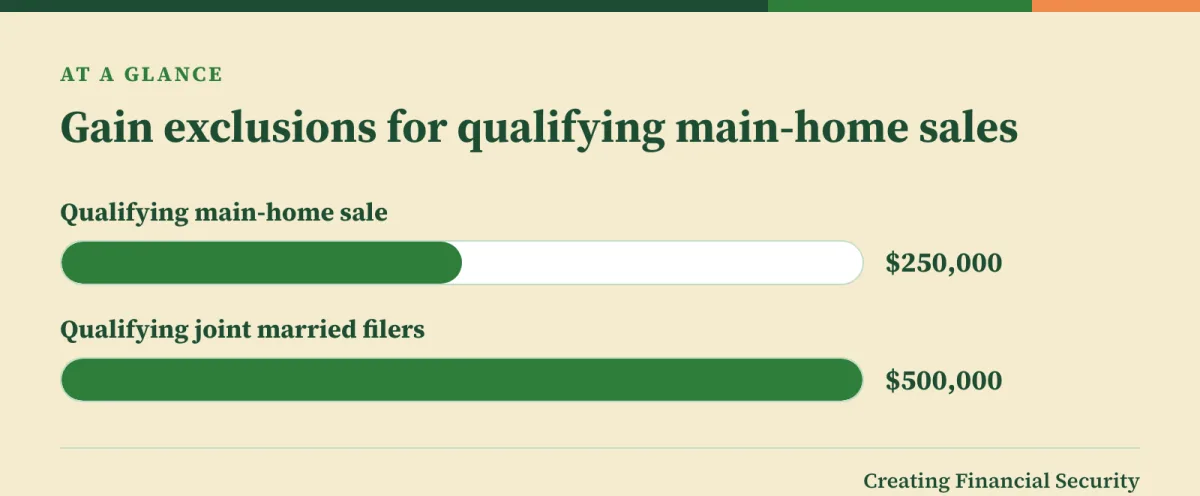
A qualifying main-home sale may receive a gain exclusion of $250,000, increased to $500,000 for qualifying joint married filers. Gain or loss is the amount realized minus adjusted basis. Publication 523 explains the eligibility tests and sale-reporting rules.
Several items on closing papers belong on the sale side:
- Selling expenses. A seller can't deduct loan placement fees paid to the lender to arrange the buyer's financing as interest, but they reduce the amount realized.
- Basis. Settlement costs counted toward basis don't include escrow amounts, and charges connected with getting a mortgage loan can't be added to it.
- Property taxes. The settlement statement shows property taxes paid when the sale closed, and Schedule A handles them on a separate line from mortgage interest.
A common worry is whether an excluded gain erases the interest deduction. The IRS lists the conditions for deducting home mortgage interest, including a secured debt on a qualified home you own an interest in, and itemizing. An excluded gain isn't among them. A tax professional can confirm how that plays out on your return.
Review the sale-year return before filing
A short records check before you file:
- Form 1098 for the sale year, matched against your payment history and the interest on your closing papers.
- The payoff statement and closing paperwork, with principal and escrow marked as not interest and each fee or penalty checked.
- Your notes on every difference, plus the lender's reply if you contacted them.
- Any refund of overpaid interest, and any points reported.
- Records of earlier points or a refinance, if either applies.
- Form 1099-S, if you received one, for the sale date.
- The Schedule A instructions for the year of your sale, not an older edition.
Compare a corrected Form 1098 with the filed return before deciding whether a change is needed. Form 1040-X handles amendments, with a separate form for each affected tax year. Refund and credit claims generally have a deadline measured from filing or payment: 3 years after filing the original return, including extensions, or 2 years after paying the tax. The later deadline generally controls; the IRS instructions explain exceptions.
Questions to bring to a licensed tax professional:
- Does itemizing make sense for my return this year?
- Is the payoff interest already in my Form 1098, and how can I confirm it?
- Did earlier points or a refinance leave anything unfinished?
- Is my sale gain covered by the exclusion, and does the sale need reporting?
The bottom line
In the year you sell, the part of your payoff that can be mortgage interest is the eligible interest for the period before the sale date, plus a few charges, such as qualifying penalties or points, that the IRS treats as interest. The loan balance, escrow money, selling fees and any sale profit follow other rules and don't belong on the interest line.

The work is matching records: your payment history, Form 1098, the payoff statement and the closing paperwork. Count each dollar of interest once, note any difference, and ask the lender when the numbers don't line up. If the lender can't settle it, the CFPB takes complaints about mortgage companies.
Qualifying interest goes on Schedule A only if you itemize, and the instructions for the year of your sale decide the exact lines. For your own numbers, the IRS Interactive Tax Assistant, IRS Publications 936 and 523, or a licensed tax professional can help.
Questions readers ask
Can I deduct eligible mortgage interest if my home-sale profit is excluded from tax?
What if I do not receive Form 1098 after selling?
Can I claim interest the buyer pays me back at closing?
Is the escrow refund after payoff mortgage interest?
What if a corrected Form 1098 arrives after I file?
Can I deduct all remaining refinance points when the mortgage is paid off?
Sources