

You open your mortgage interest statement and something looks off. The interest total doesn't match your records, the property address is wrong, or two statements arrived for one year. Contact the filer named on the Form 1098, usually your lender or mortgage servicer, name the box in question and send the records that show the difference.
Before you do, check that the difference is a real error. Form 1098 is an information statement, and a gap between it and your own numbers can have an ordinary explanation, especially when more than one company has handled your loan.
One thing holds either way. Asking for a corrected form is a conversation with the filer, not a filing with the IRS, so it doesn't move your tax filing deadline. A short, specific request with the right records gives the filer something to act on.
This guide is part of our larger one on claiming qualifying mortgage interest.
Check whether the statement actually needs changing
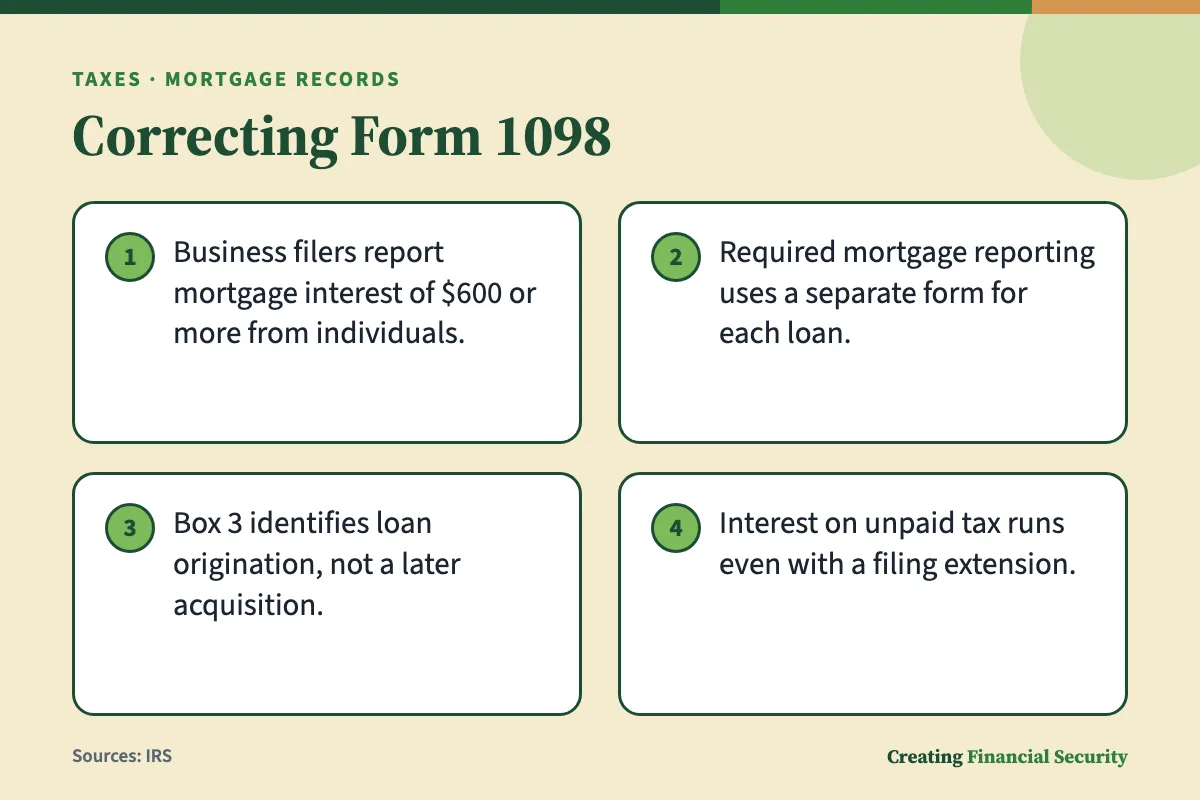
Under IRS instructions, a business generally files Form 1098 when an individual pays it at least $600 in mortgage interest during the year. The individual can be a sole proprietor. Reporting a smaller payment is also allowed, although it is not required merely because interest was received.
When reporting is required, the filer reports each mortgage separately and applies the $600 threshold to that mortgage. Reporting below the threshold is optional.
Reporting can also cover home-equity borrowing, including a credit line, when real estate secures the debt. A separate loan against the same home can therefore produce another statement. The form count alone does not establish that anything was duplicated.
Match the disputed box to the right records
Reading the form box by box is the quickest way to separate a real error from an ordinary difference. Pair the box that bothers you with the record that should agree with it:
- Box 1, interest. This records the year's mortgage interest receipts; points appear separately. Some early-payoff penalties and late-payment fees also count, but a late fee charged for a particular mortgage service does not. Compare the entry with the interest shown in your payment records, rather than with your entire monthly payment.
- Box 2, outstanding principal. Usually this is the balance at January 1. For a loan originated that year, the starting balance applies instead. If the filer acquired the loan that year, it uses the balance when it acquired it. Ask which date applies before comparing this box with a later statement.
- Box 3, origination date. This identifies when the original lender made the loan. A later purchase of the mortgage by another company does not replace that date. Compare it with the loan's closing records.
- Box 4, refund of overpaid interest. A refund or credit of interest overpaid in a prior year. An entry you don't expect is worth asking about.
- Box 6, points. This covers reportable purchase points for the principal borrower's main home. Compare the entry with points identified in the closing disclosure; not every closing charge qualifies as points.
- Boxes 7 through 9, property. The property securing the mortgage, which can differ from your mailing address.
- Box 10, other items. The filer may use this space for additional information, including escrow-funded property taxes or insurance. A collection agent may identify whose interest it collected here. These entries are not additional box 1 interest simply because they appear on the same statement.
Why separate statements may both be valid
A servicing change is one reason two statements can both be valid. The IRS instructions say that a servicing bank collecting payments for a lender, as the first to receive the interest, generally has to file the form. A company you don't recognize can show up on your form for a good reason.
Under IRS rules, a business taking over another business may, by agreement and subject to conditions, handle reporting that otherwise belonged to the earlier business. That can affect which company sends a statement and what it includes. Ask each filer about its coverage before deciding that the forms conflict.
When the filer bought the mortgage during the reporting year, box 11 records that purchase date. Box 3 still identifies origination. Different dates in those boxes can therefore be appropriate. A company acquiring an existing mortgage is not, by itself, evidence that the borrower refinanced.
A repayment of overcharged interest is another ordinary case. For a qualifying repayment of earlier overcharged interest, the relevant statement is for the year the money is returned or credited. That repayment alone does not require revising the older statement.
How it works, step by step
- Find the filer's name and telephone number printed on the form to learn which company issued it.
- Contact the mortgage company first; if the problem stays unresolved, a complaint can go to the CFPB.
- Keep sensitive details protected when sending records, and never share account passwords.
Find the team that can correct the statement
Once you've confirmed a mismatch, the next question is who owns the statement. Three short steps point to the right desk:
- Find the filer's name, address and telephone number on the form itself.
- Work out whether that filer is your current servicer, a former servicer, the original lender or a company designated to file for them.
- Look up that company's own channel for tax-document questions, using a number or portal you already trust.
Start with the issuer shown on the form
The form identifies its filer with contact details. Start with that identity rather than assuming the original lender prepared the document. IRS rules also permit an eligible designee to handle filing and the borrower's statement for the interest recipient. That arrangement can explain an unfamiliar company name without establishing an error.
If the filer is a former servicer, your current servicer may not be in a position to change its statement. When two companies each sent a statement, ask each what its statement includes, and use a transfer notice from your files to match each question to the right company.
Use a verified contact channel
Refinance offers may be landing in your mailbox and inbox. Keep those completely apart from this request, and use the phone number or secure portal printed on your own statements or on the form rather than one from a flyer or an unsolicited message.
Ask the filer which channel it accepts for tax-document questions and what identification it needs. Offer a partial loan number if the filer accepts one.
The IRS warns taxpayers to safeguard identifying details and financial data, including Social Security numbers and login credentials. A correction request never calls for sharing a password, so a message that asks for one is a reason to stop and go back to the number on your own paperwork.
Build a small evidence packet
A correction request works best when it points to one entry and shows the record that disagrees with it. A thick folder of everything you own makes it harder for the filer to follow.

Gather only what supports the disputed entry
Match the documents to the box in question:
- The statement itself, plus any earlier or corrected copy, so the filer can see exactly what you received.
- A payment history for the tax year, showing the interest portion of each payment. This is the main record for a box 1 question.
- Closing records, if the question involves the origination date, points or starting loan terms.
- Servicing transfer notices from the old and new servicer, if your loan changed hands.
- An escrow statement, if the question involves box 10.
- Records of any refund or credit, if the question involves box 4.
Leave out documents that don't touch the disputed entry. Send copies rather than originals, and keep your own set.
Describe the mismatch without guessing
Describe the comparison rather than assigning blame. For example, identify that box 1 is below the interest total in the same year's payment history, then identify the records used. That gives the filer a specific mismatch to investigate without claiming that you already know its cause.
Some questions turn on an amount or explanation only the filer can verify, such as how interest was divided between companies. Say so plainly, and ask the filer to explain how the figure was built and to reconcile it with your records.
Send a correction request the issuer can act on
A good request is short, names one problem per line and asks for a written answer. The pieces are the same whichever channel the filer accepts:
- State the tax year and the form you're questioning.
- Identify the account the way the filer asks, through its verified channel.
- Name the box and the entry that looks wrong.
- List the records you've attached.
- Ask for a corrected Form 1098, or a written explanation if the original stands, and for confirmation of receipt.
A message template with clear placeholders
Subject: Request to review Form 1098 for [tax year]
I received a Form 1098 for [tax year] on the account identified as [identifier the filer asked for]. I'd like it reviewed because box [number] shows [what the form says], while my records show [what your records say].
I've attached [list of documents]. Could you confirm you've received this request, tell me when I can expect a response, and send a corrected Form 1098 if the statement needs to change? If it doesn't, please send a written explanation of how the figure in box [number] was calculated.
Thank you, [your name], [phone number or secure channel reference]
Walkthrough: a homeowner finds a mismatch
For an amount question, begin with the payment history. For a date question, begin with the closing documents and any acquisition information on the statement. For an address question, distinguish the borrower's mailing address from the property securing the loan. Then identify the filer responsible for the disputed entry.
Keep the request moving without losing the paper trail
A little tracking turns the request into a record you can rely on later:

- Save the confirmation or reference number.
- Write down any response time the filer gives you.
- Note each contact: date, method, person and what was said.
- Follow up in writing on the stated date, citing the reference number.
Ask for confirmation and an expected response date
Ask the filer to confirm it received the request and to say when it expects to respond. Whatever date it gives is the one to track, and if it doesn't offer one, ask for it.
If the issuer disagrees or does not respond
If the filer says the original is right, ask for a written explanation that reconciles the disputed entry with your records. Sometimes that settles it: the difference turns out to be a transfer date or a fee category.
Federal consumer guidance puts contact with the mortgage company first. If that does not resolve a lender-related problem, it directs consumers to the CFPB, the federal consumer financial regulator. For deceptive mortgage practices, it also identifies state consumer-protection offices as a complaint route. A complaint does not guarantee that the statement will change.
Keep document correction separate from mortgage-relief offers. Federal consumer guidance warns about scammers promising a mortgage adjustment that reduces payments and prevents foreclosure. Such a promise is not part of checking a tax statement, and an unsolicited relief offer is not a verified route to the filer.
Handle tax filing while the correction is pending
Keep the original statement and the records behind the disputed entry available for preparing the return. A request to the filer does not establish how much interest qualifies for a deduction. The reporting question and the deduction question can involve different rules, even when they concern the same payment.
IRS mortgage-interest guidance distinguishes the statement a business sends from the conditions a taxpayer must meet to deduct interest. That distinction is useful when a replacement has not arrived: a reported total is not, by itself, a determination of the deduction.
The statement is evidence, not the deduction itself
IRS deduction rules require itemizing through Schedule A. They also require the mortgage to be secured by an eligible home in which the taxpayer has an ownership interest. These are conditions for the deduction, not tests of whether the business correctly completed every box on its statement.
While you wait, the statement is one piece of evidence about what was paid, and your payment history and closing records back it up.
An extension does not extend the time to pay
The IRS charges interest when tax remains unpaid past its payment deadline. Having additional time to submit the return does not prevent that charge. Keep the payment obligation separate from the document request, rather than treating a pending correction as permission to postpone payment.
If an unresolved form leaves you unsure what amount to report or pay, that's a good question for a qualified tax professional, who can look at your whole return rather than one form.
Check the replacement against your records and return
When the new form arrives, read it box by box against your records, as you did the first one:

- Ask the filer to confirm the document replaces the earlier version.
- Check the tax year, the account identifier, your name and the property details.
- Compare the box you disputed with your payment history or closing records.
- File the correspondence with both forms.
Confirm what changed and keep both versions
Check that the box you raised changed and that other entries stayed put. A fix to box 1 shouldn't quietly alter the origination date. If something new looks off, start a fresh request that names it.
Keep the original statement, the corrected one, your message and the filer's reply together. Counting both as separate statements could report the same loan twice, so ask the filer which one governs.
A corrected form does not automatically require an amendment
An error found after filing may mean the return needs changing, but whether it does depends on whether the return as filed has to change, not simply on a corrected form existing. Sometimes the corrected figure matches what you already reported.
Form 1040-X is the IRS form for changing a previously filed individual return. For refund or credit claims, the general deadline is the later of these periods: 3 years from filing the original return, including extensions, or 2 years from paying the tax. Special filing-date rules, refund limits and exceptions can affect a claim; the general deadline is not the entire test.
For amendment processing, the IRS gives a general range of 8 to 12 weeks, with some cases taking as long as 16 weeks. Those estimates concern the amended return, not the mortgage company's response to a correction request.
The bottom line
A mortgage interest statement is the filer's record, so a mismatch starts with your own records, not a guess. Here's the short checklist:
- Verify. Match the disputed box to your payment history or closing papers, and rule out servicing transfers, separate loans and timing.
- Contact the filer. Use the company named on the form and a channel you trust, and keep sensitive details and passwords protected.
- Document the request. Send only the records that support the entry, ask for a written answer and save every reference number.
- Handle filing separately. The request doesn't move your filing deadline, an extension doesn't extend time to pay, and a qualified tax professional can help with unresolved facts or whether to amend.
An unresolved lender complaint can go to the CFPB after contact with the company. Keep the complaint record alongside the correction correspondence so the disputed entry, supporting documents and responses remain together.
Questions readers ask
Can the IRS correct my mortgage interest statement?
Does a wrong mailing address always mean I need a corrected form?
What if the corrected statement is only available online?
Can a tax preparer request the correction for me?
What if the issuer says the original statement is correct?
Sources