



Tax figures can change from year to year because many amounts are adjusted for inflation. The IRS has announced its adjustments for tax year 2027, including deductions, tax brackets and credits that affect household taxes.
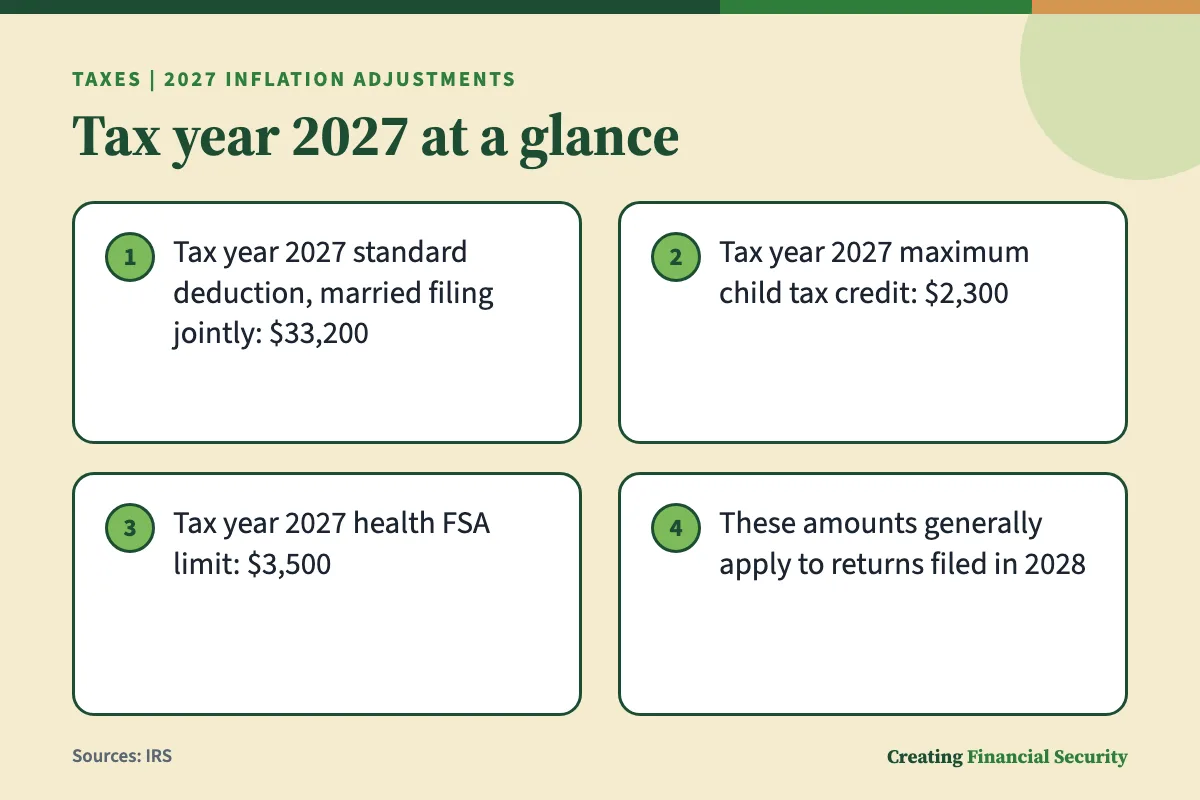
The timing is important: these adjustments generally apply to returns filed in 2028, rather than the return due next spring. The tax year identifies which year's rules and amounts apply; it is not necessarily the year when the return is filed.
What the IRS announced
Almost 70 provisions are covered by the IRS's tax year 2027 announcement. Among them are the standard deduction and income tax rate schedules. The detailed amounts appear in Revenue Procedure 2026-35.
The IRS also points out that some items are not indexed for inflation because of the way the law is written. Personal exemptions, for example, stay at 0 for tax year 2027, just as in tax year 2026.
| Filing status | Standard deduction |
|---|---|
| Married filing jointly | $33,200 |
| Head of household | $24,925 |
| Single | $16,600 |
| Married filing separately | $16,600 |

The standard deduction for tax year 2027
The IRS lists standard deduction amounts by filing status. For tax year 2027, they are:
- $33,200 for married couples filing jointly
- $24,925 for heads of households
- $16,600 for single taxpayers
- $16,600 for married individuals filing separately
The revenue procedure also lists additional deduction amounts. For tax year 2027, the additional standard deduction for age or blindness is $1,700. For an unmarried person who is not a surviving spouse, the additional amount is $2,100.
There is also a separate rule for someone whom another taxpayer can claim as a dependent. For tax year 2027, that person's standard deduction is capped at the greater of $1,400 or their earned income plus $500.
Where the bracket thresholds sit
Tax rates work in layers. For tax year 2027, these thresholds refer to taxable income. Each rate applies to the portion of taxable income that falls in its layer, not necessarily to all of it.
For tax year 2027, single taxpayers fall in the 10% bracket on taxable income of $12,800 or less. The 12% rate applies to taxable income over $12,800, the 22% rate over $52,025, and the 24% rate over $109,125. Above that, 32% applies over $208,325, 35% over $264,550, and 37% over $661,375.
For tax year 2027, married couples filing jointly fall in the 10% bracket on taxable income of $25,600 or less. The 12% rate applies over $25,600, 22% over $104,050, and 24% over $218,250. Then 32% applies over $416,650, 35% over $529,100, and 37% over $793,650.
The top rate remains 37% for tax year 2027. A bracket threshold alone does not establish someone's total tax bill. A licensed tax professional can help explain how the rules apply to an individual case.
Credits that may matter to families
For tax year 2027, the child tax credit has a $2,300 maximum; up to $1,800 may be refundable.
For tax year 2027, qualifying taxpayers with at least three qualifying children can receive an earned income tax credit of up to $8,496. Other eligibility categories have their own maximums. Revenue Procedure 2026-35 lists those amounts, plus the income thresholds and phase-outs.
Adoption has its own credit. For tax year 2027, qualified adoption expenses can count toward an adoption credit capped at $18,250. Up to $5,280 of that credit may be refundable for tax year 2027.
The earned income and adoption credits are separate from the child tax credit and the standard deduction. Their maximum amounts do not mean every filer qualifies for the full credit: income thresholds and phase-outs apply to the earned income credit, while the adoption credit depends on qualified expenses.
A few everyday workplace and gift limits
The tax year 2027 announcement also covers workplace benefits and gifts.
- For tax year 2027, the IRS sets monthly limits for qualified parking and transportation fringe benefits.
- For tax years beginning in 2027, employees' voluntary salary reductions for health flexible spending arrangements are limited to $3,500.
- For calendar year 2027, gifts to any one person have a $20,000 exclusion from taxable gifts. For gifts to a spouse without U.S. citizenship, the exclusion for calendar year 2027 is $201,000.
The gift exclusions concern taxable gifts, rather than the income tax brackets listed above.
The bottom line
The IRS has set its tax year 2027 numbers, and they cover everything from the standard deduction to brackets, credits and workplace benefit limits.
The standard deduction varies by filing status, and the credit maximums do not establish what any particular filer will receive. Revenue Procedure 2026-35 supplies the detailed amounts and rules. For questions about an individual return, a licensed tax professional can explain which provisions apply and how they fit together.
Questions readers ask
When do the tax year 2027 amounts apply?
What additional standard deduction applies for age or blindness?
What is the 2027 gift exclusion for a non-U.S.-citizen spouse?
Sources