

Before you carry rent cash anywhere, it helps to check the counter first. A reliable money order location is one where you can verify who is selling the order, who stands behind it, what the terms are and where to turn if the payment goes wrong. A familiar storefront alone doesn't settle any of that.
This guide is part of our larger one on comparing places to purchase money orders.
Look for proof, not just a familiar storefront
A familiar store may feel reassuring. Still, familiarity does not answer who handles an inquiry or what records a replacement request requires.
Four checks turn reliable into something concrete:
- Seller status. You know who is selling the money order, and you can confirm it through a contact you found yourself.
- Written terms. Fees, limits and the ways you can pay are written somewhere you can read, not only spoken across the counter.
- A purchase record. You leave with a receipt or matching record tied to your money order.
- A recovery route. You know who handles a lost, stolen or damaged order, and how to reach them.
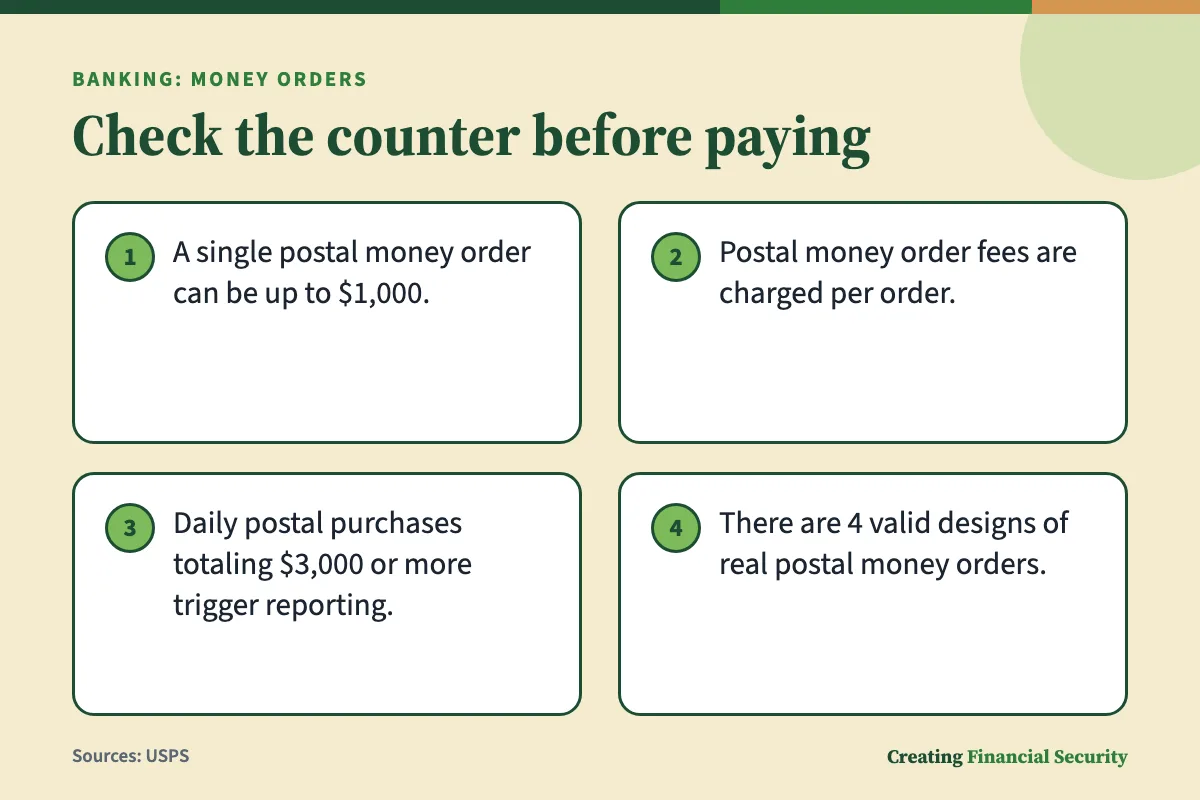
The Post Office shows what it looks like when all four are in view, because its rules are public. Postal money orders can be bought or cashed at any Post Office location, and the fee is charged per money order, with prices listed in Notice 123. A single order can go up to $1,000 anywhere in the United States.
Save the receipt. It can help establish the order's value and follow the payment if the order is lost, stolen or damaged. A postal money order can be verified, and an inquiry can be started if needed.
The seller and the issuer may have different jobs
Ask whether the counter sells the order on another organization's behalf. Confirm who issues it and who handles questions about tracking, replacement or refunds.
At a Post Office, one organization does both jobs: it sells the order, and it's the one to ask about replacement, inquiries and claims.
At any other counter, it's a question worth asking: who issued this money order, and who do I contact about it? Ask the issuer how to report an order that is lost or damaged, and what records are needed. If the clerk can't name the issuer, that's useful to know before your rent is inside the order.
How it works, step by step
- Check a postal money order you receive using the online tool, the telephone verification system or its QR code if present.
- A buyer, payee or endorsee can submit a signed Form 6401 to inquire about a domestic postal money order. An applicable fee is required, with exceptions for specified filings.
- For a damaged postal money order, take the order and its receipt to a local Post Office to request a replacement.
- After filing a Texas consumer complaint online, save the confirmation email and the complaint number it contains.
Compare nearby options by what you can verify
Compare nearby counters by the terms, records and help routes you can confirm.
Post Office counters
Postal rules are public, so many of the questions can be answered before you leave home: the price list for fees, the $1,000 single-order limit, the receipt and the replacement route.
Postal customers can buy several orders together, with equal or different values, subject to restrictions. Purchases reaching $3,000 or more during a day require a report.
Rural and highway contract route carriers
If getting to town is the hard part, there's a postal route that comes to you. Money orders are also available through rural carriers and highway contract carriers authorized to provide this service. The carrier supplies the application form; return the completed form with payment. Ordinarily, delivery is on the carrier's following trip. Mailing is an alternative if you supply an envelope addressed in advance and cover postage plus any required mailing fees. Ask about timing before relying on this option for a rent deadline.
Other counters
Other nearby places may or may not sell money orders. Ask whether the location sells money orders, accepts cash and requires an account. Confirm the issuer and its help process before traveling.
Side by side, you're comparing four answers: who is the issuer, can I read the terms, what record do I get, and who do I call if it goes wrong. A fee tells you what the order costs, not whether the seller is authorized or well supported.
Treat reviews as clues, not proof
If a review mentions long lines or an early counter closing, use it as a prompt to ask about current service rather than treating it as confirmation.
Use reviews to form questions about current authorization, issuer identity and refund procedures, then confirm the answers directly.
Confirm the service before carrying rent cash there
A wasted trip is the cost you can avoid most easily. This routine works whether or not you have a bank account.
- Find contact details on your own. Use a phone number from an issuer's or agency's official website, or from a receipt you already have, not one from a flyer or a listing you can't trace.
- Ask whether money orders are sold during the hours you plan to arrive. Ask specifically about money order service hours rather than assuming they match the store's hours.
- Ask which issuer's money order the counter sells. Then contact that issuer through official contact information you found yourself, and ask how it confirms sellers and what its help process looks like.
- Ask where current terms are written. Fees, limits and replacement rules should be somewhere you can read before you go.
- Expect the occasional outage. Postal online tools can be temporarily unavailable during maintenance, so a tool that isn't working doesn't automatically mean a problem with an order.
State regulators can add a check. Texas, for example, requires licensing for money services businesses conducting money transmission or currency exchange as defined by its law. A licensed business can appoint authorized delegates who do not hold individual Department licenses. Ask the relevant state regulator whether its rules cover the counter's service.
Ask for answers that apply to this counter
General answers about a chain or an issuer don't always match the counter in front of you. Ask about this one:
- What are the hours for money order sales, not only the store?
- How can I pay, and is there any account or identification requirement?
- Is there a limit on one order? For postal money orders sent within the United States it's $1,000, so a larger rent payment takes more than one order.
- Does a larger purchase trigger paperwork? For postal purchases totaling $3,000 or more in a day, the customer must fill out a Funds Transaction Report and present acceptable primary identification. Purchases at different postal facilities still count toward that daily threshold.
- Where can I read the current terms, and who do I contact about tracking or replacement?
Write the answers down as you hear them. Two counters are easier to compare from notes than from memory.
Pause when the payment process does not add up
A few things should slow you down, even when the storefront looks ordinary:
- The seller can't say who issued the money order, or the issuer's name doesn't match what you were told.
- No receipt or matching record is offered, or the receipt is left blank.
- You're asked to leave the payee line empty. Postal rules require an identifiable recipient. The buyer must enter both parties' names and addresses on the order and on the customer receipt.
- The terms are only spoken, or they change from one call to the next.
- Someone asks you to send payment by an unofficial route, or to buy an order for a person you've never met.
None of these proves wrongdoing. Each one is a reason to check before money changes hands.
Receiving an order is a different job from buying one, but the same habit applies. Real postal money orders carry marks meant to prevent fraud, and there are 4 valid designs. Look for unusual coloring or disturbed paper fibers near the amount; either may indicate alteration. A postal money order can be verified online, by scanning the QR code on versions that have one, or by phone through a verification line. That checks the order. It doesn't tell you whether a store is authorized to sell one.
A genuine money order can still be part of a scam
A real money order from a real counter only shows that the payment method is real. It says nothing about why you're being asked to send it. A legitimate purchase location and a legitimate reason to send money are two separate questions.
If an unexpected message, or someone you haven't met, asks for rent or a deposit by money order, it's worth confirming who owns the place and how they take payment before you buy anything.
If you suspect fraud involving a postal money order, the U.S. Postal Inspection Service takes reports at 1-877-876-2455. The Texas Attorney General's general complaint form lists scams and not receiving what you paid for among the problems it covers. USAGov explains where to find consumer or legal help if a complaint to a company doesn't get resolved.
Find the help route before you need it
Before you pay, work out what you'd do if the money order were lost, stolen or damaged. These steps come from the postal process, and the same questions apply at any seller.

- Save the purchase receipt. It helps trace the payment and establish the order's value if it is lost, stolen or damaged.
- Know the status tool. After an inquiry starts, you can follow its progress, and the order's status, in the postal Money Orders Application.
- Know the inquiry form. The buyer, named recipient or endorsee can request a payment inquiry for a domestic postal money order. Complete and sign Form 6401, then submit it with the required fee. Ordinarily, each order requires its own application and fee; specified institutional and official filings are exempt from the fee.
- Know the replacement rule. A replacement is issued once loss or theft has been confirmed. To request replacement of a damaged order, bring it with the purchase receipt to a Post Office.
- Ask any other seller the same questions. Who handles tracking and replacement, and where is the process written down?
- Know the complaint routes. If a seller won't help, USAGov points to company, federal and state options, and Texas's banking department takes complaints about money services businesses.
The Texas Attorney General's complaint page shows what is worth gathering: the business's name and full address, and a clear statement of the problem with dates. It also asks you to leave out items such as a Social Security Number and financial account numbers.
Know what the counter cannot promise
Ask the issuer whether a refund is available and what its process requires. A clerk's goodwill doesn't replace the issuer's rules.
A postal money order has no stop-payment option. Replacement is available for loss or theft, subject to confirmation. Without the purchase receipt, a theft claim may not result in full reimbursement. For an order that is defective or spoiled during printing or completion, replacement costs nothing when the customer returns the negotiable part together with its matching receipt. Postal records are the basis for deciding payment claims.
For a non-postal order, ask the issuer what options its rules allow and whether the payment's status affects them. A complaint number isn't a promise either: the Texas Attorney General says it is only for reference and doesn't mean a decision has been made. A clear process is useful, but it is not a guarantee of recovery.
Choose between convenience and clearer support
In this made-up example, a renter is comparing two counters along the same route.
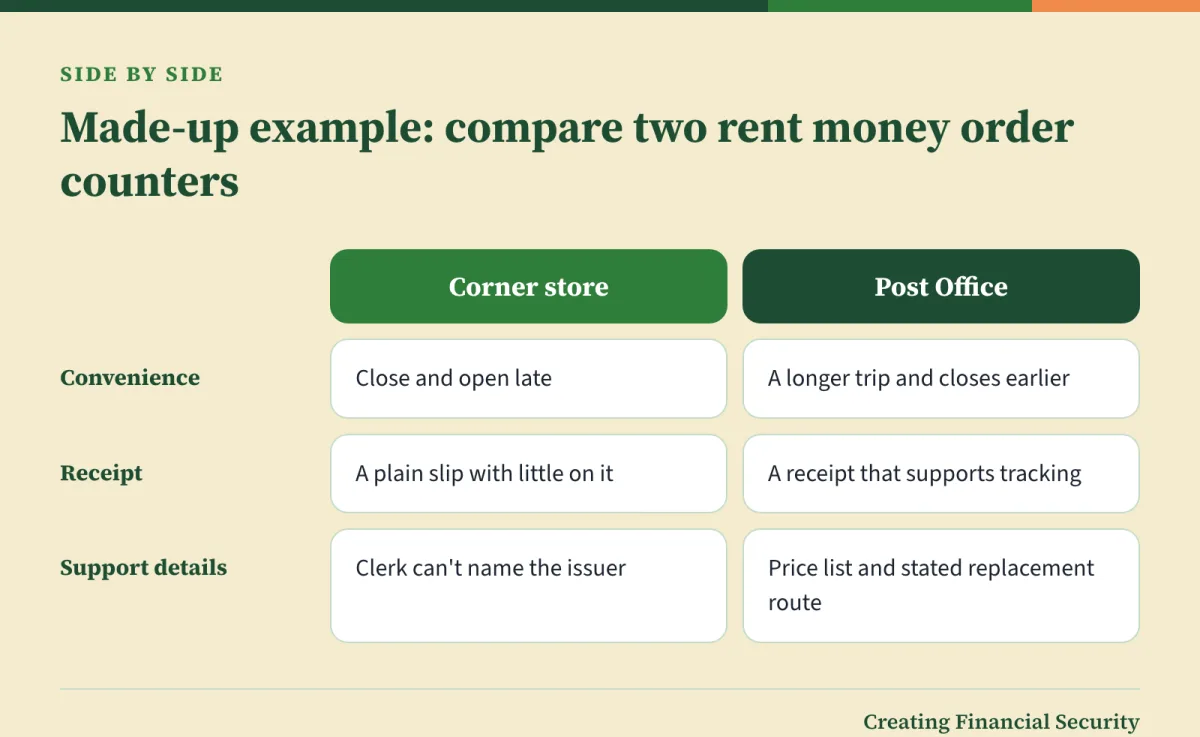
The corner store is close and open late. But the clerk can't name the issuer, and the receipt is a plain slip with little on it. The Post Office is a longer trip and closes earlier. But it points to a price list, gives a receipt that supports tracking and has a stated replacement route.
There's no universal winner. A few questions can help sort it out:
- How many days are left before the rent is due, and what does the trip cost in time and in rides?
- If the payment were lost, how hard would it be to recover?
- Could a phone call to the corner store settle the unknowns? If the clerk names the issuer and shows where the terms are written, the gap may shrink.
In this example, the closer counter is easier to reach, while the postal option has clearer documentation. The decision depends on the deadline, transportation and whether the closer counter can resolve the unanswered questions.
Keep a location checklist for the next rent payment
A short note on your phone, or a card kept with your lease, saves you from repeating the work each month. For each place, write down:

- The name and address of the counter, and the date you last verified it.
- Hours for money order sales and how you can pay.
- Any account or identification requirements you were told about.
- The issuer's name, and where you found its verification and help contacts.
- Where current fees and terms are posted.
- What the receipt looks like, and where you'll keep it.
- Who to call about tracking or replacement.
Hours, terms and the way a counter handles money orders can change, so it's worth rechecking before each rent payment, or whenever something looks different, like a new receipt style.
The bottom line
A place is a dependable option for a rent money order when you can verify it, not when it simply looks familiar. That means knowing who sells the order and who issued it, reading the terms, leaving with a receipt and knowing who to contact if something goes wrong.
A bank account isn't what makes a seller reliable. Whether a counter requires one is something to confirm before you travel, along with its hours and how you can pay.
A reliable seller cannot make the reason for a payment legitimate or remove every risk. For this week's rent, a few phone calls and a saved checklist can spare you a wasted trip and give you a record if something goes wrong. For an unresolved consumer complaint, USAGov identifies routes to consumer or legal help.
Questions readers ask
Can a place be reliable even if I do not have a bank account?
Does a higher purchase fee mean the seller is safer?
How can I check whether a store is an authorized seller?
Are good online reviews enough to trust a location?
Can the store refund a money order if I change my mind?
Sources