



A rent-payment errand can be hard to fit around work. Checking availability before traveling can help with planning. Before you head out, a short check can tell you a lot: find the official page for the exact store you can reach, then call that store and ask whether it sells paper money orders today.
A listing that says 'money transfers' or 'bill payment' doesn't, on its own, tell you a paper money order is for sale. Those can be different services, so it's worth asking about the one you actually need.
A pharmacy's availability, fee and purchase requirements need location-level confirmation. Postal money-order limits and requirements are not pharmacy terms. Even a clear phone answer is current information, not a guarantee that a sale will be possible when you arrive.
This guide is part of our larger one on where to shop for money orders.
Start with the exact store, not a general search result
Search results blur things together: a map pin here, a company-wide page there, a review from some other year. None of those is the store you plan to walk into. The aim of this first step is one address and one phone number that belong to the same place.
Here is one way to get there:
- Write down the address of the pharmacy you can realistically reach on a day off or between shifts. Think about the bus line or the drive, not just the distance on a map.
- Open the company's own store-locator page and look up that same address, not a nearby branch with a similar name.
- Check that the street address on the official page matches the one on the map result you started from.
- Copy the phone number from that official page rather than from a third-party listing.
- Note any wording the page uses about services at that location, exactly as written.
If the page says nothing about money orders, that isn't a no. It only means the page doesn't settle the question, and a call may help.
Use online listings as leads, not guarantees
A listing helps you decide which store to call first. By itself, it isn't enough to decide whether to drive.
A review describes one person's visit on one day. A chain-wide page may or may not describe your branch. A search snippet may be pulled from a page that's out of date. None of these can tell you whether this store can complete your purchase today.
Treat each listing as a reason to ask. Write down which counter handles money orders, when it can complete a sale, whether cash is accepted and what identification is required.
How it works, step by step
- To find a backup, search for nearby Post Offices and check whether money orders appear among the services listed.
- Before leaving the counter, read the payee on the order; a postal order needs one identifiable payee, who may be the buyer.
- Keep the receipt; a damaged postal order can be replaced when you bring it and the receipt to a Post Office.
Work out what the money-service listing actually means
Money-related wording on a page or sign can mean several things, and only one is what you need: a paper money order you can hand to your landlord. Here is how common wordings read, as questions to settle rather than answers.
- 'Money transfers' or 'send money': This suggests moving money to someone, often electronically. It leaves open whether a paper money order you can carry is also sold. Ask whether it's a paper money order you can take with you or a transfer to someone else.
- 'Bill pay': This suggests paying a company's bill. It leaves open whether rent counts and whether the same counter sells money orders.
- 'Check cashing': This is cashing a check you already hold, the reverse of buying a payment. It leaves open whether a purchase is offered at all.
- 'Money orders' named outright: This is the closest match. It still leaves open whether the service is running today, the fee, the limit and how you can pay.
- No mention at all: Leave availability unconfirmed and ask the store directly.
If a listing names money orders, ask whether a purchase is possible today and what terms apply. If it doesn't, the same question still applies; the page just hasn't answered it.
Ask specifically about buying a paper money order
Asking 'Do you offer money services?' can get you a yes that doesn't help. Name the action instead.
Try something like: 'I'd like to buy a paper money order to pay my rent. Can I do that at this store today?' It names the document and the purpose, so the employee can tell you which service, if any, fits.
If you hear 'transfers,' a kind follow-up is: 'Is that a paper money order I can take with me, or a transfer to someone else?' You're not challenging anyone. You're making sure you both mean the same thing. Using the same words on every call also makes your notes easy to compare.
Get confirmation from the counter that handles the sale
Whoever picks up the main line may know the answer or may be guessing. Ask the person or counter that handles the sale for the clearest available answer, and don't assume that's the prescription counter.

- Call the number you copied from the official page for that exact store.
- Say you want to buy a paper money order, and ask which counter or employee handles that.
- Ask to be connected, or ask the person to check with that counter instead of answering from memory.
- Ask whether a purchase can be completed today, and write the answer in their words.
- Note the date, the time you called and the first name of the person who answered, if offered.
If the answer is 'I think so,' you don't have a confirmation yet. A polite follow-up works well: 'Could you check with that counter and let me know, or should I try again later?'
A phone answer is still a report of what someone believes at that moment. It's useful, and it's worth recording as a quote rather than as a promise.
Separate store hours from money-order service hours
Check the transaction hours as well as the posted store hours. A postal location, for example, can have different access arrangements for its staffed windows and its lobby: many Post Offices provide kiosk access after the windows close.
So ask two things: 'Can the counter that sells money orders complete a sale right now?' and 'Is it staffed the whole time the store is open?' Also ask whether anything is temporarily unavailable today. You're asking what is true at this store today, not about a rule that applies everywhere.
Confirm that the purchase will work with your cash and rent payment
A confirmed yes can still fall apart at the counter if the details don't fit. These questions decide whether the trip is useful:
- The fee: What does one money order cost, and is the fee added on top of the amount? If your rent needs two orders, does the fee apply to each?
- The limit: What is the most one order can be for? Can I buy more than one?
- How you can pay: Can I pay in cash? Ask it aloud instead of guessing.
- Identification: Do I need to show ID, and which kind?
- The payee: Who fills in the payee name? Confirm the exact payee name with your landlord before you go.
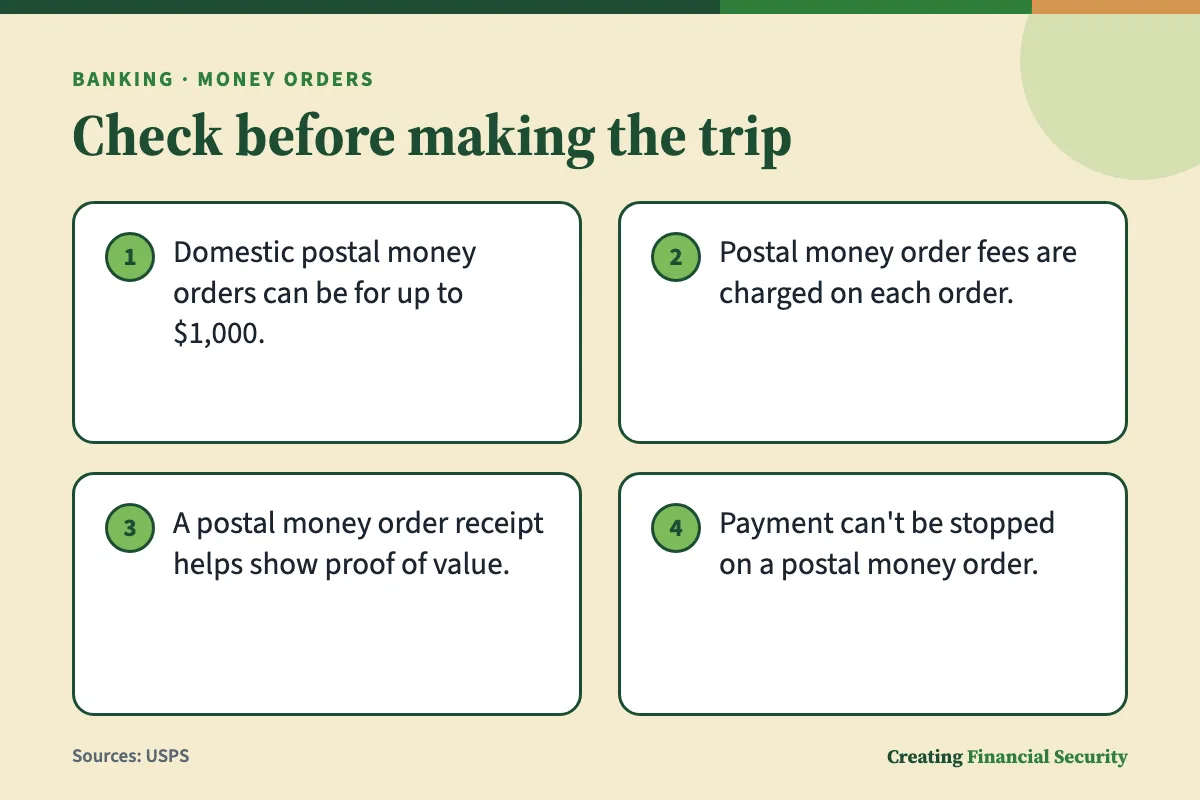
Postal rules give a sense of the kinds of conditions that exist. Domestic postal money orders can be for up to $1,000 each. A fee is charged per order; the postal price list gives the current charges. For postal purchases totaling $3,000 or more in a day, the buyer must submit a Funds Transaction Report and present an acceptable primary ID. Purchases count toward that threshold even when spread across visits or postal locations.
Postal payment rules include qualifying traveler's checks denominated in U.S. dollars. They also allow ATM/debit-card payments at approved locations, with a PIN entered through the payment terminal's keypad. Ask a pharmacy about its own accepted payments rather than assuming postal terms apply.
Keep quoted terms separate from confirmed facts
A phone quote is what someone told you. At the counter, check whether the fee, limit and payment terms match that quote before paying. A two-part note sheet keeps them apart: fill in the first part on the call and the second at the store. You can copy it onto paper or your phone.
- Store address and phone number from the official page: ____
- Date and time of call, and who answered: ____
- Sells a paper money order today? (their words): ____
- Which counter handles it, and when it can complete a sale today: ____
- Fee quoted for one order: ____
- Limit quoted per order: ____
- Payment accepted (cash or other): ____
- ID needed: ____
- Payee name confirmed with landlord: ____
- Confirmed at the counter (fee, limit, payment): ____
Leave a line blank if you didn't hear an answer. A blank line shows what to ask next.
If the website and the employee disagree
Sometimes a page says one thing and the person on the phone says another. That's frustrating when you're planning around work. Neither side is necessarily wrong: a page can be out of date, and an employee may be new or thinking of a different counter.
- Say what you saw: 'The store page lists money orders. Could someone at the counter confirm?'
- Ask for the person who handles the sale, and ask your question again in the same words.
- If you hear that the service isn't available, write it down with the date and time. A same-day answer from that store says more about today than a page that may not have been updated.
- If the employee is unsure, ask whether a manager or customer service desk can look into it, and wait for that rather than relying on a guess.
- If there's still no clear answer, label the service unconfirmed and turn to a backup.
You don't have to win the disagreement. You only need enough information to decide whether the trip is worth your time.
Know when the answer is still unconfirmed
An old review, a call that rings out and a vague 'maybe, come by' can all feel like answers. None is a reliable yes. The honest label is 'unconfirmed,' and it's useful: it points you toward more checking or toward a place where the answer is clearer.
If you go anyway, you'll know you're taking a chance, and you can plan the day around that.
Build a trip plan that fits around a work shift
After receiving a clear answer, compare the counter's stated availability with the time available for the errand. Keep the payment deadline in mind without treating the phone answer as a promise.

- Pick a day and time when the counter was said to be staffed, using the service answer you wrote down, not the store's general hours.
- Set aside the rent amount plus the quoted fee, and a little extra in case the fee differs when you get there.
- Bring any ID the store said it needs. Confirm the exact payee name with your landlord before completing the order.
- Keep your call notes handy, so you can mention who you spoke with and when if the counter has a question.
- Decide where the receipt will live and how the order will reach your landlord.
If rent is due soon, build in a buffer. A quick re-check call that morning may be worth it, since a quote is a snapshot of one moment.
Keep one realistic backup if the service is unavailable
A backup is a second place you've already checked, so one failed stop doesn't end the errand. Pick one you can also reach around your shift, and check it the same way: exact address, exact service, same-day answer.
A postal location finder can help identify nearby Post Offices and money-order services. Postal money orders are available for purchase at Post Offices; ask the location about completing the transaction at the time you plan to visit.
Still read the location type. Village Post Offices offer only some postal products and services. Contract postal units are hosted by other businesses and provide the full postal retail range at standard postal prices. Ask the exact location what it can sell today; if the answer is unclear, availability remains unconfirmed.
Check the transaction before leaving the counter
The visit doesn't end when you pay. A few quick checks at the counter can save trouble later.
- The amount and payee: Read the order to confirm both are right. Postal purchase rules require one clearly identified recipient; the buyer may name themselves.
- Your part of the form: With a postal order, the buyer enters both parties' names and addresses—the buyer's and the recipient's—on the payment document and its receipt. Ask another seller how to complete its paperwork.
- The fee shown: Compare what you're charged with the quote you wrote down, and note any difference.
- The receipt: Keep it. A postal receipt supports payment tracking and establishes the order's value if it goes missing or is damaged. A theft claim without that receipt may not result in a full refund.
- The document itself: There are 4 valid postal money-order designs. Consult the official postal verification guidance for the security features to examine.
Postal money orders do not allow stop-payment requests. Replacement is available after loss or theft has been confirmed. For a damaged or defective order, bring the document and receipt to a Post Office to request a replacement. For a nonpostal order, ask the seller which replacement rules apply and how to contact support.
The bottom line
A listing, an old review or a store's closing time can point you toward a call, but none of them is a yes. When an answer is vague, the website and the employee disagree, or the phone just rings, it's fair to call the service unconfirmed and keep looking.
Writing down the fee, limit, payment and ID answers as quotes, and checking them against what happens at the counter, keeps a phone answer from turning into a surprise. Before you leave the counter, read the order and keep the receipt.
For bigger questions, like how to pay rent or whether to use a bank account, a licensed professional or a nonprofit credit counselor can look at your own situation, and the seller can explain that specific purchase.
Questions readers ask
Does a money-transfer sign mean the pharmacy sells money orders?
Can the pharmacy department confirm availability?
What if the pharmacy does not answer the phone?
Can I buy a money order without a checking account?
Does the store's closing time tell me when money-order sales stop?
Is a phone quote a guarantee of the fee or availability?
Sources