



When refinance offers start arriving, in the mail and from your credit union, it's natural to wonder who is really behind each one. In general, a mortgage broker arranges financing through lenders, while a direct lender is the company that makes the loan. Neither route automatically costs less.
So the label on the envelope isn't the thing to compare. The loan terms are, along with how each provider is paid, which lenders it can reach and who handles your file once paperwork starts moving.
Mail and phone offers are also marketing. The Federal Reserve notes that ads and mailings are built to show a loan in its best light, so a low advertised rate is a starting point for questions, not an answer.
This guide is part of our larger one on comparing bank and nonbank refinance offers.
Who is finding the loan, and who is making it?
Two jobs often get blurred together: finding or arranging a loan, and making it. Sometimes one company does both. Sometimes two companies split the work.
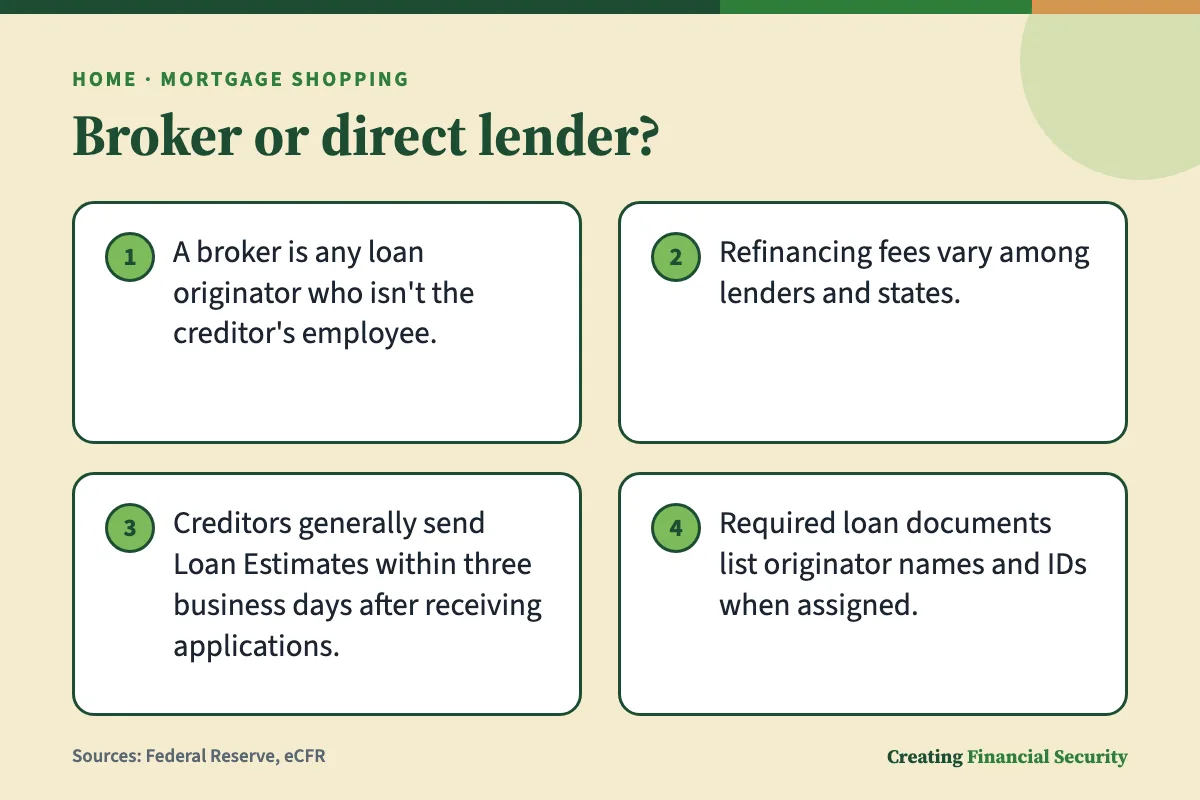
The federal loan originator rule describes the first job broadly. An originator is someone who, for pay or other gain, takes applications, offers or arranges credit, assists a borrower in getting a loan or negotiates terms for another person. For a particular transaction, the rule calls an originator a mortgage broker when that person isn't an employee of the creditor. That describes roles, not quality, and the rule doesn't say either model is friendlier or safer.
A broker connects the borrower with a lender
A broker sits between you and a creditor. It may take your application, collect documents and talk through loan options, while a separate creditor makes the loan. Arrangements differ, so it's fair to ask who coordinates your file and which company decides on approval.
The Federal Reserve's refinancing guidance notes that either a lender or a broker can charge a loan origination fee, and that some of each also charge points as a way to earn money on the loan. If a broker is involved, ask to see every such charge in writing.
A direct lender offers loans through its own lending operation
A direct lender is the creditor, the company named on the loan. A loan officer who works for the creditor does many of the same tasks a broker does, but under the rule's wording that person isn't a mortgage broker.
A website or online application doesn't reveal which model is behind it. Plain questions do. Are you the creditor, or do you arrange loans with other creditors? Which programs do you offer, and can you arrange financing from another creditor if none of yours fits? The same questions apply when your credit union's name is on an offer: is the credit union the creditor itself, or is another company acting for it?
How it works, step by step
- Ask each provider to name the creditor that will actually make the loan.
- Ask for written details of each loan, including its costs, before paying any nonrefundable fee.
- Distinguish an early written estimate from the official Loan Estimate before selecting an offer.
- Check the primary individual originator's name and assigned registry ID on the covered documents.
How much of the mortgage market will each search?
More contacts don't guarantee better pricing. What matters is whether a provider can reach loans that fit a refinance like yours and whether it shows you real choices rather than one. The Federal Reserve's shopping advice is to compare both rates and costs from several providers and let each know you're comparing.
Ask which lenders a broker can approach
A broker works with a set of creditors, not the whole market. The federal steering rule shows what a broker's search can look like. One way for an originator to stay inside the rule is to collect options from a meaningful share of the creditors it regularly does business with, then present choices for each kind of loan you've said you want, believing in good faith that you likely qualify.
Those choices include the loan with the lowest interest rate among those without certain features, such as a prepayment penalty or interest-only payments, and the loan with the smallest combined charge for discount points, origination points and origination fees. When more than three loans are shown for a type, the originator must highlight the ones that fit those descriptions.
Questions that bring out the details:
- Which lenders do you regularly work with, and are any left out of this refinance?
- Do they offer the loan type I'm asking about, such as a fixed rate?
- Can you show me the lowest-rate option and the lowest-fee option?
- Which lender is behind each offer?
Ask what limits a direct lender's menu
Ask a direct lender which programs are available for your refinance and whether it can offer financing from another creditor. Its answer identifies the options available through that provider without assuming what its business model permits.
The Federal Reserve explains that lenders weigh income and assets, credit score, other debts, the home's current value and the amount borrowed. If the loan-to-value ratio falls outside a lender's guidelines, it may decline or offer less favorable terms than you have now. Asking each provider which factors shaped its answer helps explain why two offers differ.
| Question | What to ask | Written support |
|---|---|---|
| Who makes the loan? | Ask each provider to name the creditor | Creditor's name and address on the Loan Estimate |
| Is there a prepayment penalty? | Ask whether the loan includes one | The Prepayment Penalty line on the Loan Estimate |
| Is the rate locked? | Ask whether and until when | The Rate Lock statement on the Loan Estimate |
| What are the origination charges? | Ask for an itemized explanation of borrower-paid origination amounts | The Origination Charges section of the Loan Estimate |
Follow the compensation, not the sales pitch
Every provider is paid somehow. The federal rule treats salaries, commissions and any financial or similar incentive as compensation. The useful questions are where the money comes from and where it shows up on paper.
The Federal Reserve suggests getting written details about each loan you're considering before paying any nonrefundable fee. A written figure can be compared line by line, and a spoken one can't.
Borrower-paid and lender-paid broker compensation
The rule generally says an originator's pay can't depend on the terms of a transaction, with listed exceptions. The loan amount isn't treated as a term, so pay set as a fixed percentage of the amount borrowed is allowed, though it may carry a minimum or maximum dollar amount.
If a borrower directly compensates a loan originator, the rule generally prohibits compensation from other sources to any loan originator involved in that transaction. People who know, or have reason to know, about that borrower-paid compensation generally cannot pay an originator either. An organization receiving borrower-paid compensation may pay its individual originator, subject to the rule's compensation limits.
Where the creditor pays the originator instead, a separate exemption tied to the Truth in Lending Act can allow it, as long as the originator receives nothing directly from the borrower. That holds even when the borrower pays points or fees up front.
The rule also addresses steering. An originator may not guide you toward a loan because it will earn more from the creditor on that loan, unless the loan you end up with is in your interest.
Why no separate broker fee does not mean a free loan
A missing broker-fee line doesn't mean nobody is paid. The Federal Reserve notes that lenders define "no-cost" refinancing in different ways. In one version, the lender pays the closing costs and, in exchange, charges a higher interest rate that you carry for as long as the loan lasts.
The Federal Reserve suggests requesting a written comparison showing how that rate trade-off affects initial charges, the borrowed balance and monthly payments. It also cautions that a no-cost loan may include a prepayment penalty meant to discourage refinancing in the first few years.
It also helps to avoid counting one charge twice. On the Loan Estimate, the origination section lists what you pay creditors and originators for making the loan, and points that lower the rate appear on their own line. Reading those lines first shows what each provider charges before you add anything else.
Test the offers without favoring either channel
Two offers can look very different until they're priced the same way. Comparing them for the same balance and term makes the real differences stand out. Rates and costs both matter, and the Federal Reserve's guidance says to look at them together.
A made-up comparison for a homeowner with a 7% mortgage
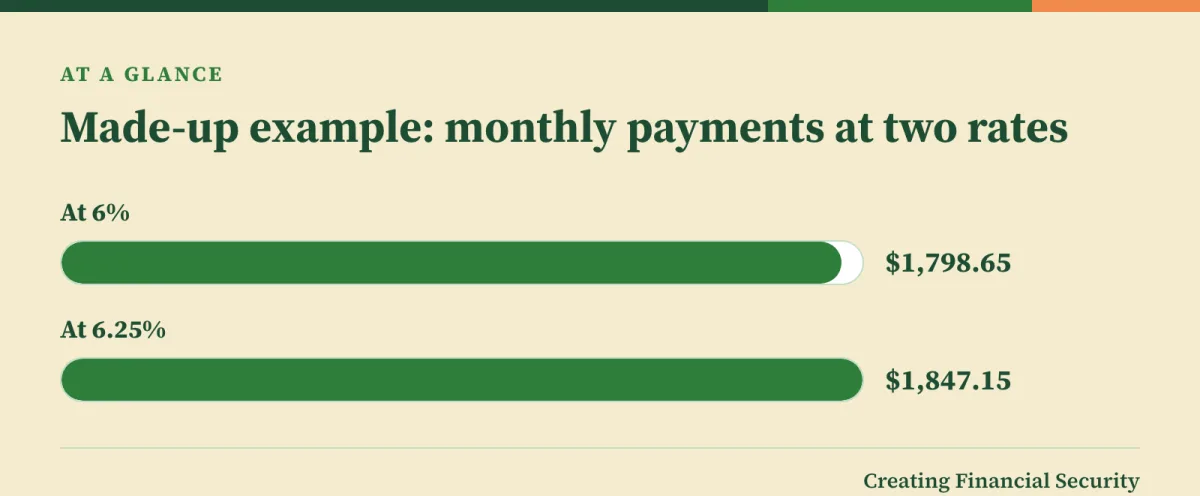
The table below is a made-up example. It assumes a replacement loan with a $300,000 balance over 30 years, priced at 6% in one scenario and 6.25% in another. Those loan details are assumptions for illustration. They aren't your balance, your remaining term or a live quote, so the table can't say whether any refinance would help your actual mortgage.
| Interest rate | Monthly payment | Total interest |
|---|---|---|
| 6% | $1,798.65 | $347,514.57 |
| 6.25% | $1,847.15 | $364,974.58 |
Fixed rate, equal monthly payments of principal and interest; taxes, insurance and fees are not included. These figures assume a fixed rate with equal monthly payments of principal and interest. Taxes, insurance and fees aren't included.
In the made-up example, the 6% row has a payment of $1,798.65 a month and the 6.25% row has a payment of $1,847.15. Either scenario could come from a broker or from a direct lender, so the table says nothing about which channel is better. It shows that a small rate gap changes both the monthly payment and the interest paid over the life of the loan.
What the payment table cannot settle
A payment table leaves out fees, points, timing and how long you'll stay in the loan. The Federal Reserve says it's not unusual for refinancing fees to run 3 percent to 6 percent of outstanding principal. It describes a break-even calculation that weighs monthly savings against those costs, which matters most if a move might be coming. A prepayment penalty on a current loan, if there is one, lengthens the time to break even.
Points are one example. The Federal Reserve says the number of points can be negotiated and that how long you expect to keep the mortgage helps decide whether paying points up front makes sense. It adds that points paid on a refinance may not be fully deductible in the year paid, and it points readers to the IRS for the current rules.
Rate locks matter too. The Loan Estimate states whether the rate is locked and when the lock ends, and it notes that the rate, points and lender credits may change unless the rate is locked. Ask each provider whether a lock is confirmed in writing and what, if anything, it costs.
Know who handles the file when something changes
Between application and closing, a refinance moves through several steps, and it helps to know who is responsible for each before something shifts.
Identify the decision-maker and your main contact
With a broker, ask who coordinates the file and which creditor will decide on the loan, since those can be different companies. With a direct lender, one company may handle both. Either way, get the name of your main contact and the name of the creditor.
The disclosure rules sort out roles on paper. When a broker receives your application, either the creditor or the broker can provide the Loan Estimate. If the broker does, it has to follow the rule's requirements, and the creditor must make sure the disclosure is delivered properly. Generally, the creditor must deliver or mail the Loan Estimate no later than the third business day after it receives your application.
An informal quote is a different thing. If a creditor or another person gives you a written estimate of terms or costs specific to you before the Loan Estimate, the rule requires this statement at the top of the first page: "Your actual rate, payment, and costs could be higher. Get an official Loan Estimate before choosing a loan."
Ask what happens if the lender or rate lock changes
If the original Loan Estimate used an unlocked rate and that causes points or lender credits to change, the creditor generally must issue updated disclosures within three business days after locking the rate. Closing Disclosure requirements also govern which form can be used: once that disclosure has been provided, the creditor cannot issue another Loan Estimate.
Separately, if a Closing Disclosure you've already received becomes inaccurate in certain ways, such as the annual percentage rate, a changed loan product or an added prepayment penalty, a new three-business-day wait generally applies.
Questions to put to either kind of provider:
- If the lender or the lock changes, will I get written confirmation of what changed?
- Who is responsible for a delay, and does it cost me anything?
- Which extra documents might be requested, and from whom?
Check the people behind the offer
Before pay stubs or account numbers go anywhere, it helps to know who is on the other end. The federal rule says a loan originator on a home-secured loan must be registered and licensed when state or federal law requires it, including under the SAFE Act and its implementing rules.

Distinguish state licensing from federal registration
Not every originator faces the same requirements, and a difference isn't, by itself, a sign of wrongdoing. Whether someone must be licensed or registered depends on the SAFE Act, its regulations and state law.
The rule also sets duties for originator organizations, other than government agencies and state housing finance agencies. Such an organization must follow state requirements for legal existence and make sure each of its individual originators is licensed or registered to the extent required before that person works on a home-secured loan.
For individual employees who are neither required to be licensed nor licensed, the rule adds screening and training duties: a criminal background check, a credit report, registry information about administrative, civil or criminal findings, a determination about the person's record and fitness, and periodic training. The hiring date and the person's record affect how those duties apply, so the rule's full text is the place to confirm a specific case.
Licensing or registration describes regulatory status. It doesn't tell you whether an offer is a good one.
Verify contact details before sharing documents
The rule gives you a trail to follow. When the national registry has assigned an ID, an originator organization must show its name and NMLSR ID on the Loan Estimate and other covered loan documents. Those documents must also name the individual originator with primary responsibility and, if one exists, that person's ID.
The rule explains that the ID supports electronic tracking and uniform identification of originators and gives the public access to their employment history and publicly adjudicated disciplinary and enforcement actions. So the names and IDs on your paperwork are worth reading closely, and a missing or unclear one is a fair thing to ask the provider about.
Use the same interview questions for both
A worksheet keeps the comparison even-handed. The Federal Reserve suggests bringing one to every conversation with a lender or broker and filling it in as you go. In your notes, make four columns: the question, the broker's answer, the direct lender's answer and the written support.

Record answers and request written support
Questions worth putting in the first column:
- Which lenders can you reach for a refinance like mine?
- How are you paid on this loan, and by whom?
- What are the origination charges, points and lender credits?
- Is there a prepayment penalty?
- Is the rate locked, and until when?
- Who is my main contact, and who decides on approval?
The written-support column matters most, so ask for the Loan Estimate itself. Under the rule, a creditor can't require you to submit documents verifying your information before providing it. Neither a creditor nor anyone else may impose a fee connected to your application until you've received the Loan Estimate and shown you intend to proceed, other than a reasonable fee for a credit report.
Keep missing answers separate from actual disadvantages
A blank cell isn't a mark against a provider. It may only mean the question hasn't been answered yet, so write "unknown" and follow up.
A slow reply can say something about how communication may go, but keep the two ideas apart. An unanswered question is something to resolve. A written term you dislike is a real difference. The worksheet is for comparing facts, not ranking companies.
The bottom line
A broker arranges loans with creditors and a direct lender makes them, but neither label says what a loan will cost. The comparison that holds up is the same for both: an official Loan Estimate for the same balance and term, the origination charges and points, the rate lock, any prepayment penalty and a clear answer about how each provider is paid.
Check the names and IDs on the loan documents, and ask in writing who handles the file if the lender or the lock changes. Where an answer is missing, treat it as a question to resolve rather than a verdict.
For your own numbers, a HUD-approved housing counselor or a licensed professional can look over the offers with you.
Questions readers ask
Can I get offers from a broker and a direct lender?
Will a mortgage broker always find a lower rate?
Can a broker send my application to my credit union?
Who gives me the Loan Estimate when I use a broker?
Will the broker or direct lender collect my payments after closing?
Sources
- Federal Reserve Board: Refinancing costs, comparing offers, points, simple break-even calculations, financed cost
- eCFR: 12 CFR 1026.36 -- Prohibited acts or practices and certain requirements for credit secured by a dwelling.
- eCFR: 12 CFR 1026.19 -- Certain mortgage and variable-rate transactions.
- eCFR: 12 CFR 1026.37 -- Content of disclosures for certain mortgage transactions (Loan Estimate).
- eCFR: 12 CFR 1024.33 -- Mortgage servicing transfers.
