



Rent is due, you need a money order, and you're wondering whether you can pay for it with a credit card. Before you hand the card over, it helps to know that the seller saying yes answers only half of the question.
The seller decides which payments it takes at its counter. Your card issuer decides how the purchase is charged to your account, under the terms of your card agreement. So the question to put to the issuer is a plain one: how would you classify and charge this money-order purchase?
Card agreements can carry a separate fee and a separate rate for cash-style borrowing. The federal disclosure rules require written terms, but they don't establish the classification of a particular money-order purchase. Ask your issuer how it would classify and charge this payment.
This guide is part of our larger one on payment requirements for purchasing money orders.
A card payment can be accepted and still cost more than expected
That's also why costs can arrive in layers. The seller may charge for the money order itself. Your issuer may add its own charges on top, according to the terms of your card, and you might not see them until the statement arrives.
The CFPB requires account-opening disclosures of applicable fees and rates. Use your own disclosures when asking the issuer about the payment.
Why a money order may not count as an ordinary purchase
The CFPB requires issuers to disclose a cash-advance fee as its own item, set apart from late fees, balance transfer fees and returned-payment fees. The rules also list the rates for purchases, cash advances and balance transfers separately. When a card has different rates for different kinds of transactions, the disclosures have to say which transactions each rate covers.
Ask whether the agreement's definition of cash or cash-equivalent credit includes this money-order payment. The disclosure requirement itself does not answer that transaction-specific question.
So two things matter together: the exact wording of your agreement and the exact transaction. A confident answer at the counter can't stand in for your issuer's answer, and an answer about one card can't stand in for another.
How it works, step by step
- Find your account-opening table or card agreement and compare the cash-advance rate with the purchase rate.
- Find the cash-advance fee in the agreement and how it is worked out.
- Find the interest-start rule and check whether a grace period applies to the transaction.
- For a billing-error notice, use the designated address and allow for receipt within 60 days after the issuer sends the first statement reflecting the alleged error.
Separate the counter fee, card fee, and interest
The first layer is whatever the seller charges for the money order, if anything. Ask the seller to confirm the full price before authorizing payment. Size can matter too. A postal money order, for example, can be for up to $1,000 within the United States, so the amount of your rent may come up when you ask about limits.
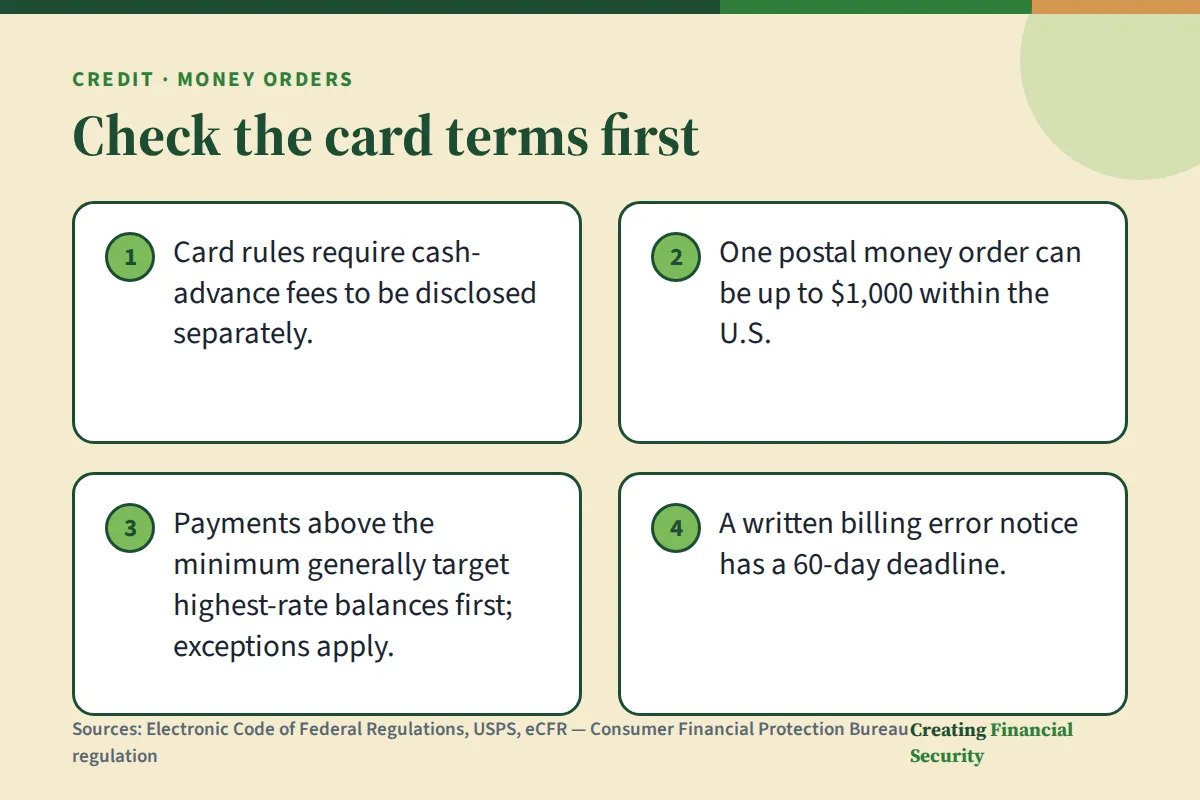
The second layer is a possible fee from your card issuer for cash-style credit. If your issuer says it would treat the purchase that way, ask which fee applies and how it's figured. The CFPB's rules let a percentage-based fee be shown as the percentage and the amount it applies to, rather than as a dollar figure, so read that line closely.
The third layer is interest. A cash-advance rate is disclosed separately from the purchase rate, and your agreement says when interest begins and whether any grace period exists.
What each possible charge pays for
Each charge pays for something different, and each has its own place to check.
- The seller's money order fee, if there is one. This is the seller's to explain. Ask for the full amount you'd be charged before you authorize anything, and what the receipt will show.
- A cash-advance fee. This is a fee your issuer may charge for cash-style credit. Whether it applies to this purchase is a question for the issuer, and the fee section of your agreement says how it's worked out.
- Cash-advance interest. Your issuer sets the rate, and your agreement says when interest starts. The rate section of your agreement and then your statement show what applied.
Your statement helps after the fact. The CFPB's rules have interest charges grouped under the heading Interest Charged and other plan charges under the heading Fees, so you can see which part of a cost is borrowing and which part is a fee.
| Charge | Who sets it | Where to check it |
|---|---|---|
| Cash-advance fee, if it applies | Your card issuer | Fee section of your agreement; ask the issuer |
| Interest grouped by transaction type | Your card issuer | Interest Charged heading on the statement |
| Other fees posted to the account | Your card issuer | Fees heading on your statement |
Find the terms that control this payment
The terms that decide this are already in your account paperwork. The CFPB's rules call for account-opening disclosures that show the rates for purchases, cash advances and balance transfers, plus any cash-advance fee. Rates and fee amounts are set in bold in the account-opening table, which makes them easier to spot.
Here's a practical order for finding them.
- Find your account-opening table or full card agreement, on paper or in your online account. If you can't locate it, ask the issuer for a copy or for help finding the terms.
- Find the cash-advance annual percentage rate and compare it with the purchase rate.
- Find the cash-advance fee and how it's figured, which may be shown as a percentage and the amount it applies to.
- Find when interest begins and whether a grace period exists, and for which types of transactions.
- Look for how the agreement defines cash advances or cash equivalents.
- Note any promotional rate and what its offer says it covers.
If you don't have internet access, the number on the back of your card is where to ask.
Look beyond the purchase APR
The disclosure rules give the purchase APR prominent type, but that is not the only rate to check. A card can carry more than one rate at once, and the disclosures name the type of transaction each one applies to.
Pay particular attention to these items:
- The cash-advance APR, listed next to the purchase APR.
- The fee formula, which may be a percentage and the amount it's applied to.
- The interest start rule. In the card-offer rules, the grace period is described for credit extended for purchases, and a card that offers none has to say so. If your agreement describes a grace period only for purchases, ask the issuer whether it applies to this transaction.
- Promotional rates. An offer's wording says what it covers, so read it before assuming a purchase promotion reaches a money order. The rules also let a statement leave out a promotional rate except in periods when it's actually applied, so a rate you saw once may not show on every statement.
Check the separate cash-advance limit
Available credit on the purchase side doesn't, by itself, answer whether this payment will go through. The disclosure rules don't describe how an issuer sets limits for cash-style credit, so whether a separate limit exists is a question for your issuer, not something to test at the register.
Ask the issuer what approval requirements apply, and ask the seller about its payment restrictions before authorizing the transaction.
Ask these questions before authorizing the transaction
A trial purchase would create the very charge you're trying to understand, so ask first. Two conversations can do most of the work: one with the seller and one with the card issuer. Each can answer only its own half.

Write down the answers, with the date and the name of the person you spoke to. If you question a charge later, those notes are useful.
What the seller can confirm
The seller can speak to its own rules. These questions are worth asking:
- Do you take credit cards for money orders, or only cash or other payment types?
- What is your fee for this money order, and is there a different fee for card payments?
- Is there a limit on the amount of one money order, or on card payments for it?
- What will the receipt show about how I paid?
- What is your refund policy if I change my mind?
A yes to the card question is permission at the counter. It isn't a promise about how your issuer will charge you.
It's also worth knowing how a money order behaves once it's bought. Payment on a postal money order can't be stopped, though a lost or stolen one can be replaced, and the receipt is what lets you trace it. If your money order comes from another seller, ask about its refund and replacement rules before you pay.
What to ask the card issuer
The issuer is the only one who can speak to the card side. Questions to bring:
- If I buy a money order from this kind of seller with this card, how would the transaction be classified and charged?
- If it's treated as a cash advance, which fee and rate apply, and how is the fee worked out?
- When would interest begin, and is there any grace period for this transaction?
- Does a separate cash-advance limit apply, and would this amount fit?
- Is your answer final, or could the transaction be coded differently when it posts?
- Does any promotional rate on my account apply to this payment?
For each answer, ask where the relevant term appears in your agreement. If the explanation and the written wording seem different, ask the issuer to clarify before proceeding.
If neither the seller nor the issuer can tell you the cost, that's a reasonable place to stop and look at another way to pay, covered below.
Understand what repayment can and cannot prevent
The agreement's interest-start rule and grace-period conditions matter when considering repayment timing. Ask the issuer how a payment would affect any fee or interest already charged, rather than assuming an immediate payoff removes both.
Existing balances can complicate the payment
An account can have balances carrying different rates. Under the CFPB's general allocation rule, money paid beyond the minimum goes toward the highest-rate balance first. Once that balance is covered, any extra moves to balances with successively lower rates.
There are exceptions. Deferred-interest balances receive priority for extra payments in the final two billing cycles before the offer expires; an issuer may also honor a requested allocation for those balances. An issuer may direct extra payments to a secured balance at the cardholder's request.
The rule speaks to the amount above the minimum. How the required minimum itself is applied across your balances is a question for your issuer, so check your agreement before building any payment plan around it.
Keep a rent-payment fallback when the cost is unclear
When the cost can't be confirmed, it helps to have another route in mind. Which routes are open depends on where you live, your pay schedule and your landlord's rules, so none of this assumes a bank account or a debit card.

- A money order bought another way. Ask the seller which payment types it takes for money orders and what each one costs. Postal money orders, for one, are sold at every Post Office location.
- Getting the cash. If you start with a paycheck, ask whoever cashes it what it charges and what identification it needs.
- Another method your landlord accepts. Ask your landlord or property manager which methods are approved, what each requires and whether any carry a charge.
- Further clarification about the card. Ask the issuer to identify the written terms supporting its explanation of classification, fees and interest.
None of these is automatically cheaper or easier. Which fits depends on your pay schedule, your landlord's rules and what's near you.
Compare the whole payment route, not just the counter price
A low counter price is only one piece of a route. If your cash comes from cashing a check, that cost belongs in the comparison, along with the money order fee and any travel time to get there.
The card route has its own pieces: the seller's fee, plus whatever your issuer confirms about fees and interest. Gather real quotes for each complete route and set them side by side. Neither route wins automatically, and a guess about either one isn't a quote.
Check how the payment actually posts
A few steps after the payment help you see what really happened.
- Keep the money order receipt. It helps you trace the payment and document its value if the order goes missing or is damaged.
- When the next statement arrives, find the transaction and see how it's identified.
- Look under Interest Charged and under Fees. Note whether any cash-advance fee or interest appears, and the date.
- Compare what you see with what the issuer told you and with your notes.
- If something doesn't match, contact the issuer with the date, the amount and what you were told.
One limit is worth knowing. Interest is itemized by type of transaction, but the statement may not say how your issuer classified each individual purchase. If you want to know that, it's a question for the issuer.
Ask about a charge without assuming it will be reversed
There's a difference between a charge you didn't expect and a charge that's a mistake. A fee your agreement spells out may be correct even if it surprised you. The billing-error rules include certain errors and requests for clarification of an extension of credit shown on a statement.
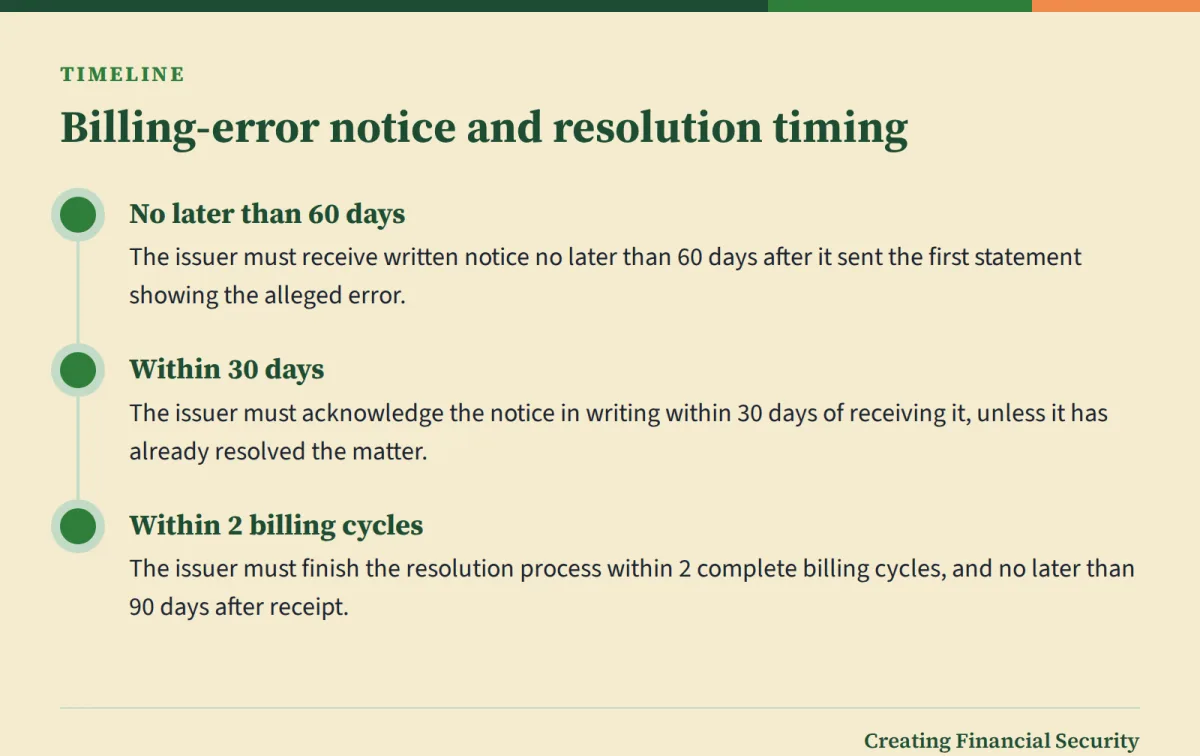
To use that process, send a written notice. The issuer must receive it at the billing-error address no later than 60 days after it sent the first statement showing the alleged error. Include your name and account number and, as far as possible, why you believe there's an error and its type, date and amount.
The issuer has to acknowledge the notice in writing within 30 days of receiving it, unless it has already resolved the matter by then. It must finish the resolution process within 2 complete billing cycles, and in no event later than 90 days after receipt.
While a dispute is open, you need not pay the portion you believe relates to the disputed amount, and the issuer may not try to collect it. If the issuer decides no error occurred, it has to send an explanation of its reasons.
A timely notice starts the billing-error process; it does not guarantee that the issuer will find an error or remove a charge.
The bottom line
Before authorizing payment, gather the seller's full price and the issuer's explanation of the applicable card terms. In the agreement, locate the cash-advance APR, fee calculation, interest-start rule and grace-period conditions. Ask which of those provisions would govern this particular money-order payment rather than assuming the purchase APR is enough to establish the cost.
If neither the seller nor the issuer can confirm the cost, ask the seller what other payment types it takes and ask your landlord which methods are accepted, without assuming you have a bank account. After any card payment, read the next statement for the interest and fee lines, and use the billing-error process within its time limit if something looks wrong. For credit-counseling information, look for the issuer's toll-free information number on your statement.
Questions readers ask
Can a money-order seller promise that my card will not charge a cash-advance fee?
Will paying the card off right away avoid every extra charge?
Does enough available credit mean the money-order payment will be approved?
Does a purchase promotion also cover a money order?
Is using cash always cheaper than using a credit card?
Can the seller undo a cash-advance fee by refunding the money order?
Sources
- USPS: Money Orders | USPS
- Electronic Code of Federal Regulations: 12 CFR 1026.13 -- Billing error resolution.
- eCFR — Consumer Financial Protection Bureau regulation: 12 CFR 1026.6 -- Account-opening disclosures.
- eCFR — Consumer Financial Protection Bureau regulation: 12 CFR 1026.60 -- Credit and charge card applications and solicitations.
- eCFR — Consumer Financial Protection Bureau regulation: 12 CFR 1026.7 -- Periodic statement.
- eCFR — Consumer Financial Protection Bureau regulation: 12 CFR 1026.53 -- Allocation of payments.