

Is $55,000 a year more than $25 an hour? On a standard full-time schedule with no overtime, yes. The $55,000 salary works out to $26.44 an hour, compared with $25.00 an hour for the hourly job.
That's only the starting point, though. Losing paid overtime can reduce annual earnings despite a higher base salary. Longer salaried weeks can also lower pay per hour actually worked.
Start with the two offers on the same schedule
To compare a salary with an hourly wage, put both in the same unit: yearly pay for a full-time schedule, then monthly and hourly figures.
| Yearly | Monthly | Hourly | |
|---|---|---|---|
| Salary | $55,000 | $4,583.33 | $26.44 |
| Hourly pay | $52,000 | $4,333.33 | $25.00 |
| Difference | $3,000 | $250.00 | $1.44 |
A full-time year is 2,080 work hours: 40 hours a week for 52 weeks, with paid time off counted as paid hours. Amounts are before taxes and other deductions (gross pay). No overtime; the hourly job is paid for 2,080 hours. The salary comes out $3,000 higher for the year, $250.00 higher each month and $1.44 higher per hour under the table's assumptions.
The condition to remember is that both jobs use the same schedule. The table does not include changes in paid hours or overtime.
What this comparison assumes
- Paid weeks: a full-time year is 2,080 work hours, which is 40 hours a week for 52 weeks, with paid time off counted as paid hours.
- Weekly hours: 40 for both jobs.
- Gross pay only: no income tax, payroll tax, health premiums or retirement contributions come out.
- No extras: no overtime, shift differentials, bonuses or side income. Side income is its own variable, easier to judge apart from the offer.
Think of this as a starting point. Fewer paid hours or unpaid time can lower hourly earnings, and extra paid hours can raise them.
How it works, step by step
- Keep weekly hours alongside weekly compensation when checking the regular-rate calculation.
- Ask what hours a weekly salary covers. For a nonexempt employee paid only that salary, those hours are used in the Labor Department's calculation.
- Ask in writing whether the job is classified exempt or nonexempt and which salary and duties support that label.
- Check whether state or local law sets a higher minimum wage or shorter maximum workweek where the job is located.
Annual salaries by hour and payday
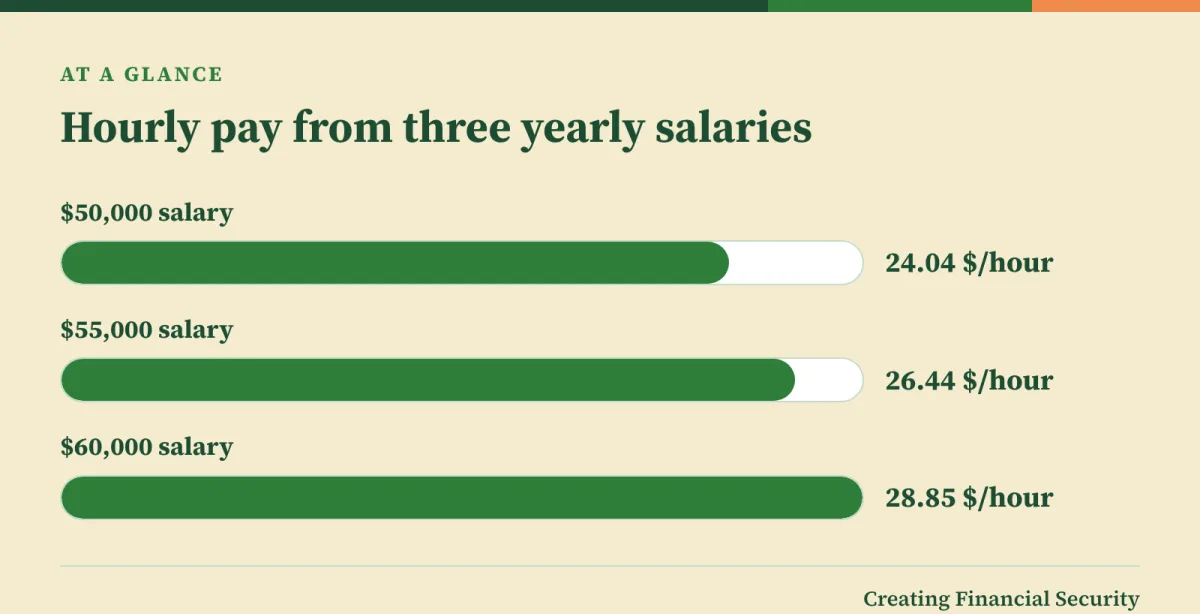
Offers rarely arrive as one clean number. One table covers salaries near $55,000 and the common pay schedules.
| Yearly salary | Monthly | Twice a month | Every two weeks | Weekly | Daily (8 hours) | Hourly |
|---|---|---|---|---|---|---|
| $50,000 | $4,166.67 | $2,083.33 | $1,923.08 | $961.54 | $192.31 | $24.04 |
| $55,000 | $4,583.33 | $2,291.67 | $2,115.38 | $1,057.69 | $211.54 | $26.44 |
| $60,000 | $5,000.00 | $2,500.00 | $2,307.69 | $1,153.85 | $230.77 | $28.85 |
A full-time year is 2,080 work hours: 40 hours a week for 52 weeks, with paid time off counted as paid hours. Paychecks: 26 every two weeks, 24 twice a month, 52 weekly; a work day is 8 hours and a work year has 260 work days. Amounts are before taxes and other deductions (gross pay). A $50,000 salary comes to $24.04 an hour and $1,923.08 every two weeks. A $55,000 salary comes to $26.44 an hour and $2,115.38 every two weeks, and $60,000 comes to $28.85 an hour.
The columns share one set of assumptions: 26 paychecks every two weeks, 24 twice a month, 52 weekly, an 8-hour day and 260 work days a year. All amounts are before taxes.
A monthly average is not a monthly deposit
A yearly salary divided by twelve is a handy yardstick. For $55,000, the table shows $4,583.33 a month. That's an average, not a deposit.
Pay frequency changes the size of each check. At $55,000, twice a month pays $2,291.67 per check, while every two weeks pays $2,115.38. The yearly total is the same; the number of checks isn't.
The Labor Department's overtime rules make a similar translation. When a salary covers a month or half a month, the rules convert it to a weekly equivalent first, then work out an hourly rate from that.
The monthly average is before taxes and other deductions. A pay stub provides the actual check amount and deductions for its pay period.
Read next: the hourly equivalent of $60,000.
| Ask about | What to learn | Why it matters |
|---|---|---|
| Weekly hours | What hours the salary is meant to cover | Federal overtime generally applies past 40 hours in a workweek for covered, nonexempt employees |
| Overtime status | Exempt or nonexempt, and which duties support it | A job title alone does not decide it |
| Supervised staffing | Whether supervision covers at least two full-time workers or equivalent staffing | The executive exemption includes a staffing test |
| Pay schedule | Every two weeks or twice a month | Changes the size of each check |
| Local rules | Whether state or local law adds wage or overtime rules | Employers must follow a higher local standard where one applies |
| Regular-rate calculation | Workweek compensation included under the law and actual hours | Some compensation is excluded from this calculation |
Hourly wages by year and paycheck
The reverse conversion starts from the hourly rate. This table takes $25.00 and nearby rates through the day, week, paycheck, month and year.
| Hourly | Daily (8 hours) | Weekly (40 hours) | Every two weeks | Monthly | Yearly |
|---|---|---|---|---|---|
| $20.00 | $160 | $800 | $1,600 | $3,466.67 | $41,600 |
| $25.00 | $200 | $1,000 | $2,000 | $4,333.33 | $52,000 |
| $30.00 | $240 | $1,200 | $2,400 | $5,200 | $62,400 |
| $35.00 | $280 | $1,400 | $2,800 | $6,066.67 | $72,800 |
| $35.10 | $280.80 | $1,404 | $2,808 | $6,084 | $73,008 |
| $55.00 | $440 | $2,200 | $4,400 | $9,533.33 | $114,400 |
A full-time year is 2,080 work hours: 40 hours a week for 52 weeks, with paid time off counted as paid hours. Paychecks: 26 every two weeks, 24 twice a month, 52 weekly; a work day is 8 hours and a work year has 260 work days. Amounts are before taxes and other deductions (gross pay). Under the hourly table's assumed schedule, $25.00 an hour comes to $1,000 a week, $2,000 every two weeks and $52,000 a year. Beside it, $20.00 comes to $41,600 and $30.00 to $62,400.
It's worth checking whether a figure in a job post is per hour or per year. The table puts $55.00 an hour at $114,400 a year, a very different thing from a $55,000 salary.
Read the hourly table without assuming a fixed schedule
Shifts get cut, added or moved. A slow season, an unpaid week or a shortened schedule pulls a real year below the full-time figure, and a busy season with overtime pushes it above.
The pay arrangements need separate checks: what period and hours the salary covers, and how many hours the hourly job pays. The table shows the base; only pay records show how actual weeks have gone.
Add the overtime that base pay leaves out
Federal rules generally call for covered, nonexempt employees to receive a premium of at least 1.5 times the regular rate for work beyond 40 hours in a workweek. The Labor Department generally figures the regular rate by dividing the workweek compensation the law counts by the hours worked in that week. Some payments are excluded.
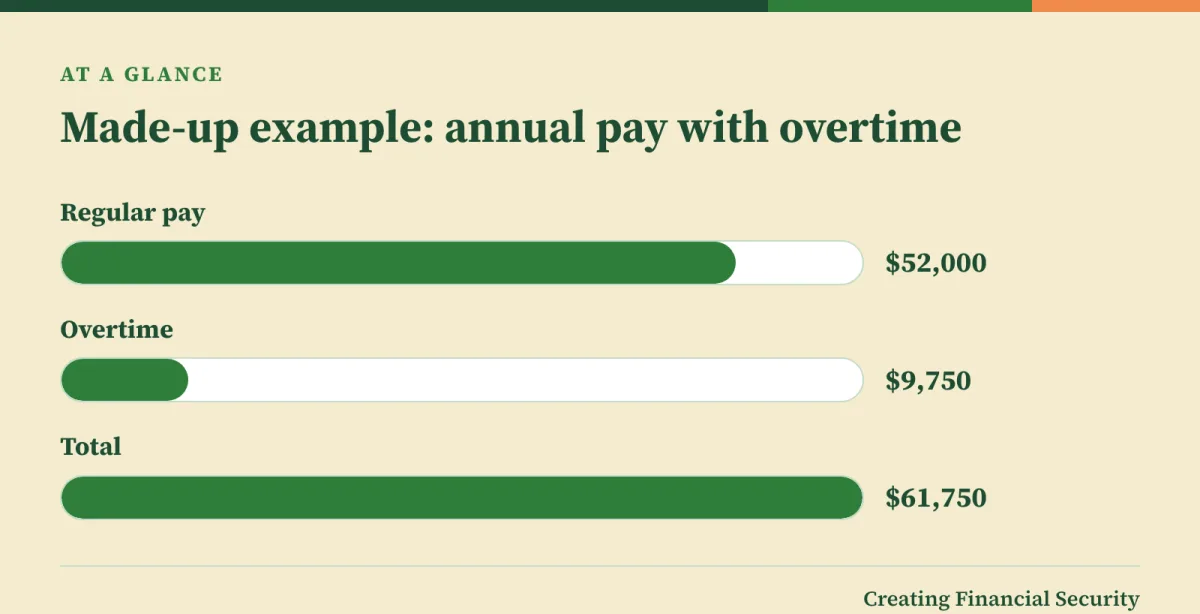
The table below is a made-up example. It assumes $25.00 is the regular rate and that five overtime hours are worked every week of the year, which may be far from a real schedule.
| Per week | Per year (52 weeks) | |
|---|---|---|
| Regular pay (40 hours) | $1,000 | $52,000 |
| Overtime (5 hours at $37.50) | $187.50 | $9,750.00 |
| Total | $1,187.50 | $61,750.00 |
Overtime is paid at 1.5 times the hourly rate for hours over 40 a week, every week of the year. Amounts are before taxes and other deductions (gross pay). In the made-up example above, each overtime hour pays $37.50, and five of them add $187.50 a week. Over 52 weeks that's $9,750.00 of overtime on top of $52,000. In that made-up example, the hourly job totals $61,750.00 a year before taxes.
That's above the $55,000 salary in this scenario. With lighter overtime the gap narrows, and a few light weeks could flip it; with heavier overtime the hourly job pulls further ahead. The table illustrates, it doesn't predict.
The Labor Department assesses each workweek on its own, so a light week doesn't cancel the overtime from a heavy one.
Use recent pay records, not a hoped-for schedule
The most useful input is what was actually paid. One way to line it up:
- Gather pay stubs for matching periods, using a full year if available, so busy and slow stretches both show.
- Separate regular wages from overtime pay so each has its own total.
- List shift differentials and bonuses separately, marking which came up regularly and which were one-offs.
- Compare the regular-wage total with the salary, then the all-in total, keeping uncertain bonuses apart.
Setting a few months of wages against an annual salary mismatches periods, so the same stretch has to sit on both sides.
Check the hours and overtime status behind the title
The dollar figure is half of an offer. The other half is how many hours the salary is meant to cover and whether overtime still applies. The same salary spread over more hours is a lower rate for each hour worked.
A salary does not automatically mean no overtime
It's a common belief that a salaried job means no overtime. The Labor Department's regulations say a title alone can't settle exempt status; the employee's salary and duties both have to meet the tests.
For the executive exemption, the general salary threshold is $684 weekly, paid on a salary basis. The regulation specifies lower thresholds in certain U.S. territories. Meeting the pay requirement alone does not establish exemption.
The duties requirements also apply. Management of the business or an established department or subdivision must be the main duty. Supervision must customarily and regularly cover at least two full-time workers, or equivalent staffing. The employee must either have hiring or firing authority or make personnel recommendations that carry particular weight.
Mixed duties are judged case by case. Some nonexempt tasks don't disqualify an executive if the requirements are otherwise met. But a working supervisor whose main duty is production-line work doesn't become exempt just by occasionally directing others.
A salary can also go to someone who isn't exempt. Under the Labor Department's method for a nonexempt employee whose only pay is a weekly salary, the divisor is the number of hours that salary covers. A separate method exists for nonexempt employees whose hours fluctuate while pay stays fixed. Payroll can explain which one applies.
State and local laws can go further: employers must follow a higher minimum wage or shorter maximum workweek where one applies. Whether a given job is exempt is fact-specific, and the Wage and Hour Division, a state labor department or an employment lawyer can look at the actual duties.
Count work time and paid time off consistently
Both jobs have to be measured the same way. For a paid-hours comparison, count paid leave in both. For an effective rate per hour actually worked, divide a year's pay by the hours really worked on both sides, leaving leave out. Counting vacation on one side only tilts the result.
The hourly job's yearly pay includes any overtime. For the salaried job, the hours are all the hours the role truly asks for, which may exceed a standard week. The effective hourly rate is yearly pay divided by yearly hours, so it can't be found until true weekly hours are known.
Separate federal tax estimates from take-home pay
Gross pay isn't what lands in an account. A rough federal picture helps, as long as it's labeled an illustration and not a paycheck.

The tables below are for tax year 2026 and a single filer. The IRS says the standard deduction for single filers is $16,100 for tax year 2026, and the 2026 adjustments generally apply to returns filed in 2027.
| Yearly salary | Standard deduction | Taxable income | Federal income tax | Social Security (6.2%) | Medicare (1.45%) | Left after these taxes | Per month |
|---|---|---|---|---|---|---|---|
| $50,000 | $16,100 | $33,900 | $3,820 | $3,100 | $725 | $42,355 | $3,529.58 |
| $55,000 | $16,100 | $38,900 | $4,420 | $3,410 | $797.50 | $46,372.50 | $3,864.38 |
| $60,000 | $16,100 | $43,900 | $5,020 | $3,720 | $870 | $50,390 | $4,199.17 |
Tax year 2026 federal figures from the IRS; single filer; the standard deduction; no other income, pre-tax deductions or credits. State and local income taxes are not included; they depend on where you live. Payroll taxes are the employee share. Real paychecks also depend on your W-4 and benefits. These are bracket-based federal illustrations, not exact return tax and not paycheck predictions. For a $55,000 salary, the table subtracts the deduction to reach taxable income of $38,900. The illustration estimates federal income tax at $4,420, Social Security at $3,410 and Medicare at $797.50. It leaves $46,372.50, or $3,864.38 a month, before the omitted items.
Federal income tax isn't a flat percentage of the whole salary; it's figured in steps by rate. The next table shows the steps for the $50,000 row, where taxable income is $33,900.
| Tax rate | Part of taxable income | Amount taxed | Tax |
|---|---|---|---|
| 10% | $0 to $12,400 | $12,400 | $1,240.00 |
| 12% | $12,400 to $33,900 | $21,500 | $2,580.00 |
| Total | $33,900 | $3,820.00 |
Taxable income $33,900 = $50,000 minus the $16,100 standard deduction. The first $12,400 is taxed at 10% and the rest at 12%, for $3,820.00. The $55,000 row follows the same steps with more income in the 12% layer.
Payroll taxes are separate. The IRS says the Social Security rate is 6.2% for the employee and the Medicare rate is 1.45% for the employee. For earnings in 2026, the Social Security wage base limit is $184,500, and Medicare has no wage base limit.
Tax owed and tax withheld are different things. Employers withhold using the Form W-4 and IRS tables. Your return reconciles tax liability with withholding and other payments and applicable credits.
What the federal illustration includes and leaves out
- Included: federal income tax after the single-filer standard deduction, plus the employee share of Social Security and Medicare tax.
- Left out: state and local income taxes, which depend on where you live.
- Left out: credits, other income and pre-tax deductions such as health insurance or retirement contributions.
- Left out: other filing statuses, and whatever a W-4 tells the employer to withhold.
Overtime generally remains subject to Social Security and Medicare taxes. A separate federal income-tax deduction may apply to qualifying overtime premiums required by the Fair Labor Standards Act, rather than to all overtime wages. Eligibility conditions and income limits apply; current IRS guidance or a tax professional can address a particular return. The federal tables do not include that deduction. An employee exempt from federal overtime requirements does not receive qualifying overtime merely because another arrangement provides extra pay.
Judge the offer against local pay and real bills
People ask whether $25 an hour is good pay, whether $55,000 is good, or whether $20 an hour is enough to live on. A gross-pay conversion answers a narrower question: what the rate produces under a stated schedule. For an offer comparison, local wages for similar work and the costs the paycheck must cover are separate questions.
One way to test an offer without leaning on averages:
- Look up what comparable roles pay in the same area, both supervisory and hourly.
- List real monthly costs: housing, utilities, transportation, food, insurance and debt payments.
- Compare those costs with take-home pay from an actual pay stub, not gross pay.
- Ask which job leaves more room once real overtime and hours are counted.
Compare the occupation, location and household
Keep the comparison specific: the occupation, the job's location and the expenses the income must cover. Useful questions include whether the wage comparison is for similar duties, whether household costs are shared and whether the proposed schedule changes transportation or other expenses. The conversion tables supply no local wage finding or household budget.
A nonprofit credit counselor or a licensed financial professional can look at actual numbers and help fit an offer to a budget.
Questions to get answered before signing
Written answers make it easier to compare the offer's pay terms, hours and benefits side by side.

The checklist groups the questions by what each one settles: hours, overtime status, supervisor duties, pay schedule and local rules. Overtime status helps determine whether federal law requires an overtime premium for extra hours, so it deserves a written answer.
A few more items belong on the list: how holidays, paid leave and unused leave are handled, what health premiums and deductibles come to, whether there's a retirement match and when eligibility starts, and whether any pay is discretionary or written into the offer.
Put both compensation packages on one page
A single sheet makes the comparison concrete. Two columns, one for the current job and one for the offer, with rows for base pay, overtime from recent stubs, differentials and bonuses marked regular or one-off, leave, monthly premiums, retirement benefits and expected schedule. A blank cell on the offer side is the question to take back to the employer.
The bottom line
The offer's base salary is only the first part of the decision. A complete comparison also needs matching pay periods, actual overtime records and a clear account of the proposed job's hours. Without those details, the headline salary cannot establish whether total compensation improves.
Overtime, the hours a supervisor role will actually require and whether the job is exempt can each change which offer pays more. In the made-up example, steady overtime lifted the hourly job above the salary, while longer salaried weeks lower the effective rate per hour worked.
The federal tax figures are general, and a real deposit depends on the W-4, state taxes and benefits. Before signing, it helps to get the hours, the overtime classification and the benefit costs in writing. For a question about exempt status or personal taxes, the Wage and Hour Division or a tax professional can look at the actual case.
Questions readers ask
Is there one after-tax hourly rate for a $55,000 salary?
Can the $35 hourly conversion predict take-home pay?
Is overtime paid in the same check as regular pay?
Is getting paid every two weeks the same as twice a month?
Does paid time off change the hourly figures in the tables?
Do state or local laws change overtime and minimum pay?
Does the overtime deduction eliminate payroll taxes?
Sources
- IRS: IRS releases tax inflation adjustments for tax year 2026
- IRS: Topic no. 751, Social Security and Medicare withholding rates
- Electronic Code of Federal Regulations: 29 CFR Part 778 -- Overtime Compensation
- Electronic Code of Federal Regulations: 29 CFR Part 541 -- Defining and Delimiting the Exemptions for Executive, Administrative, Professional, Computer and Outside Sales Employees
- Internal Revenue Service: Publication 15 (2026), Employer's Tax Guide