



When your paycheck lands in a bank account, it's natural to wonder what happens to it if the bank ever runs into trouble. Federal deposit insurance is the safety net built for that moment.
The protection is automatic, but it isn't unlimited, and it follows a few specific rules. Once you see how the depositor, insured bank and ownership category fit together, the rules become easier to follow.
What deposit insurance does
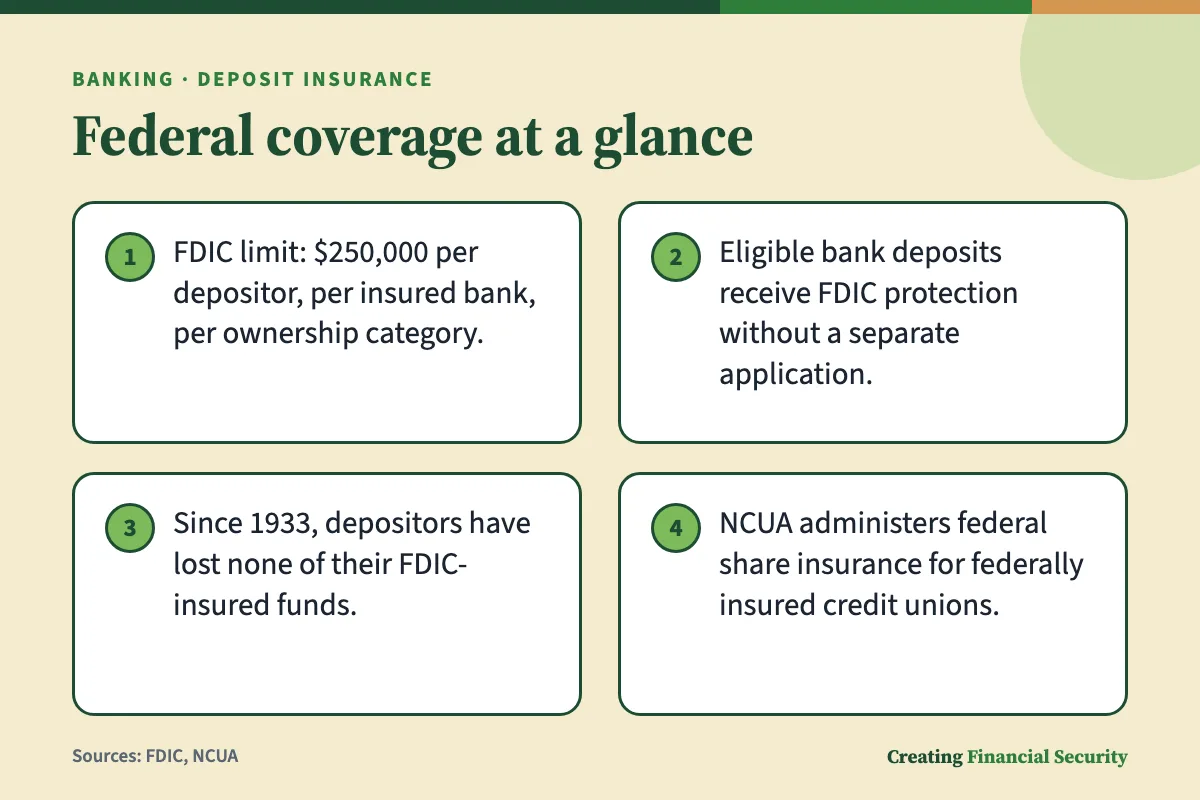
The FDIC says its insurance protects money held in deposit accounts if an insured bank fails. The FDIC says that, since it was founded, every depositor has retained all of their FDIC-insured funds.
There's no form to file. The FDIC says coverage begins the moment a deposit account is opened at an insured bank.
If a bank does close, the FDIC says it moves quickly so people keep access to their insured money. Often another insured bank takes over the failed one, and customers reach their funds there. If no bank steps in, the FDIC says it identifies customers, works out their coverage and pays them as fast as it can.
Coverage extends to the deposited principal and interest accrued through the day the insured bank fails, subject to the insurance limit.
How it works, step by step
- Check that the bank is insured by searching the FDIC's BankFind tool.
- For a credit union, look it up in the NCUA's Credit Union Locator to see whether it is federally insured.
- Run balances through the FDIC's EDIE calculator to see how much is covered.

The standard amount, and what it's counted by
The FDIC's standard amount is $250,000 for each depositor at each insured bank, separately for each ownership category. Opening multiple accounts in the same ownership category at one bank does not create a separate limit for each.
Within one ownership category at a single bank, the FDIC combines checking balances, savings balances, certificates of deposit (CDs) and money market deposit accounts when calculating coverage. So a checking account and a savings account you own alone are combined for the calculation.
Deposits held at separate FDIC-insured banks have separate coverage limits.
How ownership categories let coverage stack
An ownership category is the way an account is legally owned. The FDIC says deposits in different categories at the same insured bank can add up to more than $250,000 in coverage, if all requirements are met.
The FDIC gives a simple case. At one insured bank, eligible deposits owned solely by you and your share of eligible joint deposits are insured separately, each up to $250,000.
Consider the FDIC's example of someone holding checking, savings and an individual retirement account (IRA) at one bank. When checking and savings are both single-owner accounts, their balances are combined under a $250,000 limit. The IRA is insured separately, up to $250,000, because its ownership category differs.
Other categories have their own rules. Under the trust rule applicable as of April 1, 2024, the FDIC caps coverage at $1,250,000 for an owner who has at least five beneficiaries. That maximum combines all of that owner's trust accounts held at one bank. The listed limit for a corporation, partnership or unincorporated association is $250,000. The FDIC's detailed brochures explain category requirements.
What isn't covered
The FDIC says its insurance applies to deposits only, and only at an FDIC-insured bank. Non-deposit investment products fall outside it, even when an insured bank sells them.
The covered event is an insured bank's failure. The FDIC does not reimburse theft or fraud losses through deposit insurance; other laws address those losses.
Treasury securities—bills, bonds and notes—have U.S. government backing, but they do not carry FDIC insurance.
Credit unions have a parallel system
Credit unions aren't covered by the FDIC. At federally insured credit unions, eligible member share accounts receive protection from the National Credit Union Share Insurance Fund. Congress created this federally backed fund in 1970, and the NCUA administers it.
The NCUA says joining a federally insured credit union brings coverage automatically, without a separate application. Single ownership means one owner with no beneficiaries; its limit is $250,000 per member-owner. Joint ownership means at least two owners and no beneficiaries, with the primary owner a credit union member. Each owner's combined interest in joint accounts has a $250,000 limit.
These limits apply to combined shares in the relevant category at each federally insured credit union, assuming coverage requirements are satisfied. IRA and KEOGH retirement deposits have separate protection of up to $250,000.
Some state-chartered credit unions use private insurance that has no U.S. government backing. The NCUA directs members to its Credit Union Locator to verify federal insurance. NCUA coverage excludes investments such as stocks and mutual funds, along with bonds and annuities. Safe deposit box contents and digital assets, including cryptocurrencies, are also excluded.
Where to check your own coverage
BankFind is the FDIC's tool for verifying a bank's insured status. Its Electronic Deposit Insurance Estimator, or EDIE, calculates coverage for deposits. For questions, call the FDIC at 1-877-275-3342.
For credit union coverage, the NCUA provides its Share Insurance Estimator through its consumer website.
The bottom line
Federal insurance protects against an insured institution's failure; it does not cover every financial product that institution offers. Coverage depends on the institution's insured status, the kind of deposit and the applicable ownership rules. Different categories can provide separate protection, but their requirements still apply.
For a particular set of balances and ownership arrangements, the FDIC's EDIE and the NCUA's Share Insurance Estimator provide coverage calculations. BankFind and the Credit Union Locator address a different question: whether the institution has federal insurance. The agencies also offer help with coverage questions.
Quick check
1. What is the FDIC's standard amount counted by?
2. Which of these does FDIC deposit insurance not cover?
3. Which agency administers the federal Share Insurance Fund?
Questions readers ask
Do I have to sign up for FDIC deposit insurance?
Does deposit insurance cover investments sold at a bank?
How can I estimate my credit union share insurance?
Sources