



Compounding lets earlier interest earnings generate interest of their own. That helps explain why starting earlier can make a difference: money has longer to grow. But an illustration of compound interest is not a promise about an investment's future value.
Time also matters when thinking about risk. A long holding period does not remove the possibility of investment losses.
What compound interest actually is
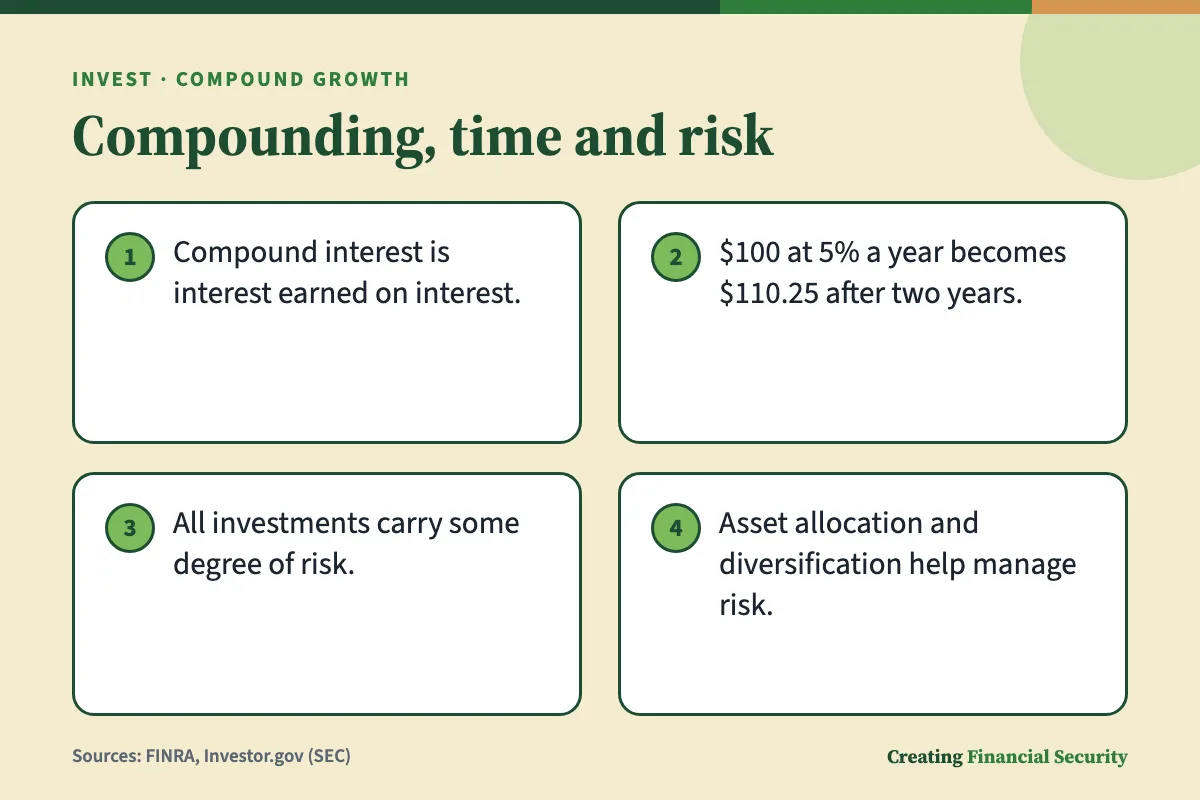
Investor.gov, the SEC's investor education site, describes compound interest as the interest you earn on interest.
In its example, $100 earning 5% each year grows to $105 after one year and $110.25 after two. The first year's gain was $5. The second year's gain was a little bigger, because it included $0.25 earned on the earlier $5 of interest.
That extra amount is interest earned on earlier interest. It's small at first, which is exactly why the example is useful.

Why time gives it room to work
A quarter doesn't sound like much. Investor.gov says it adds up. With no further deposits, the example reaches more than $162 in 10 years and almost $340 in 25 years.
Notice what changed between those figures: not the starting amount, only the number of years. That's why starting earlier is described as giving money more time to compound.
Investor.gov also offers a classroom exercise. A $2 slice of plain pizza bought every day for a year adds up to $730. Invested at 5% interest, that $730 would be $931.69 after five years.
The example assumes a steady 5% rate; it is not a forecast of investment returns.
The other half: every investment carries risk
FINRA says every investment involves some risk. Unfavorable markets can reduce the value of stocks, bonds and funds, potentially to zero.
Even insured certificates of deposit (CDs) from banks or credit unions face inflation risk. Their earnings may not keep up with living costs.
FINRA names other kinds of risk too, including market, business, liquidity and concentration risk. Business risk includes the effect of company decisions, such as expanding into a new business or merging with another company. Liquidity risk concerns whether an investment can readily be turned into cash when money is needed. Concentration risk grows when too much money depends on a single investment.
Time doesn't erase risk either. FINRA describes an investor whose $10,000 broadly diversified stock portfolio reaches $20,000 after 19 years, then loses 20 percent, or $4,000, the next year, ending at $16,000. FINRA's conclusion is that stocks don't get safer just because they're held longer.
Staying invested is also a practical question, not just a calendar calculation. FINRA points out that a job loss can leave a gap that leads someone to sell stocks during a downturn. Medical bills or a child's education may also require money from investments. Planned expenses and unexpected events can both make it harder to keep stocks for a long stretch.
How people think about dividing money
Investor.gov describes asset allocation as the way investments are distributed among assets like stocks, bonds and cash. It calls the mix personal, and says it changes over a lifetime.
Two things shape it. One is time horizon: how many months, years or decades someone plans to invest. Investor.gov says people with more time may be comfortable with bumpier investments, while those with less may prefer steadier ones. The other is risk tolerance: how much loss someone is financially able and personally willing to accept while seeking potentially higher returns.
Diversification means spreading money across different investments to lower risk. It can happen across asset categories and within them. Different market conditions may help one category while hurting another. Within a category, owning different stocks or bonds and covering different industries can also spread exposure. The aim is for stronger holdings to help offset weaker ones, not to guarantee that losses disappear.
Mutual funds and exchange-traded funds (ETFs) pool investors' money to buy investments. That can make it easier to own portions of many holdings. But a fund focused on a single industry may still leave money concentrated in that industry. Investor.gov also cautions that owning several funds is not enough by itself: their largest holdings may overlap. Different fund names do not necessarily mean different underlying investments.
Over time, some holdings grow faster than others and shift a portfolio's balance. In Investor.gov's example, a 60% stock share climbs to 80% after market gains. Rebalancing means returning to the original mix. That may involve selling some stock holdings, directing additional money toward other asset categories, or both. Moving money away from recent strong performers can feel difficult. Investor.gov explains that rebalancing can follow a schedule or be triggered by a specified change in an asset category's share. It generally favors making these adjustments infrequently.
FINRA adds that investment risk can't be eliminated, but asset allocation and diversification can help manage it.
The bottom line
Compounding means interest earns more interest, and more years give it more room to work. The SEC's example shows this clearly, but it uses a fixed rate and is not a prediction.
The official sources are just as clear that every investment carries some risk, and that how money is divided is personal, shaped by time horizon and risk tolerance. Investor.gov and FINRA both offer free investor education pages, and a licensed professional can talk through your own situation.
Quick check
1. What does compound interest mean?
2. Which risk is about holding too few investments?
3. What is a time horizon?
Questions readers ask
What is compound interest?
Does holding stocks longer make them safe?
What is rebalancing?
Sources